Category Archives: Hit Parade

7.02.07 Issue: Subtexting, “Sicko,” and a Dandy Handey

Each week, the Emdashes staff dons a big foam hand to identify those aspects of last week’s issue that most closely resemble a walk-off home run. Happy Fourth!
The spot illustration, by Rachel Domm, for John Lahr’s review of Sarah Ruhl’s production of Eurydice was remarkable. It reminded me a bit of the work of Tara McPherson, only without that artist’s painful Goth overtones. —MCS
To me, “George Packer” means stern, lucid commentary on war and politics. This weekend, though, he pricked me with humor, and three times on a shuddering ferry to Vancouver Island I laughed out loud at this depiction of what a powerful New York contingent (Clinton, Giuliani, and Bloomberg) might mean for the next Presidential election.

“[It] would so thoroughly explode the Sun Belt’s lock on the White House that an entirely new kind of politics might be possible, in which evolution is not an issue, no one has to pretend to like pork rinds, and the past tense of “drag” is “dragged.”

Also: a few chuckles from Jack Handey’s delightfully cruel nature documentary: “The monkey is shot by a poacher and falls from giraffe.” Golden. —JB

There’s so much pressure to like monkey-themed Shouts, but I did anyway. I haven’t enjoyed nature documentaries the way I used to ever since I read a powerful essay somewhere about how these blithe, leafy programs lull us into a dangerously cheerful stupor, in which we forget that the earth is already a goner, because look, an antelope, a toucan, and an ibiza! I think it was a Harper’s Reading; I keep trying to cite it, so I’ll have to look at their archive. On the other hand, if it weren’t for nature documentaries, etc., would we care about that godforsaken polar bear in An Inconvenient Truth in the first place?

Anyway, some of my favorite stories: I liked seeing Ken Auletta throw caution to the wind and just write the heck out of a piece on Rupert Murdoch. To accompany it, there’s an absorbing and fun interview with Auletta by Blake Eskin for the new “New Yorker Out Loud” podcast; it’s nice to hear the Nextbook veteran interviewing again. At least in my experience, it’s faster and easier to subscribe to this and the other (fiction, New Yorker Conference, etc.) podcasts directly through iTunes, but my computer’s been wonky lately, so it might just be me.

Also notably top-notch: Margaret Talbot on lie-detecting machines; Maxim Biller’s sad, beautiful, and beautifully short story “The Mahogany Elephant” (would that I could have read it a decade ago and avoided a heap of foolishness, but that’s how it crumbles, cookie-wise); Joan Acocella proving once again how good her book reviewing can be; Joyce Carol Oates writing intelligently and well about Stephen L. Carter; John Updike on a revisionist history of the Depression—the book section is uniformly good this week. The cover is also a subtle, satisfying event. Where does one buy those bulbs? I’ll mail one to the first person to tell me. —EG

O Caption! My Caption! Winner #99 Speaks

As the New Yorker Cartoon Caption Contest creeps inexorably toward #100, intrepid Canadian intern John Bucher continues the renewed tradition of interviewing the clever and astonishingly elite contest winners.

davidwilkner.JPG
David Wilkner, trolling for the next Big One


Congratulations to David Wilkner (above), of limerick-worthy Pawtucket, Rhode Island, for taking the prize in Cartoon Caption Contest #99—a Leo Cullum illustration of a doctor advising a glum and projectile-pierced cowboy—with the line, “I’d like to get your arrow count down.” Although this contest number has special resonance for Canadians—it’s Wayne Gretzky’s sweater number—David and I discussed things even more vital than hockey. Fishing, for one. —JB
One thing I always wonder about contest winners is whether the caption comes to them quickly or slowly. Which was it in your case?
My “arrow count down” caption was the first one I thought of that Monday morning while online, and it took three to five minutes to compose. I normally come up with a couple of captions that I like the first day, but by the end of the week I will have added ones I think are much better. I hardly ever submit an early one, but I knew this one fit the New Yorker mold of a professional person using his “professionspeak” in an absurd situation. I go to my doctor once a year for a physical, and, of course, he always wants to “get my weight down,” my “cholesterol down,” my “drinking down,” etc.

What process is the devising of a funny caption most like?

Fishing. You’re sitting in the boat waiting for something to bite inside your head. There are days when you catch nothing, or fish so small you throw them back, while searching and waiting for the “big one” you hope is lurking just below the surface.
I really study the cartoon and its makeup, and then follow my thought trail, which may draw from personal experiences or lead to something dealing with irony or an abstract idea. If I’m not getting anywhere I’ll even consider hackneyed phrases. I try to let the cartoon take me down its path to its “rightful” caption rather than forcing one on it.
What kind of relationship do you have with a) The New Yorker and b) its cartoons? How far back does the connection go?
I’ve been hooked on New Yorker cartoons for most of my adult life. As a long-time subscriber, I’ll cut out the cartoons that make me laugh the hardest and tape them on top of each other at my place of work so that people can flip through them. My mother compiled many scrapbooks of her favorites. She passed away five years ago, and would have been ecstatic to know that I won one of these contests.
Of the ones you cut out and post at work, can you winnow out three favorites? What, specifically, do you find funny about them?
1. The classic “I’m sorry, Sir, but Dostoevsky is not considered summer reading. I’ll have to ask you to come with me” cartoon of the beach patrol officer accosting the bewildered tourist; it’s by Peter Steiner. I read a lot of Dostoevsky in my twenties, and like the hilarity of the officer extending his authority into the realm of seasonal reading.
2. The Henry Martin cartoon of the explosion with the title: “Tim, a walking time bomb, met Ed, an accident waiting to happen.” This may be my favorite of all time, because it has no characters or quotations. It’s merely two volatile clichés in a head-on collision.
3. An illustration by Michael Crawford of a Swiss Army knife, but with fourteen corkscrews and no other options—the “French Army knife.” It’s so much fun to make fun of the French!
If you could have one thing in your home autographed by its creator, what would it be?
That’s easy! The print of the Leo Cullum cartoon I won in last week’s contest. It hasn’t arrived in the mail yet. Beyond the home, I’d have to say a Degas pastel of a ballerina in motion that I saw at the Providence Museum of Fine Arts last year. It was so perfect!
What, to the best of your knowledge, were you doing at 11 a.m. on February 17, 1986?
Skiing down the slopes of Killington with my two young daughters and wife.

***

Other Emdashes caption-contest interviews:

  • Robert Gray, winner #106 (“Have you considered writing this story in the third monkey rather than the first monkey?”)
  • David Kempler, winner #100 (“Don’t tell Noah about the vasectomy.”)
  • Richard Hine, winner #98 (“When you’re finished here, Spencer, we’ll need you on the bridge-to-nowhere project.”)
  • Carl Gable, winner #40 (“Hmm. What rhymes with layoffs?”)
  • T.C. Boyle, winner #29 (“And in this section it appears that you have not only alienated voters but actually infected them, too.”)
  • Adam Szymkowicz (“Shut up, Bob, everyone knows your parrot’s a clip-on”), winner #27, and cartoonist Drew Dernavich interview each other in three parts: One, Clip-On Parrots and Doppelgangers; Two, Adam and Drew, Pt. Two; Three, Clip-On Parrots’ Revenge
  • Evan Butterfield, winner #15 (“Well, it’s a lovely gesture, but I still think we should start seeing other people.”)
  • Jan Richardson, winner #8 (“He’s the cutest little thing, and when you get tired of him you just flush him down the toilet.”)
  • Roy Futterman, winner #1 (“More important, however, is what I learned about myself.”)

Tina Brown: “Blondes Are More Interesting, It Seems”

They sure are when they come in the form of such accomplished women as Lesley Stahl and Tina Brown. Last night I ventured to the Union Square B&N to witness a “chat” between Stahl and the former New Yorker editor; the latter is, of course, promoting her incipient blockbuster, The Diana Chronicles (currently #7 on Amazon). This being Brown’s first book ever, not to mention her first book signing ever, it made for quite a heady event.
As the rain came down, in between wincing at the overamplified Pat Metheny music and pouncing on a slew of 48-cent Penguins at the Strand stall (I collect them), I had the good fortune to enjoy a solid hour of intelligent, delicious repartee about, like it or not, like her or not, one of the most fascinating figures of our time: Princess Diana.
I would not have been quick to grant Diana such a grand appellation, but Brown quite simply won me over. For her part, Stahl had clearly done her homework, found the subject matter riveting, and betrayed every sign of wanting to have a ball. “Should I keep dishing?” she kept asking the audience. “I should?” Normally I disavow the dishy, but her enthusiasm was infectious—dish on!

tina2.JPG

tina1.JPG


Stahl called Brown’s book “an autopsy of the monarchy under Queen Elizabeth,” and it’s easy to see why. Having worked at the Tatler during Diana’s formative first years as Princess, and having written one of the most important pieces of the Diana canon, “The Mouse That Roared,” for Vanity Fair in 1985, shortly after taking over the editorship there, Tina might well be the most qualified person in the world to discourse on the subject. If the book is half as engaging as last night’s chat, it’s going to be the best beach book in years.

During the Q. & A., someone asked Brown to draw out the parallels between Diana and Hillary Clinton. To her credit, Brown demurred—while acknowledging that both women contain compelling contradictions (“You know, blondes are more interesting, it seems,” she hazarded impishly), the chasm between the senator with the voracious intellect and the scarcely lettered socialite remains too gaping to ignore.

When Brown signed my copy of the book (see above), I told her what an effective advocate for the book she is. Apparently, she took my words to heart: When I got home and switched on the TV, what’s the first thing I see? Brown entertainingly explaining Diana to Anderson Cooper. [And last night, she was on Charlie Rose. —Ed.] You’re welcome!

—Martin Schneider

O Caption! My Caption! Winner #98 Speaks

Due to popular demand, the New Yorker Cartoon Caption Contest interviews are back! Hardworking Canadian intern John Bucher interviews a brand-new member of a truly select group.

CIMG1995comp.JPG
Richard Hine, on the bridge to somewhere


Congratulations to New York’s own Richard Hine (above) for winning Cartoon Caption Contest #98—a P.C. Vey drawing of a man gazing into a wall through a telescope—with the line, “When you’re finished here, Spencer, we’ll need you on the bridge-to-nowhere project.” I asked Richard to address some critical questions for Emdashes readers. —JB
What, for you, goes into writing a caption? I’ve tried the contest (always with miserable results), and I’ve come to feel it is, in many ways, a mental exercise—of identifying an idea related to the drawing, but not an immediately obvious one. Do you have a method?
The short answer is: Yes, but I would hate to give away trade secrets. The long answer is: First, I look at the cartoon online, before my magazine arrives. This, I feel, gives me a crucial head start on other captioneers. I stare at the screen, bite my bottom lip, and shake my head slowly. “Don’t waste your time,” I tell myself, “this one’s impossible.” When my magazine arrives, I look again, searching for details I missed the first time. “Maybe,” I tell myself, “just maybe.” Then, I start making a list of ideas for a few minutes. When I feel confident enough, I test them on my girlfriend. She usually tells me they are lame. So I immediately stop and try and do other things, like write a novel. I come back to my caption list once or twice during the next few days, just to see if I have any other brainwaves. There have been too many weeks when I’ve sent what I thought was my best caption too early in the week, only to come up with something far superior on a Thursday afternoon. I don’t know what other people do, but I only ever enter one caption per week, so once I have a favorite, I try writing it a few different ways and only send it when I feel it’s just right. This method, is of course, 100 percent guaranteed to fail 99 percent of the time.
Your caption has two features that are uncommon among the winners so far—length (fourteen words) and a reference to current events. Brevity, of course, is the soul of wit, and current events have a way of seeming try-hard. Why does this one work?
I was a finalist once before, in contest #82, with a fairly long caption. Of course, I lost out to a shorter, snappier, more crowd-pleasing line. But the experience of being a finalist emboldened me. These days, I allow myself to flex my long caption muscles more and more. Of course, I’ve nothing against short captions. I still send in a short one from time to time. In regard to current events, even though I’ve spent most of my career working for Time and The Wall Street Journal, I usually avoid referencing news items, as they seem not to work well in this contest. But in the case of this P.C. Vey cartoon, I went crazy and broke all my own rules! I not only abandoned my previously described method, I brought in current events, too. As soon as I looked at the cartoon I realized it had “time-wasting” written all over it—both in what it depicted and in its potential to suck up hours of my own time. Through sheer force of will, I made myself come up with a caption quickly and send it in immediately. I figured the “bridge-to-nowhere” concept summed up the reality of corporate thumb-twiddling pretty well, even if not everyone was familiar with the current-events angle.
I’m sensing an emerging time-wasting theme. What, for you, occasions a leap into the ephemera of non-work? What is your most enduring diversion, other than the caption contest? And what gets you back?
Each day, I wake up striving for the ideal balance between productivity and procrastination. I left the corporate world a few months ago, so my definition of “work” and “non-work” has shifted. I’ve finished my first novel and, while hunting for an agent, have started another. I write every day. I also do freelance and consulting projects. My girlfriend, Amanda Filipacchi, actually gets paid to write her novels, so we take advantage of the flexibility we have to travel when we can. On a daily basis, my standard forms of procrastination include: watching The Daily Show and The Colbert Report online, reading news and blogs on Huffington Post and rearranging my Netflix queue. And working out, of course. I plan on doing a lot of that soon.
What’s been your favorite New Yorker cartoon in recent memory?
One of my favorites was actually another caption-contest winner. It was also a P.C. Vey cartoon: two men are looking through a door at an arm sticking up through quicksand and one says to the other: “Of course, the current tenant will be gone before the first of the month.” I don’t think I entered the contest that particular week, but I would not have stood a chance against that line!
If you were convalescing in hospital, what public figure, past or present, would you want in the bed beside yours?
Sir Laurence Olivier would probably have some great stories to tell and if he ran out of anecdotes, I’d just ask him to quote Shakespeare.
Picture the two of you in a cartoon frame. You’re lying back, and your broken leg is suspended in traction. Sir Laurence, his mouth open, inclines himself to you. What’s the caption?
“Should I have said ‘good luck’ instead?”
***

Other Emdashes caption-contest interviews:

  • Robert Gray, winner #106 (“Have you considered writing this story in the third monkey rather than the first monkey?”)
  • David Kempler, winner #100 (“Don’t tell Noah about the vasectomy.”)
  • David Wilkner, winner #99 (“I’d like to get your arrow count down.”)
  • Carl Gable, winner #40 (“Hmm. What rhymes with layoffs?”)
  • T.C. Boyle, winner #29 (“And in this section it appears that you have not only alienated voters but actually infected them, too.”)
  • Adam Szymkowicz (“Shut up, Bob, everyone knows your parrot’s a clip-on”), winner #27, and cartoonist Drew Dernavich interview each other in three parts: One, Clip-On Parrots and Doppelgangers; Two, Adam and Drew, Pt. Two; Three, Clip-On Parrots’ Revenge
  • Evan Butterfield, winner #15 (“Well, it’s a lovely gesture, but I still think we should start seeing other people.”)
  • Jan Richardson, winner #8 (“He’s the cutest little thing, and when you get tired of him you just flush him down the toilet.”)
  • Roy Futterman, winner #1 (“More important, however, is what I learned about myself.”)

Ask the Librarians (V)

A column in which Jon Michaud and Erin Overbey, The New Yorker’s head librarians, answer your questions about the magazine’s past and present. E-mail your own questions for Jon and Erin; the column has now moved to The New Yorker‘s Back Issues blog. Illustration for Emdashes by Lara Tomlin; other images are courtesy of The New Yorker.
Q. How does The New Yorker collect the newspaper clippings with the funny typos and malapropisms?
Jon writes: The clippings, which have been appearing in the magazine since its first year of publication, are called newsbreaks. They are submitted to The New Yorker by its readers and also gathered by members of the magazine’s staff. They were originally used to fill up leftover column inches at the end of stories, but quickly became a popular department in their own right. By the early 1930s, readers were sending in as many as a thousand newsbreaks a week; at that time, the magazine also employed staff members whose duties included scanning the daily newspapers for potential breaks.
The writer most closely associated with newsbreaks is E.B. White. Harold Ross gave White a batch of newsbreaks as a test before hiring him, and was pleased enough with the results to make newsbreaks one of White’s first assignments at The New Yorker. (At that time, the newsbreaks department was considered the lowliest position on staff.) White quickly made them his own, generating witty taglines (the tagline was known in-house as the “snapper”) and creating many of the now-familiar headings, such as Neatest Trick of the Week and Constabulary Notes from All Over. In the foreword to Ho Hum: Newsbreaks from “The New Yorker” (1931), White noted, “There is a secret joy in discovering a blunder in the public prints. Almost every person has a little of the proofreader in him.”
White continued working on newsbreaks well into the 1970s, long after he and his wife Katharine had quit New York for Maine. Writing to Ross in 1943, he said, “My breaks are raised right in the home from hardy vigorous stock.”
Since White stopped doing them, newsbreaks have been handled by a number of editors. These days, the magazine receives far fewer clippings than in earlier decades, and no one on staff is now employed to scan newspapers and other publications for potential breaks. Even so, most of the newsbreaks printed in The New Yorker still come from the magazine’s readers.
Q. What did Garrison Keillor write for the magazine?
Erin writes: Garrison Keillor, the popular Prairie Home Companion host who is also a writer and satirist, began writing for The New Yorker in the early 1970s, around the same time he began his radio career in Minnesota. His first piece for the magazine was a short casual (now called Shouts and Murmurs) titled “Local Family Keeps Son Happy,” which ran in the issue of September 19, 1970. It’s a humorous account of a suburban family that hires a prostitute as a live-in companion for their unhappy teenage son. According to Ben Yagoda’s About Town: The New Yorker and the World It Made, when editor Roger Angell first read Keillor’s piece, he walked the corridors of the office, waving the manuscript and shouting, “This is great!”
In his twenty-two-year career at The New Yorker, which spanned 1970 to 1992, Keillor contributed a total of one hundred and three pieces. He primarily wrote humor casuals, short stories, and Comments, but he also contributed two features to the magazine: an Onward and Upward with the Arts on the Grand Ole Opry (May 6, 1974) and a Reporter at Large about country musicians and golf (July 30, 1984). It was while researching his piece on the Grand Ole Opry that Keillor conceived the idea of A Prairie Home Companion, which debuted two months after his article appeared in the magazine. The following is an excerpt from that piece:

The Grand Ole Opry is the oldest continuous radio show in America today…. You listen to the Opry and pretty soon you have a place in mind—a stage where Uncle Dave [Macon] sang and told jokes and swung the banjo, where the Great [Roy] Acuff wept and sang “The Great Speckled Bird,” where Hank Williams made his Opry debut with “Lovesick Blues”…and the crowd wouldn’t let him go, where Elvis sang (and Bill Monroe sings) “Blue Moon of Kentucky,” where Cousin Minnie calls out “How-dee! I’m just so proud to be here”…. I watched my first Opry from the Allright Parking lot beside Ryman [Auditorium, in Nashville]…. The music drifted out—high lonesome voices, sweetened with steel guitars, singing about being left behind, walked out on, dropped, shunned, shut out, abandoned, and otherwise mistreated, which a fellow who’s driven eight hundred and sixty-one miles to crouch in a parking lot can really get into.

In the introduction to his book We Are Still Married: Stories and Letters (1989), Keillor writes that he first encountered The New Yorker as a teenager in Anoka, Minnesota. “I read Talk as the voice of inexhaustible youth,” he writes, “charged with curiosity and skepticism, dashing around the big city at a slow crawl, and tried to imitate its casual worldly tone, which, for a boy growing up in the potato fields of Brooklyn Park township, was a hard row to hoe, but I tried. The magazine was studded with distinguished men of initials, including E.B., A.J., S.J., E.J., and J.D., so I signed myself G.E. Keillor for a while, hoping lightning would strike.” E.B. White was one of his earliest—and most enduring—influences.

Keillor elucidated his view on humor writing in his first story collection, Happy to Be Here (1981): “It is more worthy…if a writer makes three pages sharp and funny about the lives of geese than to make three hundred flat and flabby about God or the American people.” In an interview on PBS in 2006, he indicated that–of the current crop of New Yorker humorists–he enjoys Ian Frazier, Paul Rudnick, and David Sedaris. Collections of Keillor’s stories for the magazine can be found in Happy to Be Here, We Are Still Married, and The Book of Guys (1993); a fictional account of his tenure at The New Yorker appears in his novel Love Me (2003).

Q. Where is New Yorker founding editor Harold Ross buried?
Jon writes: Harold Ross died on Thursday, December 6, 1951, while undergoing surgery to remove a cancerous growth from his lung. The following Monday, more than 1,500 people attended a memorial service for him at the Campbell Funeral Church on Madison Avenue and Eighty-first Street. An account of the service in The New York Times stated, “The body of the 59-year-old editor was cremated and burial was at Ferncliff Cemetery in Ardsley, New York.” Thomas Kunkel notes in Genius in Disguise (1995), however, that in 1956, in accordance with his final wish, Ross’s ashes were scattered over the Rocky Mountains near his birthplace, Aspen, Colorado. As such, there is no gravestone or memorial site to visit. Perhaps the closest is the plaque near the entry to The New Yorker‘s old offices at 25 West Forty-third Street where Ross presided for the last sixteen years of his editorship. A portrait of Ross taken by Fabian Bachrach in 1944 still hangs in the editorial department of the magazine’s current offices in Times Square.
Q: What are some of the funniest or most mysterious pseudonyms in the archives of The New Yorker? Did you have to make any educated guesses for The Complete New Yorker‘s DVD book?
Erin writes: The New Yorker has a long history of writers using pseudonyms. In the beginning, many of the contributors—who were working for other magazines and newspapers at the time—used pseudonyms to hide the fact that they were writing for a new rival magazine. Other writers used pen names as a device to allow them to write in a different voice. Genêt, a.k.a. Janet Flanner, is probably the magazine’s most famous example of pseudonymous reportage. When Flanner began writing her column, Letter from Paris (or Paris Letter, as it was known then), it was editor-in-chief Harold Ross who decided to dub her the more French-sounding Genêt.
Robert Benchley originated The Wayward Press column with the nom de plume Guy Fawkes, and Dorothy Parker wrote a popular books column in the twenties under the pen name Constant Reader. The fashion writer Lois Long wrote two columns, Our Washington Correspondent and Tables for Two, under the pseudonym Lipstick. Most of the magazine’s sports columnists, from Russell Maloney to David Lardner, also wrote under pseudonyms. The prolific G.F.T. Ryall wrote a horse-racing column, The Race Track, under the pen name Audax Minor, and an automobile column under the name Speed. (And who can forget the engaging Talk of the Town pieces by Maeve Brennan and Rogers E.M. Whitaker, filed under the pseudonyms The Long-Winded Lady and E.M. Frimbo, respectively?)
Several of the magazine’s best-known contributors used pseudonyms for occasional articles and stories rather than for recurring columns. James Thurber wrote multiple pieces in the mid-thirties under the pseudonym Jared Manley; both Wolcott Gibbs and Alexander Woollcott wrote stories under various pen names at one time or another. E.B. White may be the writer with the most plentiful (seventeen) pseudonyms, among them Elmer Hostetter, Baedeker Jones, Squire Cuthbert, and Lee Strout White. My own favorite pseudonym is E. Bagworm Wren, one of White’s various noms de plume. The New Yorker‘s frequent use of pseudonyms tapered off in the forties and fifties, and today it’s rare that a writer uses one. (One notable exception is the Cop Diary series written in the late nineties by an undercover N.Y.P.D. officer under the pen name Marcus Laffey.) Fortunately, the magazine’s library contains an archive matching all of the pseudonyms with the writer they belong to, so there was no need for educated guesses when the DVD index for The Complete New Yorker was being created.
Q. When did The New Yorker publish its first cartoon featuring a board of directors?
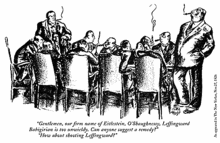
Jon writes: Though cartoons depicting businessmen and executives (often of the fat-cat variety) have appeared in The New Yorker from its very first issue, it took more than a year for the magazine to print one featuring a board meeting. The first single-panel cartoon of a board meeting was by Carl Rose; it ran in the November 27, 1926, issue. The drawing is of a group of businessmen sitting around a table smoking cigars. The caption reads: “Gentlemen, our firm name of Eitlestein, O’Shaugnessy, Leffingward and Babigirian is too unwieldy. Can anyone suggest a remedy?” “How about shooting Leffingward?” comes the reply. Though the artwork, in heavy charcoal, is clearly from the magazine’s early days, the caption still feels contemporary. It calls to mind a Charles Barsotti cartoon from October 11, 2004, in which an executive says to one of his employees, “I won’t, of course, Hollingsworth, but I could have you killed.”
TNY-nov.27.1926.pg31-toon.gif


Addressed elsewhere in Ask the Librarians: VII: Who were the fiction editors?, Shouts & Murmurs history, Sloan Wilson, international beats; VI: Letters to the editor, On and Off the Avenue, is the cartoon editor the same as the cover editor and the art editor?, audio versions of the magazine, Lois Long and Tables for Two, the cover strap; V: E. B. White’s newsbreaks, Garrison Keillor and the Grand Ole Opry, Harold Ross remembrances, whimsical pseudonyms, the classic boardroom cartoon; IV: Terrence Malick, Pierre Le-Tan, TV criticism, the magazine’s indexes, tiny drawings, Fantasticks follies; III: Early editors, short-story rankings, Audax Minor, Talk’s political stance; II: Robert Day cartoons, where New Yorker readers are, obscure departments, The Complete New Yorker, the birth of the TOC, the Second World War “pony edition”; I: A. J. Liebling, Spots, office typewriters, Trillin on food, the magazine’s first movie review, cartoon fact checking.

Betty Hutton, 1921-2007

Unless I’m mistaken, there was no Betty Hutton moment at this year’s Academy Awards. (I was stuck in the Denver airport at the time and watched the awards intermittently at the Mexican restaurant there; afterward, my friend C. texted me each winner as they were announced, so it was an inadequate viewing experience, to say the least.) And now she can’t get a Lifetime Achievement Award, for which there was a movement afoot, because she’s gone. From Playbill News:

Betty Hutton, Vivacious Star of Hollywood Musicals, Dies at 86
By Robert Simonson
Betty Hutton, the high-energy comedic actress who had a brief but memorable career as the star of Hollywood musicals and comedies in the 1940s, died in Palm Springs, CA, it was reported by AP. She was 86 and had lived in virtual isolation for much of the last 40 years…. “Brassy,” “exuberant” and “energetic” were some of the adjectives routinely used to desribe Ms. Hutton’s singular performance style and she brought those qualities to nearly every role she took on. Cont’d.

Damn Academy has no taste. R.I.P. (Here’s the NYT obituary.)

Update: I asked Martin “Squib Report” Schneider to root out any Betty Hutton references in The Complete New Yorker. He notes that the magazine panned The Miracle of Morgan’s Creek (!), and found only a breezy mention of Hutton as patriotic dish in a Talk from January 15, 1944—screen shot after the jump; click to enlarge. Let’s hope Denby, Lane, Lahr, or, say, Richard Brody mentions Hutton in a more nuanced spirit of appreciation (though she was a dish, too) in a column soon, or perhaps a Critic’s Notebook or DVD Note at the front of the book.

Continue reading

Seen the New Yorker Website Today?

It’s taken the waters, it’s had an extreme makeover (aided by the wizards of Winterhouse), it’s wired for sound, it’s ready for its closeup, it’s full of poetry, history, and animation, it’s taken some busy Bobolinks under its wing, and, in the words of the old television ad (which would make a great multimedia addition to—to Emdashes, actually!), it’s probably the best New Yorker website that ever was. Hats off to redesign captains Matt Dellinger and Blake Eskin! Not to mention the entire rest of the staff, who’ve been toiling for months and can finally take a fraction of a break.
As you can imagine—since this event blends some of my most beloved preoccupations, magazines, design, the web, and The New Yorker—I’ve been waiting for months for this afternoon. I was out of the office when the redesign sprang to life, and when I returned the always current Jason Kottke had already posted his first impressions, including useful technical notes for the web team. Michael Stillwell weighed in, too; his post links to other reactions. (The site’s archive page addresses some of the concerns listed: “Coming Soon: Most New Yorker articles since 2001 and selected pieces from before; thousands of brief reviews of books, movies, recordings, and restaurants; and a searchable index, with abstracts, of articles since 1925.”) And what do you think, reader?
While you’re touring the new site, by the way, be sure to read this week’s best Talk of the Town—GOAT-herding wunderkind Michael Schulman’s practically McPhee-like journey through all nine hours of the recent Tom Stoppard marathon. It sparkles like a glass of Breaky Bottom à la méthode champenoise. The boy has a bright future, mark my words!

Investigation: Bruce McCall’s Wheel of Article Ideas

Happy 82nd birthday, New Yorker! (The magazine debuted on Feb. 17, 1925, with the Feb. 21 issue.) I asked Martin Schneider, Emdashes Squib Report bureau chief, to do a little sleuthing into a corner of Bruce McCall cartoon on pp. 168-69 of this week’s anniversary issue.
As Emdashes’s resident archival expert, I found McCall’s cartoon of the first-ever guided tour of The New Yorker‘s offices highly irresistible. My favorite invention is the “Wheel of Article Ideas,” which pokes fun at the identifiably New Yorker blend of subjects—often fascinating, often arcane, sometimes too trendy, sometimes too dusty, but never, ever straightforwardly or unselfconsciously au courant. (After all, any magazine can be merely up to date; only a special magazine asks what in going on in J.Lo.’s brain.)
Does there lurk in this inscrutable amalgam a hidden code, each item pointing to a different era or major leitmotif of The New Yorker? Were I better versed in New Yorker lore, would it be within my grasp to crack that code and watch the different shards of the enigma interlock into a grander pattern? (The other possibility is that it’s just a cartoon.)
Anyway, let’s get to it. Did McCall include any topics that The New Yorker has already handled? Armed with the bottomless Complete New Yorker, I decided to find out.
LOGS
In the 2/13/1984 issue, The New Yorker ran a poem by Karl Shapiro called “The Sawdust Logs.” Quoth Shapiro, “Why shouldn’t sawdust have its day?”
NAPS
In the 5/31/1941 issue is a cute little TOTT about two young women who are prepared for their suburban journey out of Grand Central. They produce an alarm clock and nap right up to one minute before their train arrives in Scarsdale. Then they scamper off the train.
OXEN
In the 8/24/1946 issue, Berton Roueche reports on a day in the company of Percy Peck Beardsley, breeder of Devon oxen, who plies his weary trade in the bleak and pitiless plains of…Connecticut. In my opinion, this is a dig at the Shawn era, what with its E.J. Kahn “Staff of Life” treatises on wheat and the like.
BALLET DESIGN
Joan Acocella’s 5/28/2001 review of a Jerome Robbins bio cites “Balanchine’s grand, unfolding design.” Arlene Croce’s 11/17/1997 showcase on Merrill Ashley refers to “the design of classical dancing.” I suppose any ballet production has set and costume designers, and the corps may have designs on the prima ballerina’s primo position, but I take “design” here to mean something closer to an engineering term. Essentially an absurd juxtaposition.
J.LO I.Q.
Astoundingly, The New Yorker has never devoted any significant space to the question of Ms. Lopez’s intellectual gifts. In the 10/2/2000 issue, however, Christopher Buckley did float the idea of someday replacing future VP Dick Cheney with J.Lo. So back off, hatas! If “Oxen” is the kind of profile Shawn would have run, here we surely hark back to the Tina Brown era.
MAMBO
This seems to be a dig at the uneasy fit that such a steamy, sultry subject would be in the pages of The New Yorker, and McCall certainly has a point: The New Yorker has never produced much copy on the subject. There’s a TOTT from 4/18/1988 about an uptick in dance-course enrollments in the wake of Dirty Dancing. There was also that 2000 Oscar Hijuelos book The Mambo Kings Play Songs of Love, which got some coverage too.
IRAN’S BILLBOARD CRISIS
No such thing. I take this somewhat absurd reference to be essentially a compliment. The implication is that The New Yorker has a knack for producing fresh coverage—perhaps at times perversely—even on hot spots that have already received plenty of exposure. Who can forget that 2002 look at trampoline fetishism in Karbala?
FERNANDO PÓO
What a marvelously supple reference. Fernando Póo, Fernando Pó, and Fernão do Pó refer to both a person and a place. He was a Portuguese explorer who in 1472 discovered an island off the west coast of Africa in the Gulf of Guinea that for centuries was named after him. In 1979 it assumed the name Bioko after some sort of revolution. His name was also applied to certain places in Cameroon, which he also explored, this fact leading to the only mention I could find in The New Yorker—a 2/18/1961 TOTT about “Cameroun.” Other Fernandos mentioned in The New Yorker include Meirelles, Luis Mattos da Matta, Scianna, Medina, Collor, Henrique, Ferrer, Ochoa, Valenzuela, and Nottebohm. The Fernandos created by ABBA and Billy Crystal have apparently escaped The New Yorker‘s notice.
JAM
Oh, could we get any more quaint and cozy? Why not just choose the tea cosy, for that matter? As it happens, jam figures prominently in the searing 9/10/1966 TOTT on the National Fancy Food and Confection Show. So there.
MILLARD FILLMORE
Ah, our most risible president. Does anyone even know whether he was any good or not? His amusingness seems a priori. Alas, the world awaits the definitive New Yorker treatment of the subject. In the meantime, Morton Hunt’s 11/3/1956 account of the presidential race of 1856 will have to do.
Can anybody read that last one? “Zoo”? I await further clarification (shout? murmur?) from Mr. McCall.

Extra! New Yorker Cartoons Talk!

Roz Chast said recently that it took so much effort to get her characters to walk across a screen she wondered if she’d stop having fun with them, cool though the technology was. Art Spiegelman once said in jest that he’d agree to make Maus into a movie only if he could use real mice. (Then, I’ve heard, that wag Errol Morris called up to say he’d be happy to work on the project, since he’s good with rodents.) For some reason, the only people who know about this seem to be a couple of podcast directories. But you’re going to be excited about it: New Yorker cartoonists are making animated short-shorts, available as a video podcast from RingTales, and the RSS feed is here. I’ve already watched a fetching Charles Barsotti scenario in which a receptionist has an unusual suggestion for a caller on hold. I’m going to watch more now. The animations seem to be already existing cartoons slightly expanded for the shorts; remember Eric Lewis’s cartoon “I should have bought more crap”? Here it is in motion. Besides Lewis, other contributors so far include Danny Shanahan, Sam Gross, Frank Cotham, Tom Cheney, Peter Steiner, Christopher Weyant, cartoon editor Bob Mankoff, and, a nice surprise, Chast too. If this is the direction newyorker.com 2.0 will be taking within a few weeks (the website’s being completely redesigned as we speak), I’m enthusiastically for it. You think I’m enthusiastically for everything? Ah, there’s where you’re wrong.
If readers get to vote, or something YouTubey like that, on which cartoons will be sprinkled with pixie dust and come alive like the Nutcracker toys, my pick this week would be Drew Dernavich’s nutty, funny fish ladies, who would wiggle most entertainingly. Still, movement isn’t everything. All the cartoons in this issue, especially this fantastic George Booth drawing and this ridiculous J.C. Duffy concoction, are perfect just as their two-dimensional, stationary selves.
Update: There’s now a press release with details: “Subscribers to the free advertiser-supported podcast will receive three new animations of The New Yorker “RingTales” each week.”

Love Conquers All*: Emdashes Readers’ Valentines for The New Yorker

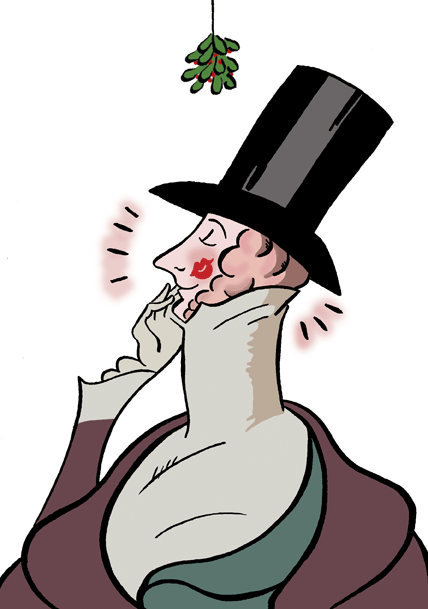
I asked some friends of Emdashes (whose abbreviation is not FOE) if they’d like to send some virtual valentines to a person, thing, or idea at The New Yorker. OK, that’s not completely true—I actually asked them to send a virtual holiday present back in December, but you know how these things go. So whether you hate Valentine’s Day or just sort of hate it, I hope this is a happy diversion, and I personally send kisses (and I’m told they’re quality) to every single one of you. Oh, and you’ll need to skip to the jump for the funny and gorgeous drawings by Patricia Storms; the first, while Christmas-themed, is eerily perfect for this week’s anniversary Tilley cover. Definitely click to enlarge!
Daniel Handler (Adverbs: A Novel, Lemony Snicket’s The End, &c.):
For Malcolm Gladwell: Three poems by Elizabeth Bishop, the first season of Golden Girls, a TRS-80 computer, a jar of dill pickles, and the results of a sociological study from the 1950s, with the expectation that he can find a life-guiding philosophical principle which governs all these specific items.
Mac Montandon (writer for Radar magazine and the author of the nonfiction book Jetpack Dreams, to be published by Da Capo Press in 2008):
1. Weekly assignments for Nick Paumgarten, Mark Singer, and Dana Goodyear.
2. A few more kids for Adam Gopnik—the better to generate story ideas.
3. A standing invitation for Ian Frazier to stop by any time and entertain me and my family with wonderful, witty tales.
4. The opportunity for David Remnick to reconsider that Silence of the City book idea.
5. Comma quotas for all!
Jesse Thorn (host, The Sound of Young America):
I would like to send Roger Angell season tickets to the Red Sox and an elixir of eternal life.
Carolita Johnson (Newyorkette and New Yorker cartoonist):
1. I’d send a beautifully tender, juicy, crackly-skinned, roasted chicken to Gary Shteyngart, with whom I had fun eating and talking about food at the Gin and Books party!
2. To Adam Gopnik, Microsoft Word’s Random Metaphor Check (as soon as it becomes available).
3. And to Orhan Pamuk, I’d send a chill pill after reading “My Father’s Suitcase”! I’ll throw in a self-flagellatory whip (one-time use only, because I do so like him).
A fan who prefers to remain anonymous has $500
for humorist Patricia Marx
.
David Marc Fischer (proprietor of Blog About Town and frequent loser of the Cartoon Caption Contest):
1. To Sasha Frere-Jones: A crate of heart-shaped rockist crackers.
2. To Emily Gordon: The return of Elk Candy. [Yes, please! —Ed.]
3. To Zachary Kanin (gatekeeper of the Cartoon Caption Contest): Whatever he wants, capische?
John Bucher (New Yorker Comment and, if all goes well, brand-new Emdashes intern):
1. Backup batteries for Rik Hertzberg’s common-sense Taser.
2. A ride on an icebreaker ship (or the biggest dump truck in the world) for John McPhee.
3. A spot for Elizabeth Kolbert in the VP’s next shooting party.
4. For Malcolm Gladwell: a Golden Ticket and a tour of the factory.
Patricia Storms (freelance cartoonist and illustrator living in Toronto, who’s illustrating a children’s book for Scholastic Canada and a humor book for Chronicle Books, both out fall 2007; a book of her cartoons about Valentine’s Day will be out in February 2008 from Red Rock Press):
1. This may sound sappy, but I’d love to give Eustace Tilley a big fat kiss as a thank-you for delighting me with such a stellar magazine. I’m feeling especially mushy about The New Yorker this year, because after many years of my reading my mom’s used New Yorker copies, she finally decided to give me a year’s subscription as a Christmas present. What the hell took you so long, ma? (Kidding, I’m kidding.)

eustace_2.gif

2. And in the spirit of the season, even though I tease poor Franzie mercilessly in my cartoons, I’d like to give good ol’ Jonathan Franzen, contributor to The New Yorker and lover of all things Charlie Brownish, a hug. I think he needs it.
goodol%27franzen_2.gif

 
Love Conquers All is a 1922 book by Robert Benchley that you can read in full here.