Category Archives: In Memoriam

Bob Mankoff on David Marc Fischer, the Winningest Non-Winner We Knew

Emily Gordon writes:
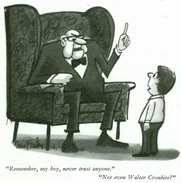
Recently, everyone at Emdashes was saddened by the death of David Marc Fischer, a dear friend of our site and of The New Yorker‘s cartoon caption contest. The following tribute is by The New Yorker‘s Bob Mankoff, and we think David would have loved it (click to enlarge the image):

In his “Blog About Town,” David Marc Fischer meticulously catalogued The New Yorker‘s Cartoon Caption Contest, including his 179 consecutive non-winning entries. Upon learning of this lovely man’s untimely passing, I went back and meticulously reviewed all of his entries, looking for the one that would best honor him and his devotion to the contest. I think this one, from contest 150, fits the bill.

–Bob Mankoff, Cartoon Editor, The New Yorker magazine

captiondmf.jpg

R.I.P., David Marc Fischer, Devoted New Yorker Blogger and Extraordinary Friend

Emily Gordon writes:
There are no words to describe the sadness we feel at the death of David, the man behind (among many other projects and passions) Blog About Town, who was a friend of The New Yorker, particularly its cartoons and cartoonists; an unwavering friend of Emdashes who always encouraged us to do our odd but heartfelt job more creatively and uncompromisingly; and a friend of mine. I could never match his generosity or his ingenuity in getting fellow New Yorkers to ditch their work-crazed ruts and get together, out to dinner, out to a play. His list of loyalists was the loyalest.
The last time we emailed, he invited me to see Twelfth Night. I couldn’t go. Here’s a short post he wrote about the play and its famous riddle about the initials M.O.A.I. In the comments (he was an active and conscientious commenter, including on his own posts), he wrote:

Methinks that M. O. A. I. could very well be a red herring, meant to torture Malvolio with its unsolvability. However: Now that I’ve (just) read about it containing the outer letters of Malvolio’s name, I also realize that continuing the progression would produce L. L. O. V., which is something close to love. That’s also plausible to me.

It’s a shocking loss, not least because it was so unexpected. He’ll keep his place of honor in the Emdashes Rossosphere for all time. Maybe someone else will take up the project of faithfully chronicling the New Yorker‘s Cartoon Caption Contest, mapping the winners, and tracking Daniel Radosh’s always hysterically anarchic Anti-Caption Contest. But no one will do it with so much L.L.O.V.

Later: Here’s a nice post about David from Radosh.net.

And later: Yesterday’s memorial service was one of the most touching occasions I’ve ever witnessed. I’ve been to three funerals in recent months for people far too young to die: Andrew Johnston, Michal Kunz, and David. It’s disquieting to hear eulogies by and for one’s peers (of course, one must also get used to this). But there’s an energetic, offbeat quality to such tributes that I can only describe as youthful, and that can be cathartic and apropos, too.

The first person to speak was the photographer Matt Mendelsohn, who knew David for almost all of their 46 years, and, with Matt’s permission, I wanted to share this part of his tribute with you. The caption contest line, you’ll be glad to know, got an enormous laugh. Everyone knew how passionate David was about the contest, but I didn’t realized he’d entered it so many times. And I didn’t know till yesterday that the huge group of passions and communities David either formed or enthusiastically promoted was just the tip of the iceberg. You wouldn’t believe how many people he was connected to, and how many people he connected. As another friend observed, “He was a giver.”

David was the smartest, brainiest, most loyal, most culturally aware friend I’ve ever had. He was interested in everything and he was interesting about everything. That is to say, there was no topic off bounds or out-of-reach for David. No subject, highbrow or lowbrow, he was unable to add a cogent, witty, insightful comment on. As a child, that could have been a topic of mild importance, say, the assumption to the presidency of Gerald Ford in 1974; of moderate importance, like the jazz trombone stylings of his idol, Bill Watrous; or, one of dire, absolute importance, like the groundbreaking 1968 Patrick McGoohan television series The Prisoner.

As an adult, that could mean a topic of mild importance, like the election of Barack Obama; of moderate importance, like discussing his one hundred and seventy-nine consecutive non-winning entries in the New Yorker Cartoon Caption Contest; or, finally, a topic of dire, absolute importance, like the groundbreaking 1968 Patrick McGoohan television series The Prisoner.

David, young or old, was a collector of culture, a guardian of civility. You never so much as argued with David as debated him cordially. It’s no surprise that in the 1980’s, when Life magazine still published monthly, David was the Letters to the Editor editor. In an age now, when anonymous and vicious comments on the internet are run amok, the notion of David vetting every published letter for accuracy and intelligence seems downright quaint. But that’s just what he excelled at. He was a lifeline to a more literate and worldly world. The last postings on Blog About Town, the New York diary he kept up for years, include, quite randomly, tips for securing Shakespeare in the Park tickets, a word-for-word handicapping of the National Spelling Bee (“Kavya Shavashankar gets a huge Monty Python word, “Blancmange,” and swallows it whole; Kyle Mou gets lucky, I think, by drawing avoirdupois–and he takes full advantage of the situation”), and, finally, an old clip of the French songwriter Charles Trenet singing his 1946 classic “La Mer,” in his native tongue, long before Bobby Darrin re-wrote it into a hit song in 1959. Not knowing anything about Charles Trenet, I watched the clip, read the translation and thought to myself, “Wow, the original is so much more poetic.”

Will I someday use this morsel of knowledge David just gave me? I’m not sure. Like all of his wisdom, I’ve filed it in my brain, and someday it will find its way back out and into a conversation. These are the little gifts David loved to give.

Walter Cronkite, 1916-2009

Martin Schneider writes:
I think the people who do Emdashes are uniformly too young to remember Cronkite in the role that made him such a ubiquitously admired figure. Speaking for myself, to watch Dan Rather chafe so uncomfortably in the role he inherited was to witness the most palpable sign of Cronkite’s distinction.
Every year, on January 1, the New Year’s Concert, consisting mostly of waltz masterpieces, is broadcast worldwide from Vienna. I watch it most years. For as long as I can remember, Cronkite was the host for the American telecast, and he did a really good job every year. For someone who was supposed to represent “everyman” in some way, he did “high culture” awfully well too. In a way, he embodied the best of America, a sentiment I’m sure we’ll be hearing plenty of in the days to come.
Judging from the archive, The New Yorker never really did a big Cronkite article. Perhaps I missed it. My guess is that he perhaps got very entrenched as a national icon a little too quickly, making a Profile almost irrelevant. As with Michael Jackson, The New Yorker generally approached Cronkite obliquely, in reviews, casuals, and cartoons.
Like this one:
cronkite.png

Michael Jackson, 1958-2009

Martin Schneider writes:
He didn’t have anything to do with The New Yorker, of course. But it seems silly to try to ignore his death.
The first mention of Michael Jackson in The New Yorker that I could find is from July 14, 1975. It was in the Talk of the Town and it had two parts, both by Jamaica Kincaid (I think).
The first part is a report describing a press conference in which the Jackson family announced that it was leaving Motown to join Epic. The report emphasized the businesslike nature of the announcement: “No Jackson said anything sentimental.”
On the same page appears a kind of fan letter, this one explicitly by Jamaica Kincaid, that intentionally echoes the kinds of fan letters he received every day—one of which is actually quoted, in full, in the item.
Such reports are full of heartbreaking things. Any reference to the color of his skin, the shape of his nose, the kinkiness of his hair, his affinity for children or animals, his marriage prospects—all of these things are heartbreaking, and Kincaid refers to all of them.
Possibly the most startling bit of information is that Jackson once appeared on The Dating Game. (It’s true.)
In the July 9, 1984, issue, there is a whimsical, lightly acerbic Talk piece by James Lardner about the existence of a Michael Jackson Hotline.
In the March 14, 1988, issue, there is a tranquil Talk piece by Garrison Keillor (uncredited, in the issue) about observing Jackson rehearse a rendition of “Man in the Mirror” for the Grammy telecast. This one is not heartbreaking. This one is about Jackson in his element, as a supreme entertainer, and it emphasizes his confidence and ease among people.
I don’t have much to say about him. I was never a fan in any real sense, but I admired the skill. He was a genius; he was damaged. Everyone knows it. A friend today asked me if he was the most famous person in the world. Was he? He might have been.
On the New Yorker blog, Ben Greenman gives his thoughts.

Frankie Manning, Dance Legend, 1914-2009

2224529682_ea622d36ff_o(2).jpg
Farewell to a radiant human being, a breathtaking performer, a great teacher, a jazz innovator, and the inspiration to untold numbers of swing and other dancers around the world.
This remarkable photo of Frankie, taken (most likely) last year, is by Holly Van Voast and is used with permission.
Later: That weekend was a long and lindy-hopping celebration of Frankie’s life and exuberant self.

Natasha Richardson in The New Yorker

Martin Schneider writes:
One day after the passing of Natasha Richardson, we present a list of her mentions in the magazine.
January 12, 1998: John Lahr, a showcase on Richardson
Digital Edition, website (abstract)
(Max Vadukul’s picture is magnificent.)
April 6, 1998: Nancy Franklin reviews “Cabaret”
Digital Edition, website (abstract)
May 18, 1998: Lillian Ross “Talk of the Town” item
Digital Edition, website (abstract)
April 5, 1999: John Lahr review of “Closer”
Digital Edition, website (abstract)
June 11, 2001: Dana Goodyear “Talk of the Town” item
Digital Edition, website
March 28, 2005: Lillian Ross “Talk of the Town” item
Digital Edition, website
May 9, 2005: John Lahr, review of “A Streetcar Named Desire”
Digital Edition, website
August 22, 2005: Anthony Lane, review of “Asylum”
Digital Edition, website
There’s also this interesting search of the archives, hits include a lot of random material from the “Goings On About Town” section. In a sense, you get a more accurate picture of her career as an actress by clicking on these (subscription to the magazine required).

James Purdy, 1914-2009–and His One New Yorker Story

Jonathan Taylor writes:
James Purdy died today, the Times‘s ArtsBeat reports, saying that he “labored at the margins of the literary mainstream, inspiring veneration or disdain.”
I was a little surprised to find a Purdy story published in The New Yorker, but not that surprised that it was a very early one: “About Jessie Mae” in the May 25, 1957, issue—just after the 1956 publication of Purdy’s novella 63: Dream Palace. It’s a grotesquely decorous little dialogue between two nieghbors in St. Augustine, Fla., seething in harmony. Myrtle and Mrs. Hemlock are bursting simultaneously with the uncontrollable urge to gossip about the breathaking “untidiness” of their rich frenemy Jessie Mae—and with Mrs. Hemlock’s icebox full of homemade fudge bars. “About Jessie Mae” was included in Purdy’s 1962 story collection Children Is All.
Here‘s a 2005 appreciation by Purdy champion Gore Vidal.

Alfred Knopf, Jr., 1918-2009

Benjamin Chambers writes:
Alfred Knopf Jr., co-founder of the Atheneum Publishing, died on Valentine’s Day at 90. Atheneum merged with Charles Scribner’s and Sons in 1978, and is now an imprint of Simon & Schuster, though it now publishes childrens’ books exclusively. Atheneum started off with a bang, however, with bestsellers The Last of the Just, and The Making of the President, 1960. Not bad for a kid who ran away to Salt Lake City after he didn’t make it into Princeton.
New Yorker contributors published at Atheneum: Edward Albee, Wright Morris, and … anyone know of others?