Category Archives: Looked Into

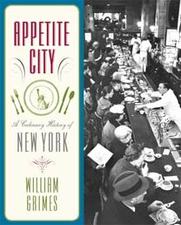
Tables for Eight Million: William Grimes’s ‘Appetite City’—An Emdashes Review Essay

Appetite.jpg
Jonathan Taylor writes:
New York is food crazy right now, even more than usual. It’s also experiencing a renaissance of interest in local history, as new populations sweep into neigborhoods across the boroughs, and some, at least, take an interest in the surroundings they are the latest to reshape. So it’s hardly a surprise to see the publication this month of William Grimes’s history of New York restaurants, Appetite City (North Point, $30). What may be perplexing is that so little of this history was already widely known. The book helps us understand why it wasn’t. [Grimes will be discussing Appetite City with Ruth Reichl and others at the New York Public Library on Thursday Nov. 5, at 7:00 p.m. Info and tickets here.]
New York is sufficiently impressed with its own importance, but it has long been too busy occupied with what is happening now, and what’s the next big thing, to pay attention to the history that makes it important. Cities whose glory days are over do that. I’ve lived in New York for 15 years, and I know off the top of my head that the oldest existing restaurants in Boston are Union Oyster House, Durgin-Park and Locke-Ober; and that the oldest in New Orleans is Antoine’s.
But what is the oldest restaurant in New York? I had hardly given it a thought. It turns out it’s not that clear, and whatever the answer is, it’s of limited interest, and cannot illuminate New York’s past in the way that these others do for their cities. The history of New York’s restaurants, as in other fields, is one of constant change, creative destruction, and nimble assimilation of other places’ traditions and talents. The only thing capable of embodying the essence of New York’s history is its present—the notable absence of so much of its history is a result of the way that history unfolded.
Grimes’s opening chapter describes a New York difficult to imagine: “A City Without a Restaurant.” The early history of eating out in New York is the history of the notion of eating outside the home at all. For the Dutch-descended Knickerbocker society of the early 19th century, dining was done in private, and in any case, they regarded the food generally served in public—at chophouses—as “foreign,” because it was English. Those chophouses, and lesser coffeehouses and pie counters, served what Grimes says was the American city where it first became customary not to return home to consume lunch.
In the busy city, eating out was thus first a matter of necessity. But the idea of going out to eat as a pleasurable activity in itself was a slightly later import. Abram Dayton, in his 1897 memoir Last Days of Knickerbocker Life in New York, recalled the “foreign element” that distinguished Delmonico’s, opened in 1827 by Swiss brothers as a French café. Delmonico’s introduced the phenomenon that defines one aspect of New York as a restaurant city: aspirational dining. Fed by its own farm in the village of Williamsburgh on Long Island (now Brooklyn’s Williamsburg), it offered above all the latest in Parisian trends, but also skimmed the world’s cuisines, offering, according to New York bon vivant Sam Ward, everything from “the caviare of Archangel, to the ‘polenta’ of Naples, the ‘allia podrida’ of Madrid, the Bouillabaise of Marseilles, the ‘Casuela’ of Santiago Chili, and the Buffalo hump of Fort Laramie [sic throughout].”
Over the course of the 19th century, Delmonico’s became New York’s most renowned restaurant, or rather restaurants: Its expansion illustrates another reason New York’s dining history isn’t well preserved—it kept moving. Their second location at 76 Broad St., opened in 1834, became the main restaurant after a fire destroyed the original 23 William St. site the next year. Lorenzo Delmonico, keeping his eye on the city’s growth uptown, moved the “flagship” Delmonico’s to a series of locations opened successively at William and Beaver in 1837; Chambers and Broadway in 1856; Fifth Ave. and 14th St. in 1862, relocated in 1876 to Fifth Ave. and 26th St. by Madison Square; and finally to Fifth and 44th, the last location, which closed in 1923.
In Grimes’s chapters focusing on Madison Square, we see New York’s emerging economic preeminence in the second half of the 1800s, as manifested in the city’s first fully realized nocturnal entertainment and social mecca. Lavish hotels, like Hoffman House and the Brunswick, boasted restaurants matching the Delmonico’s standard (and poaching its cooks), and racily decorated bars that poured the first wave of Martinis and Manhattans. The Madison Square scene functioned both as stage for the high-society likes of Edith Wharton, who gathered at the Café Martin (opened in the Delmonico’s space when that moved to Midtown), and auditorium for a mass audience of gawkers: the area was the pre-Times Square theater district, the site of a Barnum Hippodrome and, of course, the original Madison Square Garden.
While the upper crust migrated determinedly from downtown (Bleecker St. was “the Park Avenue of its day” before 1850) to Union Square to Madison Square to Midtown, Appetite City gives glimpses of the surprising pasts of the neighborhoods in its shadows. Park Row, the 19th-century home of New York’s newspaper industry, was lined with cheap spots that served journalists around the clock, like so-called “beef and” restaurants. (Journalists, in return, fancifully embellished on the kitchen argot that waiters supposedly used to shout orders to the kitchen. The symbiotic relationship between the news media and restaurants is a constant theme in the book.)
And who knew that what we now call SoHo was once settled by French emigres who patronized grubby cuisine grand-mere eating houses along Wooster Street? Nearby, the stretch of Houston just east of Broadway was once a notorious den of gambling and theivery, concentrated around the oyster saloon Florence’s and the concert hall Harry Hill’s. (It’s just barely possible to feel that the block’s raucous late-night history survives a bit in old-time dive bar Milano’s and Botanica, a.k.a. the former Knitting Factory.)
Throughout New York’s relatively short history, composed mostly of the arrival of waves of newcomers, what’s “authentically” New York has always been fiercely, and pointlessly, contested. At the turn of the 20th century, vast “lobster-palaces”—Rector’s at 44th and Broadway, Churchill’s at 49th, Jack’s at 42nd and Sixth—fed thousands of pleasure-seekers in a district that redefined the image of New York high life, Times Square, and prompted a now-familiar kind of discourse about what defined a “real New Yorker”:

There was disagreement about who belonged to lobster-palace society. The more jaded journalists dismissed the whole tribe as nothing more than out-of-towners desperate to spend money and woop it up. Convinced that they were seated amidst real New Yorkers and the cream of the theatrical crop, the rubes stared agog at their fellow visitors from Rapid City and Kalamazoo, and endured the close company of big-spending loudmouths….

What could be more “authentically” New York than the visitors’ quest to show up and be in the middle of it, and the entrepreneur’s readiness to furnish a ready-made spectacle. In any case, the original lobster palace, Rector’s, was an import: Chicago restaurateur Charles Rector simply transplanted the restaurant model that had already earned him his fortune in the Loop.
And while today, as the plans for a T.G.I. Friday’s in Union Square understandably prompt bemoaning of the dilution of the city’s character by national chains, it’s worth noting that at the turn of the 20th century, restaurant chains were the rage in New York. The city was the birthplace of the Childs restaurants, which from 1889 to 1928 grew to 112 restaurants in 33 cities in North America (including one in Union Square). At each stage of the city’s rapid development, an ever-shifting, self-centered sense of “history” is repeatedly generated. In 1921, Collier’s magazine lamented that Broadway around Times Square, “once famous for ‘gilded’ restaurants,” was now lined with “dairy restaurants, pastry shops, rotisseries, cafeterias, and ‘automats'”—the last of which are now themselves objects of nostalgia of “old New York.”
Today, New York is taken with a food culture hungry for the brand of authenticity preached by Michael Pollan and Alice Waters. But this city, although a gastronomic capital, is not the custodian of a traditional local cuisine or a terroir. To a degree, it resembles Paris in this way, since Paris is famous not because of the cuisine of the ÃŽle de France, but as magnet and stage for the entire country’s products and cuisines. But in Paris, the fanciful use of those products at high-end restaurants became itself a fully developed culinary tradition. In contrast, Grimes notes, “New York’s hallmark as a dining city is not the excellence of its best restaurants, it’s the uncommon diversity of ‘national cooking styles’ in one place.” And, like the entertainment industry they’re so connected to, the “best” restaurants also depend on talent and trends from the sticks gravitating to the New York City stage, be it Chicago’s Charlie Rector or Waters’s Californian farm-to-table movement.
The one kind of eatery that historically is as authentically local to New York as a bouchon is to Lyon is the oyster saloon—and that’s one that, typically enough, is extinct, due to overharvesting of the once seemingly limitless oyster supplies of regional waters. Mark Kurlansky, of course, explained the pervasiveness of this shellfish in New York’s economic, cultural and natural life in his book The Big Oyster. But Grimes shows vividly how oysters were, in the 19th century, the city’s “great leveler.” They were an omnipresent cheap snack food, whether a half-dozen (seven) for a dime, a hot chunk of oyster pie, or pickled oysters. (Grimes rightly finds the disappearance of the latter puzzling—with luck, maybe they’ll be revived by an artisanal fishmonger analogue of the Marlow & Daughters-style butcher shop.) At the same time, some oyster saloons functioned as the era’s “power restaurants,” whether the sumptuous Downing’s on Pell St., or the ostentatiously severe Dorlon’s at Fulton Market. The Oyster Bar in Grand Central Terminal was founded before the final end of the oyster era and is, in Grimes’s estimation, a good “approximation” of this old-time New York institution.
But cheap oysters as the quintessential food of the city’s daily life are a thing of the past, just as it’s difficult to imagine Broadway between Madison Square Park and 34th St. as “ablaze with the electric light” illuminating thronging crowds of night-owls. Yet even as so much of New York’s restaurant past has vanished, much of it is simply reincarnated, since many of the city’s eating requirements stay the same. Once you’ve read Appetite City, almost any kind of restaurant reveals itself as merely the latest avatar of a New York archetype.
“My theory about a restaurant is that to be the right sort of an eating place it must be closely related to its source of supplies,” wrote the man behind a meticulously conceptualized restaurant that was supplied by its own farm outside the city; “We feel that certain ideals of cooking and furnishings should be expressed in connection with a restaurant.” The restaurateur in question is not Dan Barber, but Arts and Crafts furniture designer Gustav Stickley, whose Craftsman Restaurant on East 39th St. lasted tantalizingly briefly, from 1913 to 1914. Graydon Carter’s Waverly Inn has as predecessor in the Pfaff’s of the 1850s, at Broadway and Bleecker, where Saturday Press magazine editor Henry Clapp “cracked the whip” over a hand-picked circus of “self-proclaimed geniuses—most of them future footnote material.” A craze for tamale carts made a notable appearance a century before the Red Hook soccer fields—”chicken” tamales sold by Irish vendors and actually made with veal, then a cheaper meat than chicken!
And the pizza slice can be said to play the same role for the city that the oyster once did: the cheapest meal available on every street, but an object of appreciation up and down the social scale. Apart from a mention of the origins of pizza’s presence in New York, though, there is scant mention in Appetite City of this ubiquitous food, and food culture, of the city. It’s almost impossible to make a fair criticism of what has to be left out, after everything that Grimes has managed to put into this book. But here’s my only real quibble. Until the early 20th century, Grimes vividly conjures the scope of popular food practices alongside the heights scaled by the likes of Delmonico’s. But the in latter part of the book focuses more narrowly on fine dining trends—telling that story as a former Times restaurant critic can—but also at the expense of the true vernacular dining of the city’s millions.
This makes the more recent history weaker for at least two reasons. It neglects to carry historical threads the book has traced for so long all the way to their fascinating manifestations in the present day. I was disappointed, after the extensive genealogy of greasy spoons—the “coffee and cake” restaurants, “beef and…” joints and “hash houses”—not to see exactly how these led to what today’s New Yorkers know as diners.
Secondly, it loses sight of Grimes’s own maxim that it’s the “diversity of national cooking styles,” not only the “best” restaurants, that define this “restaurant city.” And thus it can’t account for what is already shaping up as the next chapter in New York’s culinary history: the fact that the city’s foodies are now as fixated on seeking out the best taco cart or Hunan hot noodle hideaway as on getting the impossible Momofuku reservation—if not more.
But that’s just to say of Grimes’s achievement, “More like this, please.” As the current quest for authenticity mandates attention to (sometimes imaginary) tradition and heritage, and restaurants continue to both cause and symptom of the changing geography of the city—functioning as chicken and egg in the familiar cycle of neighborhood gentrification—Appetite City is required reading for understanding more than just how we eat in this city.
P.S.: Appetite City has some New Yorker angles too, with a number of its articles serving as key sources, including:
Romance, Incorporated,” a February 4, 1928, profile by Margaret Leech of Alice Foote MacDougall, “the Martha Stewart of the 1920s” in Grimes’s words, and creator of cozily middlebrow chain of restaurants intended for working women to repair to.
Margaret Case Harriman’s two-part profile of the headwaiters of Upper East Side society restaurant The Colony, from June 1 and June 8, 1935.
The Ambassador in the Sanctuary,” Joseph Wechsberg’s 1953 profile of Le Pavillon proprietor Henri Soulé.
Geoffrey Hellman’s 1964 profile of Joseph Baum’s Restaurant Associates, “Directed to the Product.” (As told by Grimes, the tale of Restaurant Associates’ impeccably researched artificiality is a key chapter in the history of the kind of “fine-dining business” now exemplified by the McNally, Danny Meyer and other restaurant “groups.”)
Grimes also notes two early New Yorker writers who authored guides to the city’s restaurants: George S. Chappell (The Restaurants of New York, 1925) and Walter R. Brooks (New York: An Intimate Guide, 1931).
The Cartoon Kit: New Yorker Contest

_Pollux writes_:
Robert Mankoff, cartoon editor of _The New Yorker_, talked about this upcoming feature at his class on cartooning during the New Yorker Festival–and now it’s here!
This is the “Cartoon Kit!”:http://www.newyorker.com/online/photocontests/cartoonkit It’s an advanced form of the Caption Contest: for this contest you’ll be creating your own _New Yorker_ cartoon with pre-drawn props and characters drawn by artist and writer Alex Gregory.
Caption your customized cartoon and submit your entry by **November 22, 2009**!
Fans of _New Yorker_ cartoons will love the props they can play around with, which range from cats, cavemen, dogs, martini glasses to aliens, the Grim Reaper, a fishbowl, and a sad clown.
You can drag and drop from the gallery of more than forty images, and resize and duplicate them. Let your imagination run wild!
The Cartoon Kit will be releasing a new theme with new drawings each month.
This month the site is also running a sweepstakes, in which _The New Yorker_ will be giving away a signed copy of _On The Money: The Economy in Cartoons, 1925-2009_, edited by Mankoff.
Grand prize is a trip for two to New York City. This trip will include a meeting with Mankoff and a tour of the _New Yorker_ offices.

Too Early for Pointless Nobel Predictions?

Jonathan Taylor writes:
My normally flatline sense of anticipation the Nobel Prize for Literature is a bit aroused this year, since I’m grateful, as an admittedly insular American, to have been introduced to J.M.G. Le Clézio last year.
The Nobel Committee has set dates for the announcement of the other prizes, beginning October 5. “According to tradition, the Swedish Academy will set the date for its announcement of the Nobel Prize in Literature later.” (It’s typically a Thursday.)
Anybody have an interesting line on this year’s possibilities? Or, better yet, flights of fancy on the glorious impossibilities?

Unoccasioned Link Roundup: Dimanche Apres Midi Edition

Jonathan Taylor writes:
I’ve bought the New York Film Festival ticket I want, I’m listening to “Bal de Dimanche Apres Midi” streaming from KRVS in Lafayette, La. (the French-speaker next to me on the sofa “can’t understand a word”), on the day after Emily’s birthday—here are some New Yorker–related links:

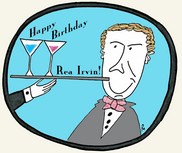
Rea Irvin’s Birthday Today

reairvinbirthday3.png
_Pollux writes_:
On this day, a hundred and twenty-eight years ago, Rea Irvin was born in a Californian town named San Francisco. A hundred and three years ago, Irvin traveled to the East Coast to assist in a birth that occurred eighty-four years ago–the founding of _The New Yorker_.
Thomas Edison invented the Kinetoscope as well as the lightbulb, and Rea Irvin did more than simply create the Eustace Tilley cover portrait.
Irvin lent his good taste and good sense towards the creation of _The New Yorker_’s page design, headings, spot illustrations, as well as the archetype of the typical _New Yorker_ single-panel cartoon.
As Emily writes in her important and much-needed “article”:http://www.printmag.com/Article.aspx?ArticleSlug=Everybody_Loves_Rea_Irvin on him, “it was Irvin’s own intimacy with classic form and craft, and his genial willingness to share that expertise, that allowed him to create a complete device: a design, a typeface, a style, and a mood that would be instantly recognizable, and eminently effective, almost a century later.”
Emily and I have worked to pull Rea Irvin out of the shadows that seem to enshroud his life and his work. I wrote the initial Wikipedia article on him, and, in the true spirit of Wikipedia, others have contributed to it, the latest contribution being a series of Irvin “drawings.”:http://commons.wikimedia.org/wiki/Category:Rea_Irvin
Rea Irvin is one of our heroes, and one of the patron saints of this publication that we love so much.
In his honor, we declare August 26 to be **Rea Irvin Day**. Celebrate accordingly.

Meditations in a Newsmergency

Michael Nielsen writes in “Is Scientific Publishing About to Be Disrupted?”, which is worth reading through to the sound advice at the end:

Some people explain the slow death of newspapers by saying that blogs and other online sources [1 (see note)] are news parasites, feeding off the original reporting done by the newspapers. That’s false. While it’s true that many blogs don’t do original reporting, it’s equally true that many of the top blogs do excellent original reporting…. Five years ago, most newspaper editors would have laughed at the idea that blogs might one day offer serious competition. The minicomputer companies laughed at the early personal computers. New technologies often don’t look very good in their early stages, and that means a straightup comparison of new to old is little help in recognizing impending dispruption. That’s a problem, though, because the best time to recognize disruption is in its early stages.

Although much of my own reporting for Emdashes is in the somewhat less world-changing realm of bagel inquiries and Shouts & Murmurs phone number calling, I heartily agree.

Important economic and media-future questions aside, this preoccupation with what a “blogger” does and doesn’t do–and can and can’t do–continues to be fascinating but frustrating to me. (This is why I’m looking forward to reading Say Everything: How Blogging Began, What It’s Becoming, and Why It Matters, by Scott Rosenberg, who, on his book’s site, answers the question “Aren’t there just too many blogs?” with a brief and hilarious “No.”) As Sewell Chan said not long ago: “The whole blogger versus journalist debate that might have existed around 2004 is dead. Over. Stale. Uninteresting. I couldn’t care less — it’s a meaningless debate to have. What’s more interesting to me is what a blog means now.”

Yes indeed, a blog means something–that’s very clear–but what about a “blogger”? If you don’t mind the self-quoting (I so rarely indulge!), I’ll repeat, Pete:

Like “radio host” or “airplane skywriter,” the term “blogger” refers only to a medium of communication, a method of delivery. The first two descriptions might indicate something about a person’s source of income; they say a little more about his or her temperament and skills (the ability to get to a radio studio, win the slot, speak into a microphone, and work the dials, at minimum; the agility and daring to fly a plane in signifying loops).

But “blogger,” like “caller from Schenectady” or “chronicler of skywriting,” reveals next to nothing about that person’s training, philosophy, background, intelligence, education, politics, reporting or research skills, social life, ethics, age, poise, lucidity, conventionality, effectiveness, impulsiveness, discretion, or relationship to (or experience in) traditional media, whether “mainstream” or not. Only watching what the skywriter spells, and listening to what Schenectady has to say, will begin to make them known.

In any case, writers who pride themselves on their sensitivity to language should avoid lumping their fellows into mass categories of either variety, don’t you think?

New ‘n’ related: Scott Rosenberg asks, Time to retire the term “blogger”?

I’m Not Hanging Noodles On Your Ears: Jag Bhalla’s Book on Idioms, Illustrated by New Yorker Cartoonist Julia Suits

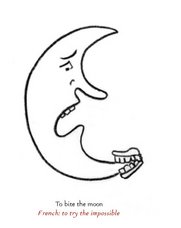
moon_bite_Julia Suits.jpg
**Illustrations by Julia Suits**
(click to enlarge)
_Pollux writes_:
Enjoying “Jag Bhalla’s”:http://www.hangingnoodles.com/ new book on idioms comes as easily as a river imp’s fart. _I’m Not Hanging Noodles On Your Ears_, published by the National Geographic Society, is a collection of “intriguing idioms from around the world.”
_Hanging Noodles_, which also features the work of _New Yorker_ cartoonist “Julia Suits'”:http://www.cartoonbank.com/search_results.asp?sitetype=1&advanced=1&section=all&artist=Julia+Suits visualizations of the idioms, collects wonderful and diverse idioms from various languages, including Chinese, Russian, French, Yiddish, and Spanish.
Our brains, as Bhalla explains, enjoy novelty in language and word play, and idioms are perhaps the best example of our collective love for linguistic playfulness. Bhalla calls idioms “frozen metaphors” and the definition is both pithy and apt.
The origins of some idioms have been lost in time. Idioms are living relics that see life everyday despite their hazy origins. They are frozen baby mammoths that we resurrect from the ice on a daily basis.
Idioms are figures of speech that are usually unintelligible to someone who hears them for the first time. If a Russian lets you know, perhaps while you are “journeying”:http://www.newyorker.com/reporting/2009/08/03/090803fa_fact_frazier across the wastes and wonders of Siberia, that he’s not hanging noodles on your ears, he means he is not pulling your leg.
But Bhalla’s _Hanging Noodles_ isn’t a soulless compendium of idioms, but a look at language and its formation. Bhalla prefaces each chapter with a short linguistic study that examines, for example, the capacity for babies and animals to learn languages, the role of facial expressions in language, the role of culture in language, the role of numbers and counting in language, semantic shifts, and what he calls the “woo-woo theory,” in which language may have gained complexity as a result of man’s efforts to woo the opposite sex, with idioms, for example, serving as a sort of linguistic peacock tail.
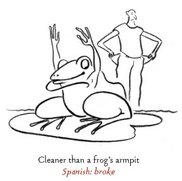
frogs_armpit_Julia Suits.jpg
Bhalla also includes trivia on words and word origins. For example, he mentions a neologism based on the Spanish word _tapas_ (literally “lids”, but referring to the little dishes of appetizers served before the main course), which is _crapas_ -a new coinage used to describe the terrible finger food served at public events. In addition, Bhalla not only discusses the origins of words, but also his own origins, and his own tastes and background regarding language.
Let me mention some of the actual idioms in Bhalla’s book. As the Germans say, _here the donkey falls_ (“that’s the important part”). Some of my personal favorites include “to vomit the sound of weakness” (Japanese, “to whine”), “to show your lamp to the sun” (Hindi, “to waste time”), and “to stick one’s nose in every sour curd cheese” (German, “be nosy”).
Julia Suits’ drawings illustrate the bizarreness of some of these idioms, making _Hanging Noodles_ not only a compendium of idioms, a collection of trivia, an autobiography, and a scholarly look at the history of language, but also a book of cartoons.
Suits’ simple lines are effective in a second translation of these idioms. Idioms such as “to stand like a watered poodle” are translated not only into English, but also into the visual language of cartooning. The result is a series of funny and surreal drawings that demonstrate the great complexity and strangeness of language.
Adding to the bizarreness of these idioms is the fact that Bhalla provides us his frozen metaphors only in their translated, English form. As Bhalla explains, the book is not intended to be a language reference book, but instead his purpose is for you to connect as a reader with the lists of idioms and “make your own sweet, beautiful meaning together.”
Bhalla includes a quote by _New Yorker_ cartoon editor Bob Mankoff that defines humor as the “counterweight to the hegemony of reason,” and _Hanging Noodles_ helps in the good fight against dispassionate logic. “Our minds,” Bhalla writes, “are not as reason-able as we like to think.”
But instead of lumping them in terms of their language of origin, Bhalla groups idioms according to theme or category. Thus, we get chapters such as _The Language of Love: Swallowed like a postman’s sock_, _Colors: Sighing with blue breath_, and _Time: When dogs were tied with sausages_.
This makes the book not only informative but funny. For example, a selection of romance-related idioms includes:
* _To live like an old farm rifle_ (Spanish, Nicaragua): to always be pregnant
* _Reheated cabbage_ (Italian): an attempt to revive an old love affair
* _Aunt seducer_ (German): a young man whose manners are much too good
Idioms enliven and brighten the languages of the Earth. Jag Bhalla’s book, adorned with amusing drawings by Julia Suits, is a welcome addition to the library of anyone who loves words.
Reading _I’m Not Hanging Noodles On Your Ears_ put the butter back in my spinach. I hope it does for you too, and may an onion not grow out of your navel.
tea_navel_Julia Suits.jpg

Raided Museum Was a ’30s ‘Culture Center’

Jonathan Taylor writes:
The Upper West Side’s Nicholas Roerich Museum, City Room reports, was recently the victim of its first art thefts. The museum was the topic of “Culture Center,” a Talk of the Town piece in 1934. (The museum was founded well before 1949, when the Times says it was). At the time, the museum was still located in the notable Art Deco building originally constructed to house both it, with its collection of a thousand Roerich paintings, and apartments for members of the theosophic Roerich Society: the Master Apartments on 103rd and Riverside. (The museum is now in a townhouse at 107th and Riverside.)
Talk called the 29-story building “the only building in town, so far as we know, that shades from deep purple at the base to white at the pinnacle. This symbolizes the idea of growth,” and, judging by the museum’s site, the colors retain their power. The piece continues archly about Roerich’s, and the Roerich Society’s, assiduous deployment of symbols.
The upper 25 stories of the building were “small kitchenette apartments for resident members of the Roerich Society.” Some became members just by virtue of signing a lease for a (nonprofit) apartment. A lease conferred an instant intellectual and social life: nightly talks on such topics as “What is Happening in the World and Why,” and birthday parties staged for folks like Goethe, Bolivar and Buddha—celebrated on the full moon of May. (The museum’s current event listings haven’t been updated lately.)
A Paris Roerich Museum is mentioned—can’t quite tell if that’s still around, but there are others in Mongolia, in a house he resided in, and in Moscow, which delightfully preserves in translation the Russian genitive form imeni, “by the name of,” for things named after people.

We’re Liberal and We Drink Vinegar

Jonathan Taylor writes:
Michael Savage is right. Vinegar is “like wine.” (It’s a trick!) I recently received, as a thoughtful gift, a “drinking vinegar” from Gegenbauer, a fine Viennese producer of vinegars (as well as whole grains and coffees), via Philadelphia’s DiBruno Bros. This one is made from the Pedro Ximénez grape, used to make sherries and raisin wines. It is appley and brisk, with enough acidity to induce a challenging euphoria resembling that of capsicum, but, at 3%, not enough, in fact, to technically be categorized a vinegar. This “Noble Sour” is, pace Savage, “special,” an after-dinner drink with a world-clarifying potency that an alcoholic digestive could not provide. I wouldn’t be surprised if it’s already on menus in Savage’s San Francisco, and it has a place on more. Don’t anybody tell him about saba .

Just Released: New Yorker App for the iPhone

Martin Schneider writes:
I do not own an iPhone, but it doesn’t take a genius to surmise that this might make an awful lot of people happy:
iphonenewyorker.png
Here’s the text:

About The New Yorker for iPhone
A weekly magazine with a signature mix of reporting on national and international politics and culture, humor and cartoons, fiction and poetry, and cultural reviews and criticism.

The New Yorker for iPhone features a selection of stories from each week’s issue as well as original material from newyorker.com and one-touch access to our blogs and podcasts.

More to come. I’m sure Emily (who does own an iPhone) is raring to give it a test-drive.
_Update_: If you want to get a taste for how it will work, look at “this”:http://iphone.newyorker.com/tny-iphone/#_home.