
Undeclared superdelegate Rahm Emanuel’s declarations at the New Yorker Conference proved newsworthy, and the magazine has posted the video of Emanuel’s interview with Ryan Lizza on its website. Now we can fact-check my scribbled quotations together! Yesterday I posted the finest lines from day one, and here are my favorites from the conference’s windup. —MCS
“You cannot get a healthy meal in a New York airport unless you bring it yourself and figure out how to get it through the security checkpoints.” —Paco Underhill
“I believe passionately in rubber-soled shoes.” —Paco Underhill
“Metal chairs should not be part of an airport’s lexicon.” —Paco Underhill
“The filthiest place in the first world is the bathroom in the economy section of a crowded airplane.” —Paco Underhill
“I think of the airport as a Berlin, with a Berlin Wall and a Checkpoint Charlie.” —Paco Underhill
“Has anyone had a pleasant experience at airport security? It’s a Stasi moment.” —Paco Underhill
“I think almost all of us agree that the airport experience is miserable.” —Paco Underhill
“World of Warcraft is the best-designed reality of all time.” —Jane McGonigal
“I have a dream of building an M.M.O. where your dog is your avatar.” —Jane McGonigal
“Miles per gallon is the new high score.” —Jane McGonigal
“I think there are people that know the Obamas better than Rahm does, there are probably people that know the Clintons better than Rahm does, but i don’t think there’s anyone in American politics that knows both the Clintons and the Obamas as well as Rahm does.” —Ryan Lizza
“At this point Barack is the presumptive nominee.” —Rahm Emanuel
“The reference point for change is George Bush.” —Rahm Emanuel
“Like in ’06, you’ve got to go take it from them. They don’t give up power easily.” —Rahm Emanuel
In the two recent special elections in Louisiana and Illinois, “The Republicans ran on taxes in Republican districts and their ace for the last thirty years came up joker.” —Rahm Emanuel
“When Hillary Clinton says, ‘I’m not a quitter, I’m a fighter,’ that is an accurate depiction of who she is.” —Rahm Emanuel
“The government has succeeded in universalizing health care for a population, not the population.” —Rahm Emanuel
“It’s not a coincidence that the big discussion in the Democratic Party is about trade and the big discussion in the Republican Party is about immigration.” —Rahm Emanuel
“Verizon is in the record business. Proctor and Gamble is in the record business.” —Steve Stoute
“The poster child for that ‘no sellout’ thing was Bob Dylan, and he ends up in a Victoria Secret ad.” —Steve Stoute
“We know that New York is the number-one terrorist target in the United States.” — Raymond W. Kelly
“You’d be hard-pressed to look at the high-end fashion industry and say they’re in trouble.” —James Surowiecki
“A copyright on the pinstripe would certainly be troubling.” —Scott Hemphill
“H&M is kind of like a gateway drug.” —Kal Raustiala
“I have a certain aversion to most famous people.” —Sheila Nevins
“The fictionalization of war seems better suited for after the war.” —Sheila Nevins
“Daytime is boring.” —Sheila Nevins
“Real Sex is our Sesame Street—people re-learn the alphabet every day.” —Sheila Nevins
“Opera fans are as fanatical about opera as sports fans are about sports.” —Peter Gelb
“One of the common errors that Americans make is to believe that all good things go together.” —Fareed Zakaria
“The real story is that the rest of the world is rising.” —Fareed Zakaria
“Over the last ten or fifteen years, China has opened up a lot more than people realize—but there are no political rights.” —Fareed Zakaria
“John McCain has drunk the neocon Kool-Aid.” —Fareed Zakaria
“It’s a good thing for there to be other centers of wealth.” —Fareed Zakaria
“In the Middle East, you had oil, you had failed dictatorships, and the two combined to form kind of an unholy alliance.” —Fareed Zakaria
“Being the 800-pound gorilla in the room is very different from being a small mouse in the room looking at the 800-pound gorilla.” —Fareed Zakaria
Note: Quotations are as accurate as I could make them; in a couple of instances I have replaced a pronoun with its antecedent.
Category Archives: New Yorker Festival
The New Yorker Conference Is Quotable: Day One
Martin spent the day yesterday flying down the heady waterslide that is the New Yorker Conference, where inventors, scientists, politicians, filmmakers, programmers, musicians, and others with an eye on the daunting/thrilling place that is the future talk with New Yorker editors and writers about their work. Now in its second year (it’s timed to go with the apparently now annual Innovators Issue), it’s a brainy mini-marathon, punctuated by sweeping visual effects (thanks in great part to Frank Gehry’s floaty IAC Building) and fancy snacks.
All of which I was sorry to miss this year, along with the strong and welcome sense that I had become smarter in a single day. Luckily for us, Martin got back from Austria just in time to attend, and is even now being walloped with more visionary ideas, but in the meantime, he’s collected some of the most memorable lines from the first set of conference conversations. Kottke has been blogging the conference as well (and made the magazine’s new Twitter feed), and we can look forward to hearing more from Martin soon. Will some of the talks be available later on video? As a low-tech guru once said, signs point to yes. —EG
“Malcolm Gladwell has a new book coming out next year. It has already sold two and a half trillion copies.” —David Remnick
“Imagine this enormous room filled with incredibly sweaty teenagers with teeth missing.” —Malcolm Gladwell
“Scouting combines are, for lack of a better word, a disaster.” —Malcolm Gladwell
“I don’t think anyone could look at the President of the United States and not conclude that we have a massive mismatch problem.” —Malcolm Gladwell
“Ninety-nine percent of what policemen do is relational—resolving disputes and so on. So why are all cops big beefy guys?” —Malcolm Gladwell
“More politicians should screw up more often.” —Gavin Newsom
“I was trying to figure out why I am speaking third today. I think I was the top choice of all the sports combines.” —Andy Stern
“Change is inevitable; progress is optional.” —Andy Stern
“S.E.I.U. had to go from a lapdog of a political party to a watchdog for its members.” —Andy Stern
“Originally ‘Workers of the world unite’ was an ideological formulation; now it is a practical one.” —Andy Stern
“I am a very bad caffeine metabolizer.” —Michael Specter
“Rapidity in genetics is higher than Moore’s Law.” —Michael Specter
“For geeks like me, sexual data repositories are heaven.” —Michael Specter
“Drugs on average only work on 40 percent of the people who take them.” —Linda Avey
“Earwax is, you know, breathtaking.” —Anne Wojcicki
“We used to think, ‘We’ll figure out the gene for breast cancer, we’ll figure out the gene for Parkinson’s, we’ll figure out the gene for why I talk too much.'” —Michael Specter
“Anyone here seen those old James Bond films? Well, you’re looking at Q—actually, Q’s boss.” —Eric Haseltine
“Intellipedia is the single greatest advancement in the intelligence community since 9/11, and it cost zero dollars and took eighteen months.” —Eric Haseltine
“In the Cold War, the NSA came to mirror the Soviet Union.” —Eric Haseltine
“You cannot kill an idea with a bullet. You have to kill it with a better idea.” —Eric Haseltine
“Intelligence isn’t neat gadgets. Intelligence is computers and math.” —Eric Haseltine
“We developed a robotic hand but it developed arthritis.” —Yoky Matsuoka
“I have Duncan Sheik to thank that in my house, ‘Some Enchanted Evening’ now segues into a song called ‘Totally Fucked.'” —Susan Morrison
“Rock and roll in musicals—it’s like seeing your grandmother in a hula hoop.” —Duncan Sheik
“Of all the continents in the world, the one with the most hybridized conditions is Africa.” —David Adjaye
“These are like the three coolest chefs you will ever see in your life.” —Bill Buford
“Twenty-five years in Switzerland is maybe enough.” —Daniel Humm
“If you don’t go nuts in the kitchen at least once a day, it’s not worth it.” —Marc Taxiera
“I always think when a new season comes—this is my favorite season.” —Daniel Humm
“I think New York has more than four seasons. It has like twelve seasons.” —Daniel Humm
“Cooking is the only profession I know where you get to act like a buffoon all day with your friends.” —David Chang
“I can tell a California cook from a New York cook any day of the week—they’re slower…. I’m calling out all of California, pretty much.” —David Chang
“This is why I became a writer—my grandmother sucked in the kitchen.” —Bill Buford
“Ten years ago everyone wanted to have an omelet.” —Bill Buford
“The Berlin Wall fell in 1989. It’s probably the most important economic event in any of our lifetimes.” —Michael Novogratz
“Ramen noodles is everyone’s friend during two-dollar-a-day week.” —Amy Smith
“The truth is, there are ingenious people everywhere.” —Amy Smith
“I found out that most of these divas, whether Italian or American, were attached to needlework.” —Francesco Vezzoli
Note: Certain quotations altered very slightly to make comprehension more seamless. Not that short-term memory is flawless anyway.
Avenue Queue: Special Festival Report From the Front (& Middle & Back of the) Line
I had the privilege to meet the talented young writer Ben Bass after the Steve Martin event at the New Yorker Festival this past weekend. Ben was kind enough to send me his report from the impressive–in length and in fervor–line that formed on the festival’s opening day.
When advance tickets for the eighth annual New Yorker Festival weekend went on sale online, events sold out quickly. Happily, more tickets were released on the weekend in question, and so it was that a line formed outside Metropolitan Pavilion on West 18th Street on the first day of the Festival.
First in the queue was Eileen Fishman of North Caldwell, New Jersey, who arrived four hours before tickets went on sale. Unlike others in line, who stood or sat on the pavement, she surveyed the landscape from the nylon comfort of a Tanglewood-appropriate collapsible lounge chair. Someone observed that Fishman looked like a hardcore fan camping out for Bruce Springsteen tickets at the Meadowlands. “I bought this chair around the corner at Bed Bath & Beyond,” she explained. “My kids are coming in from Boston and I want to get Calvin Trillin tickets.”
Arriving early was a wise move. There was room for only thirty people at this year’s version of Trillin’s popular gastronomic walking tour, and magazine insiders were rumored nearly to have cornered the market. Tickets to it are an October tradition not unlike the post-season base hits of Alex Rodríguez: more talked about than seen.
The Festival also evoked Yankee Stadium in the way that it brought families together. Lisa Kittrell of Mississippi, seventh in line, chose this weekend to visit her daughter, an NYU film student. “She told me she’d go to Miranda July with me if I went to Judd Apatow with her,” said Kittrell, who was attending her fourth straight Festival.
As the line slowly lengthened in the bright October sunshine, people settled in for an afternoon of purposeful idling. One might have expected to find some of them reading this magazine, but iPod listening and text messaging were the distractions of choice, and the most prominent magazines on display were Us Weekly and InStyle. “When you go see a band, you don’t wear their T-shirt,” explained Angie Rondeau, 28, an Oxford Press production editor who nonetheless was furtively perusing a New Yorker article on Elizabeth LeCompte.
Not everyone agreed with Rondeau’s fashion mandate against bringing coals to Newcastle. Suzanne Undy, a freelance writer fifteenth in line, was clad in a New Yorker T-shirt emblazoned with a George Booth dog drawing. She was waiting to buy tickets to see Jeffrey Eugenides and Oliver Sacks. “Everything sells out so quickly,” said the first-time Festival attendee, sounding like a veteran.
Wearing a Los Alamos National Laboratory polo shirt, Columbia M.D.-Ph.D. student Sean Escola, 26, whiled away the time working on a full-page theoretical neuroscience problem resembling the contents of a blackboard in a Pat Byrnes cartoon. Blithely unaware of the attractive fellow student forty spots behind him in line with an “I Love Nerds” button on her backpack, Escola (who, in fairness, projected a certain Weezeresque charisma) was third in line, well positioned for tickets to the Icelandic music group Sigur Rós. Their two Festival concerts had sold out online in seconds.
Hoboken’s Carter Frank, thirty-eighth in line, was buying tickets to see a panel of television writers. “I’ve got a soft spot for David Milch since he hired my daughter as a writing intern on John From Cincinnati,” she said. Asked whether she’d read the magazine’s recent Milch profile, she replied, “They got his bad back right. He interviewed my daughter lying flat on the floor.”
As the sun beat down and ennui mounted, patrons become more forthcoming with their petty New Yorker grievances, both Festival and magazine. Josh Frankel, 19, a Drew University economics major, complained that The New Yorker had attracted too much attention to his favorite hidden gem, the Brooklyn Heights restaurant Noodle Pudding.
“They ruined it,” he said. “They put a profile right in the front of the magazine and now you can’t get a table there after 5 p.m.” Princeton senior Amelia Salyers, twentieth in line, expressed dismay that Salman Rushdie and Junot Díaz were appearing at the same time; they represented two-thirds of her thesis topic, along with Vladimir Nabokov.
Less conciliatory was Marty Katz of Bloomfield Hills, Michigan, a perennially frustrated online Festival ticket buyer. “It sucks,” he said. “They should get a bigger venue.”
Predictably, the media-centric weekend spectacle also attracted Fourth Estate types, though relatively few from breakaway former Soviet republics. Shorena Shaverdashvili was covering the Festival for a literary magazine in Georgia, “the country, not the state.” Shaverdashvili, the magazine’s publisher, winkingly disavowed any conflict of interest in awarding herself the New York City weekend gig. “I just subscribed to The New Yorker because they added Georgia,” she said. “I used to have to buy it in airports or get my friend to send it to me.”
Shortly before tickets went on sale, the door to the Pavilion swung open and patrons were ushered inside. As the line started moving, a burly security guard tried to maintain open space in front of the building next door, where an Hermès sample sale was attracting a steady stream of customers. “You wouldn’t think these Hermès ladies would be that tough, but they are,” muttered the guard. “One lady this morning almost knocked an old man over. She said she was a columnist from the Post so I should let her in early. I told her to come back when we were open.”
Finally it was 3 p.m. and the ticket counter opened for business. The Festival was underway. —Ben Bass
Festival: Salty TV Writers Also Salty on Stage
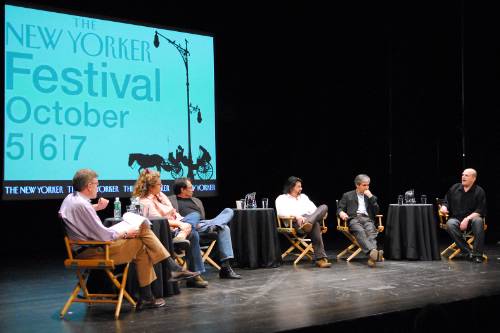
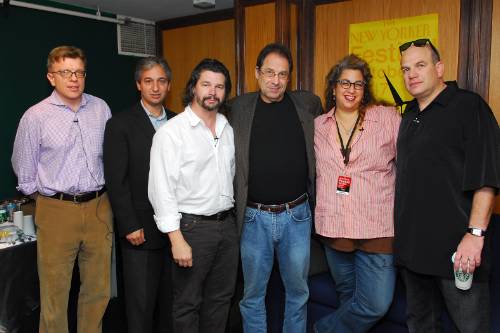
There was no better place to celebrate the current Golden Age of TV—anyone seriously doubt that one is under way?—than at the Festival’s early-morn “Outside the Box” panel, which included the creative forces behind House, M.D. (David Shore), The Wire and Homicide (David Simon), Deadwood and NYPD Blue (David Milch), Weeds (Jenji Kohan), and Battlestar Galactica (Ronald D. Moore).
The panel mostly agreed on the following givens: TV stations want to make money, and it’s good to tell your story and not the demographically dictated story that the higher-ups want you to tell. Halfway through, in full-on Crazy Uncle mode, Al Swearengen, er, Sipowicz, I mean Milch began calling spades spades (and I’ll allow the metaphoricity only if pressed), and it took the combined efforts of the rest of the panel to parry with the behemoth suddenly in their midst. A born thrower of bombs (and not only of the F kind), Milch goosed the audience with his story of a discussion years ago, when the prospect of a black man and a white woman holding hands on the air was still shocking to the network contemplating such a scene. Milch’s solution? Have the man place his penis on the woman’s shoulder, natch. The show duly fired him. The kicker? “That was the last note I ever took.” I bet!
Even more provocatively, Milch brought up the high ratio of Jews not only in show business but also on that very stage (four out of five, by a show of hands). Milch’s thesis being that Jews are well-positioned to be outsiders to the process while also passing for insiders, a tactic often denied African Americans or Asian Americans, for example. But his real point was that the bohemian/suit divide the rest of the panelists were selling was only so much pap. The suits are not looking for art, and they don’t pay for it; they’re looking for people who can give their audience the expected fare with perhaps a small edge or twist to it. For their part, so Milch, every move the so-called artists on the stage make is governed in part by commercial considerations. Better to be candid and abandon the artiste pose.
At times Milch’s positions seemed reductionist, as when he reminded David Simon that the only reason HBO is interested in The Wire is because it wants black viewers. That may be true—what’s wrong with that?—but does that mean that HBO’s frequent mention of the tidal wave of critical accolades directed Simon’s way does not also exist? It’s just as useful for HBO to be able to say it has “the best show in the history of television” (or whatever formulation however many critics have by now driven into the ground), no matter how tiny the actual audience is, a sad fact Simon mordantly referenced several times.
I’ve grown to admire Simon’s mature and ingrained modesty, groundedness, high standards. He’s famous for ripping network fare to shreds in interviews (as in this Fresh Air interview), so it wasn’t surprising that he defended HBO with vigor. It was inspiring to hear his reel off the only people whose criticisms Simon would take seriously: the cops, lawyers, city officials, judges, etc. of Baltimore and similar rust-belt cities. Those people are in a position to say: “You got it all wrong.” He doesn’t care what the rest of us think at all. I love that.
Ronald Moore spoke perceptively about the network’s preference for for one-offs over longer plot arcs, the latter a decided strength of Battlestar Galactica. BG touches on subjects like suicide bombings and therefore, albeit metaphorically, Iraq. Networks always seem to want shows to present and resolve a major social issue in 45 minutes. Since Moore himself doesn’t know how to solve Iraq, it’s more rewarding to present the complexity of the issues rather than pretending that the conventions of televised drama provide that answer.
Asked about product placement, Kohan and Simon were quick to point out that objections in the other direction often arise after the script is written. In Season 4 of the The Wire, gangs of drug-dealing teens realize that the powerful electric nail guns at Home Depot (or the show’s fictional facsimile) are far cheaper than automatic weapons and just as useful for puncturing cartilage. Similarly, in Weeds, one drug dealer purchases seven quiet Priuses—advantageous when sneaking up on “mothafuckas,” an advantage that had not yet occurred to the rest of us.
—Martin Schneider
The Festival, Reviewed by Other Media Sources
The Washington Post account of the Judd Apatow event.
An excellent Huffington Post review of the evening with Junot Díaz and Annie Proulx.
Nice tag-team coverage of several events by the Columbia Spectator, for which Emily once reviewed the debut issue of Allure, among other things.
The New York Observer calls two people conversing a “tiff.”
More sensible coverage of the Salman Rushdie and Orhan Pamuk event, plus a brief mention of George Saunders.
Enthusiast thinks the Voice‘s Rose Jacobs is mistaken (and presumably never saw our take.)
This writer notes much cursing at the Apatow event (she should have heard David Milch.)
An exhaustive and worthwhile account of the Mike Mignola, Jonathan Lethem, &c. comics event.
Is On Chesil Beach a novel? Not his problem, says Ian McEwan.
—Martin Schneider
Festival: Werner Herzog Hates Penguins
Continuous reports from the 2007 New Yorker Festival, by the Emdashes staff and special guest correspondents.
“Is there such a thing as insanity among penguins?†Werner Herzog poses this question to a taciturn biologist seated before an Antarctic field full of the flightless birds. Before the perplexed scientist can fully answer, Herzog cuts to a shot of a lone penguin who suddenly decides to make a dash for the distant mountains. As the shot widens to reveal a desolate, white world dotted by a mad penguin, Herzog, in his familiar solemn narration, asks “But why?†and then informs us that this penguin is certain to meet death.
The scene, from Herzog’s newest film, Encounters at the End of the World, invoked both wonder and laughter from the audience during Saturday night’s screening. Sitting in the row in front of the director, I turned to register the reaction of the German genius to the round of gasps and chuckles. I was curious to see if he would be put off by the reaction. Indeed, the edges of Werner’s lips crept ever so slightly up into a smile.
Billed as a documentary about Antarctica, Encounters is certainly unlike anything else I have ever seen about the frozen continent. Neither a homage to the wonders of the outdoors nor a call to arms to protect our endangered environment, it’s ultimately a dark and existential film. It’s vintage Herzog, who is ever interested in the people who choose to put themselves in the middle of the brutal, unpredictable chaos we call nature. In many ways it picks up where Grizzly Man left off, but instead of focusing on a bear-lover who answered the call of the wild, Herzog spends time with the scientists and lab techs, the fork lifters and mechanics who call Antarctica home.
All the characters, including Herzog, seem to share a Wanderlust. But Herzog is out to debunk the myth of Antarctica as an unspoiled, pristine frontier. Instead he proclaims “the end of adventure.†For an artist who has focused so much energy on studying explorers, the film exudes a deep sense of loss. While the film is something of an elegy, it’s not depressing. In fact, it’s mesmerizing, because Herzog is one of the few artists who can make a compelling film that, to me, is also a profound philosophical discourse.
What is perhaps most surprising is that Herzog’s newest masterpiece will be shown on the Discovery Channel. I am curious to know how it will translate to the small screen, possibly disrupted by commercial breaks. I only wish I could see people’s reactions when they turn on the tube to catch a rerun of Cash Cab or Dirty Jobs, but instead see an extended shot of a man crawling through an ice tunnel and hear an ominous, heavily accented voice state, without a trace of alarm, that “the end of human life is assured.â€
March of the Penguins this certainly is not.
More on the film and the post-screening discussion to come. —Toby Gardner
Festival: The Art of Jumping on Concrete
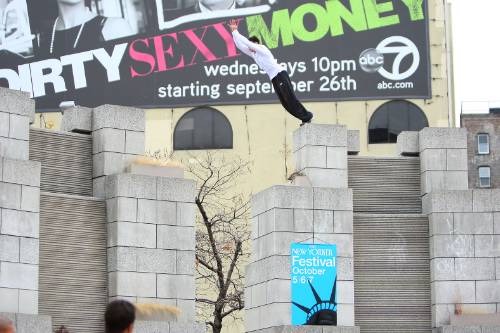
The “Parkour New York” event with David Belle happened at the same time as the Master Class on Profile Writing. I scurried over to Javits Plaza as soon as I could, hoping for a hyperactive last few minutes. By the time I got there, the event was more or less over. As the picture below demonstrates, the location was exceedingly well chosen.
I was due at the Joan Weill Center to see Alex Ross, but I took a few minutes to mill about (and dodge the occasional hurtling body). As it happened, some fellow was in the process of taking an arm’s-length self-portrait with Belle; I intervened and took a more standard posed shot from a few feet away.
Then Belle wordlessly (I think he does not speak English) called for a group photo to commemorate the event. If you ever see any such picture (I’ll be sure to post it if I do), I’m in there somewhere, certain to prompt in the other participants the pressing question, “Who the hell is that guy?”

Fortunately, Jason Kottke was there and therefore is able to provide a much fuller report than I can.
—Martin Schneider
I’ll See You Somewhere in Dreamland
Do you know that magical Max Fleischer animation from the ’30s? (“I’m gonna dunk!”) It’s probably on YouTube (yes it is), and I’ll reward myself with it after I’ve caught up with, you know, my job. All the sleeplessness and doubling up this past week has been worth it, because it was a thrilling festival, inspiring and humbling, and there’s more to say about it. So Martin, Toby, and I (filmmaker Quin and poet and fiction writer Tiffany are done with their reports; scroll through a few pages and read them all) will continue to post till we run out of notes, or until our eyes start crossing, whichever comes first.
Meanwhile, here’s Glynnis MacNicol (I am jealous of your fantastic name) on the Annie Proulx and Junot Diaz event (and Quin’s take).
Another blogger reviews the Lucinda Williams show, and is working on a David Remnick/Semour Hersh and a David Denby/Seth Rogen/Judd Apatow post. I was at those discussions as well—in the same venue and with equally intent audiences, which probably did overlap slightly—so will start working on decoding my elliptical symbols.
Best news of all: pretty soon, a brand-new Ask the Librarians! I saw a lot of stars this weekend, but none compare to Erin Overbey and Jon Michaud, in my book.
Festival: The Art of Seducing Readers
Sunday’s Master Class on profile writing with Mark Singer and Susan Orlean was the best event I saw all weekend. The talk was structured basically as Singer grilling Orlean, in a friendly way, on the process of writing profiles, while Orlean would occasionally turn the tables. As the have been friends for decades, their shared references made it a powerfully informative, probing, and intimate session. The two writers were both so genuinely curious about the other’s process, it was as if the audience were not there at all. It was a truly remarkable session.
What follows is a more or less unstructured selection of observations and quotations.
It was fascinating to observe the many things Singer and Orlean have in common (curiosity, thoroughness, mad typing skills) while approaching very similar projects quite differently. Orlean is warm and seeks emotional connection with her subjects; Singer is more detached, calling his a “deadpan approach.”
Singer prefers to do exhaustive research before meeting the subject; Orlean prefers to learn about the subject in a more haphazard way. Singer made a great point about questions, saying that you should never ask a subject for information that you could acquire independently. In other words, don’t ask “Where were you born?”—ask what it felt like to grow up in Sheboygan. The former is publicly available; the latter is what you’re hired to find out. Orlean saw this differently; as she said, “I write a profile the same way I would go about making a friend,” and you would certainly ask a budding friend where she was born.
More than you would think, a lot of the process of writing these profiles occurs before it’s even agreed that there will be a profile at all. There’s a great deal of negotiating with the subject about access, and many profiles never end up happening at all. Some of Singer’s more interesting stories had to do with unwritten profiles. Since profiles at that stage are so amorphous, the process, later too, is necessarily infused with self-doubt—is this a subject? why would people read this? What am I doing here? And so on.
To counter this, a good profilist needs a compensating sense of worth: As Orlean said, “You have to have the confidence to say, as a writer, that somehow the choices you make are, in and of themselves, justifiable.” A simple and yet elusive point—as the example of a profile she did for Esquire about “the typical ten-year-old boy” demonstrates. She had to assume, on some level, that she was, of necessity, capable of “proving” to the reader that this material worth reading. “I love seducing readers,” she said, starting with a subject that seems of doubtful interest and then winning the skeptic over. She observed that Tina Brown, someone who would normally suggest very well-known people for profile subjects, could never really understand how Orlean achieved her effects (the two women have an abiding friendship nonetheless).
On the subject of editors, both writers were unabashed in their praise—indeed, awe—of David Remnick’s reportorial skills. As Singer said, “He is so good that he can spend a week in Israel and write a ten-thousand-word piece on the flight home,” a process for which the two panelists and most of their colleagues presumably would need far longer, on both the data collection and production sides. That had come up as a tangent on the subject of notes—both Singer and Orlean take copious notes, but Orlean insisted that the writer should be able to tell the story of the piece entirely out of her head, as it were. Until you’ve gotten immersed to that extent, you’re not ready to write. She compared the process to that of telling an anecdote at the dinner table. If you say, “I heard about this car that got stolen, but the owner’s dog was still inside,” your dinner-mates will likely not wrest the floor from you anytime soon. The same dynamic is in play with a successful profile. (That anecdote was the basis for an actual profile Orlean wrote, by the way.)
Orlean raised the question of tape recorders. Singer said that he has used them but hates them, “because then you have to listen to it.” As many people do, he detests transcribing as well as the sound of his own voice. Rather surprisingly, to me anyway, Singer likes to bring his laptop along as often as possible, and will often transcribe conversation with his subjects on the spot. Singer said the best course he ever took was typing, and Orlean laughingly bragged that she types exceedingly well, even better than the well-known Meryl Streep incarnation of her .
I did not know that Orlean did profiles for Rolling Stone for a long time. She explained that the material for a Rolling Stone profile is usually gathered an hour or less, in a hotel room with the subject, a process so truncated that the writer must, of necessity, invest random utterances and actions with absurd significance. (Singer: “The best approach in those situatons is just to shoot yourself before the interview.”) In addition, “nut grafs” are a Rolling Stone requirement: “The Fugees are important right now because …” At The New Yorker, unsurprisingly, things are different. Writers are encouraged to come up with a form and approach that fit the material, even if it means spending weeks with the subject. Singer said that the process is often so attenuated that subjects frequently question whether he is competent, wondering how on earth anyone could ever make a living this way. Orlean offered that she is always grateful that she can spend three weeks not apparently accomplishing much while she gets a sense of the subject at hand.
On the subject of form, Singer referred to his “cinematic” understanding of content, which leads him to use “scenes” to help him structure the material. As he said, “You have to have a really great reason to abandon chronology,” something that Orlean does more often than most. Singer observed that it is very difficult to write profiles about very funny people. There is a constant temptation to reproduce shtick, which never comes off nearly as good in print; such pieces are always threatened by a “you had to be there” quality that is death to a good profile.
Orlean once did a kind of mental tally of the geographical origins of New Yorker employees, concluding that the staff was “overwhelmingly midwestern” (I pass on the information in the interests of sociology). Singer and Orlean agreed that in a city like New York, many good profiles arise out of a kind of restless, pavement-pounding inquisitiveness. See an odd shop? (Orlean’s example was a shop specializing in ceiling fans.) Talk up the proprietor, you’ll likely discover a hidden expert in some arcane subject: “Everybody’s more intensely whoever they are in New York.”
I could easily go on for another ten paragraphs, but I won’t. Clearly, this material fascinates me in a big way. I’ve read a great many profiles in my time, and now I have at least an inkling of how they are put together. For that I am thankful. —Martin Schneider
Festival: Alex Ross Will Get You to Dig Arnold Schönberg
Alex Ross called his late-Sunday presentation, “The Rest Is Noise: A Multimedia Tour of Twentieth-century Music,” an “improvement” on his book, as he would be able to supplement the points in his narrative with musical excerpts, so that we could actually hear examples of composers’ work along the way.
Make no mistake about it: Ross’s presentation was fabulously successful by almost any set of criteria. Simply put, it’s difficult to imagine a human being better suited to the project of explaining the tortuous path of what we might call “serious” music in the years following 1900 to a lay audience. (I can already hear the objections to that word piling up.) If Ross has any plans to reproduce his presentation elsewhere, I highly recommend catching it; it is an experience sure to benefit any enthusiast of any kind of music. If you enjoy the intentional arrangement of aural tones to achieve an effect in the listener, you will probably enjoy this. Further, it is profoundly inspiring to see the high degrees of passion, engagement, expertise, and erudition that Ross brings to the subject.
I combine fairly low affinity for what is called contemporary music (or classical music for that matter) with a high degree of exposure. Staying in the twentieth century only, I’ve seen operas by Janáček, Korngold, Strauss, Glass, Prokofiev, Harbison, Berg, and Britten, and maybe a couple others I can’t think of right now. In all honesty, most of them had a kind of “Isn’t that impressive!” impact on me without really getting me where I live.
All of which either makes me Ross’s ideal audience member or the worst one imaginable—possibly both. For my part, I got a lot out of the presentation. Ross said that his goal was to “defeat any preconceptions” about twentieth-century music, and there’s no doubt he succeeded in that. To take two examples at random, he was able to present both the forbidding and supposedly melody-free clangor of atonal music and the barren-sounding prospect of minimalism in a way that both was memorable and piqued the interest.
Anyway, enough of my yakking. Whaddaya say? Let’s boogie! —Martin Schneider