
If the New Yorker Festival Debate hadn’t ended so early (about 9:15), I might not have bothered hauling my sorry ass out to Gowanus to see Yo La Tengo. I’m lucky I did. Ben Greenman did a fine job ushering the band through an always potentially awkward blend of music and Q&A in a large darkened space. His suggestion of “Autumn Sweater” was particularly genius; that was the high point for me. I saw YLT do a proper rock gig at Irving Plaza years ago, and I must say I prefer the quasi-unplugged variant quite a bit more. YLT trades on its remarkable flexibility—every time you think they’re a step and a half away from becoming a folk band, they bust out a dose of skronk that would rouse even J. Mascis from slumber.
From the interview portions, my two favorite comments came from bassist James McNew (these are very close paraphrases): “An English teacher gave me a copy of White Light/White Heat, and it just broke my mind…. I was like, ‘I hope you realize this means I’ll be flunking your class….'” and, “A lot of the songs I write are messages to present-tense-me from just-slightly-future-tense-me telling me everything will be all right.”
Here’s what they played:
The Cone of Silence
Stockholm Syndrome
Story of Yo La Tango
Magnet (NRBQ)
Madeleine
Autumn Sweater
I Heard You Looking
Pass the Hatchet, I Think I’m Goodkind
This Man He Cries Tonight (The Kinks) (live debut)
Sugarcube [excellent choice for a closer]
(Accurate set list provided by Jesse Jarnow.) —Martin Schneider
Category Archives: New Yorker Festival
Deviant Matters: A. M. Homes and Miranda July
Continuous reports from the 2007 New Yorker Festival, by the Emdashes staff and special guest correspondents.
One of my favorite moments from Friday night’s conversation on deviants between Miranda July and A. M. Homes occurred at the very start. After Homes opened rather seriously by proclaiming that we are all deviants, July squirmed slightly in her chair, turned to Homes seated far across the stage and shyly said, “Um, yeah. I pictured us closer together.†The large audience, generally young and solidly hipster in style, exploded in laughter and, just like that, the tone for the evening was set. Perhaps the physical distance (see photo) partly accounted for the lack of sustained engagement between Homes and July. More likely, it had to do with the two artists’ approaches. While Homes the writer and July the performer never seemed to click entirely, the juxtaposition made for an entertaining evening accented by insights into the unique approaches of each artist.

The fun was no more evident than when July attempted to engage the audience in a trivia contest about Homes’s work. What she thought would be a fun little activity quickly turned humorously awkward. Her first two questions on rather obscure details from Homes’s work were not only met by the audience’s collective silence but also seemed to stump Homes herself. A slightly flummoxed July lightened the mood, timidly saying that she now realized that “no one reads like this unless they’re writing trivia questions.†Homes, who seemed a bit uncomfortable with the whole situation, suggested that the questions should be about July’s more popular film. July asked one final question about a character’s nickname from Homes’s recent memoir, someone thankfully knew the answer was “Dragon Lady,†and order was restored. (The prize? Two well-earned Festival tickets to Saturday’s debate on the Ivy League. )
Oh wait, wasn’t this talk supposed to be about deviants? Despite moderator Carin Besser’s efforts, the conversation weaved in and out of the topic. It turned out to be more of a springboard into some of Homes and July’s fascinating insights into their motivations as artists. Homes spoke about the joy of inhabiting brains other than her own. Beyond sheer pleasure, this act of distancing is actually what enables her to write fiction. She indicated that occupying the mind of a pedophile, as she did in her book The End of Alice, in some sense was easier than simply drawing on personal experience. At the same time, she acknowledged the difficulties of fully stepping outside oneself and spoke of “the inescapability of the artist’s mark.†At one point, after some pauses and false starts, July summarized her artistic intention beautifully, saying she tries to get to the place where mystery is supposed to make sense. She added that, in her work, she is “going beyond getting to have it be correct.â€
The evening became even more intriguing when the subject turned to pen pals. Homes and July have each been correspondents with some rather interesting characters. While Homes had communicated with the likes of Pete Townshend and filmmaker John Sayles (who, in one letter, apparently advised the college-aged Homes to suffocate an annoying roommate with a pillow), July maintained a multi-year correspondence with a convicted murderer (July said he will be released in 2012). With her typical sensitivity and humor, she said, “I was lucky, he was a good guy.â€
Next year’s panel recommendation: John Sayles on deviants. —Toby Gardner
In the Company of Men: Neil LaBute and John Lahr
Continuous reports from the 2007 New Yorker Festival, by the Emdashes staff and special guest correspondents.
Into a venue filled with avid Neil LaBute fans, I committed the grievous sin of arriving late. Thankfully, Neil LaBute doesn’t have a Catholic bone in his body, so, I wasn’t punished by being sent to Limbo and denied access to his chat with John Lahr.
Mormon, misogynistic, misanthropic, male: the first three words are wrongly used when reviews or interviews are written and comments made about the playwright/screenwriter/director. Only the last is true.
LaBute opened the discussion by saying his time on stage with Lahr was better than therapy, and all of his issues should be worked out by the time they were done. He was easygoing, with an affable manner tinged with the sharp wit that is found in his writing—some of which moved past his audience’s heads, then boomeranged back to catch them after a beat or two. He has gimlet eyes that hold down the person he is directing his answers toward and a grin that belies the gaze.
The subject was Men. And there was 90 minutes to discuss it with the man who has created some of the most vile male characters ever seen in film or on stage. For LaBute, the discussion started with the father. His own was a distant man, a hard man, someone who was not easy to grow up with or around—a man frustrated in his own life, who displayed the proper emotions and actions to the world but changed when the doors were shut and the curtains closed. His older brother emulated their father, something LaBute couldn’t do; he says he paid a price for that decision. He said the atmosphere in his home was Pintersque, quiet yet volatile. He had no control there; things there “shifted with the breeze.”
Lahr asked, “When you show us in your work how we are, does it go to the silence of your life?” LaBute’s answer: “I never felt it was my work to draw from that dark place.”
While LaBute grew up in a home that didn’t nurture a playwright, he says, his parents were filmgoers. These days, his mother sees his work in motherly terms; she mentions the language on occasion, and “wishes I’d write more comedies.” He started writing monologues for himself to see if he could fool his teachers into believing they were actual monologues that he’d discovered. Once he put pen to paper, he said, he didn’t stop. Writing gave him something he didn’t have elsewhere: control.
“Wow. I’m really feeling better. How much do I have to pay for this session?” he asked Lahr. Laughter again.
Attendance at B.Y.U, mandated one thing; students signed a paper agreeing to its terms. By the time LaBute had become a graduate student, the love affair between his brilliance and the strict doctrines taught weren’t exactly bound for marriage. They blocked his stage time, and closed theaters to him. In order to stage Lepers, which later became Your Friends and Neighbors, he gave a one-hour exam, then quickly staged the play for its one-time performance. A director friend of mine was part of that audience, his theater experience after returning from his two-year Mormon mission. It’s theater he still talks about, in all of the right ways.
The discussion moved on to the film In the Company of Men. Lahr asked, “Do you feel Restoration comedy and its entertainment and the society of the 1990’s, when you were writing this, had parallels?” LaBute: “I saw the more privileged groups who were taunting me [the audience laughed], but I just couldn’t hear them.”
Clips were shown from the film, starting with the scene where Chad (Aaron Eckhardt) admits to Christine (Stacy Edwards) that, yes, she’d been set up. He is harsh, stinging in the delivery of his words, and you can hear the wind howling in the wound he leaves behind. Apparently, according to LaBute, you were also close to hearing the film as it ran out in the camera.
LaBute said he felt uncomfortable watching the scene, and then went on to discuss the ascetics of the creative process behind the making of a film that got to the pinnacle for all independent filmmakers: the winner of the 1997 Sundance Filmmakers Trophy. On his first film, ever.
“This film isn’t an editor’s film,” he said. “This is an actor’s movie. We didn’t do any cutting back and forth between faces. We did it in one long take. Aaron was starting to worry because he knew we only had a little bit of film left in the camera.” He calls this particular scene, “a textbook of male behavior—lies, charm, and ‘fuck it; it’s too much work. I’m leaving.'”
“On a first film, you stand around and (moves his hands) and say, ‘Oh, fuck.’ Thing is, there are other people standing around saying, ‘Oh, fuck.’ So, you have to have some authority—and you [moved his hands firmly] and say, ‘OH, FUCK!'”
The next scene discussed at length was the steam room scene in Your Friends and Neighbors. The intensity of dialogue is matched by Jason Patric’s delivery when he describes the best sex he ever had, with a young schoolmate, Timmy, who is gang-raped in the showers at school. It, too, was shot in one long sequence, with pick up shots taken afterwards of Aaron Eckhardt and Ben Stiller’s reactions to this revelation.
Lahr: “Something about all of your plays is a passion for ignorance. Pinter hears pauses. You hear something else.”LaBute: “I hear a self-regard. We spin circles in life—back on ourselves. ‘Whatever’ is an example. When people use the word ‘honestly’ a lot, they aren’t being honest at all. We want to connect, but, the cost is too great. We ask people for things we aren’t willing to give. It’s too much. It’s more important to sound interested than to be that way. We ask, ‘How was your day?’ And, when they start to answer, we roll our eyes and think, ‘Oh, fuck.’ ”
The floor opened up for Q & A’s. One young man said he’d started to laugh a third of the way though In the Company of Men when he first saw it.
Q: “What does it take for a man to move from the lying and the way they present themselves?”
LB: A good hour with Mr. Lahr (laughter). I don’t know, really. It’s human behavior. We are good at it. An armour created from youth on. Be strong. Don’t be weak. It’s our culture to come out on top. It that’s our nature…to lose a bit of yourself. To push to come out on top. It’s hard to shed that. You become one with that kind of ethic. I don’t the answers. It’s hard for people to let their guard down.
Q: What’s up with Wicker Man? I didn’t see you at all in the film.
LB: I got into the project because I loved the original. I was asked to give it a go. I kept the concept of a cop, and I took them to a zenith, to a world run by women. The producers wanted something different than I wanted to make.
Q: What is the film rehearsal process and how do you feel about the word “like”?
LB: Like is a serviceable word, and I use it on the page. I like rehearsals. I understand them, the process. I like the process in the theater. You can follow the process in theater, you move from start to finish in a smooth line. In film, what you start out with has to remain that strong seven weeks later. You don’t get the full rehearsal process. Rehearsal is the method along with [at this point, he started discussing yoga, natural foods and this reporter started to laugh. Loudly. Alone. Thankfully, others joined in]. What is going to go on stage…if it’s repeated, will prove if it’s strong or weak with the repeating. Ultimately, when working on a piece we are going to present working on a scene is what it is all about.
Q: How do you work?
LB: No particular clothing or process or food or time of day. I tend to not want to write until I want to write. I tried that, to be disciplined and I threw it all away. I wander around with plots and characters in my head and play devil’s advocate. You look for reasons not to see it through. If they stay with me, if after a year, I still have them in my head, I suddenly start writing dialogue in a hurried frenzy—I don’t do breakdowns of plot—I write. Sometimes, you get to page 50, and think, “There really should be a plot by now.” It’s the most exciting way I’ve found to write and by transference, a way to excite the audience.
Time was up, we all exited, leaving me with a wealth of my own questions, and a greater respect for an artist who produces amazing work. I wish we’d had another few minutes, which would lead to a few more and a few more, and the man would never get another thing done. But, he’d have his issues worked out thanks to John Lahr, I’d be entertained, and in the end, it’s really all about me. Or so I’d like to think.
—Quin Browne (Read more about Quin.)
Festival: Canuck Topples Hoser in Ivy Debate (or Possibly Vice Versa)
Well, the first annual (I hope!) New Yorker Festival Debate has come and gone, and to call it anything less than an unmitigated success would be a sham. I was seated up front at the Society for Ethical Culture, by chance nestled among some of The New Yorker‘s more elderly readers; the woman next to me, as an example, wore an expression of pure glee the few times I ventured a peek. If the Member from Gopnik and the Member from Gladwell (as the convention required they call each other) don’t collectively become a 100% Canadian staple of the Festival, then the world just doesn’t make sense. Attention programmers! I want to see these two debate a year from now! Got it? Good.
Gladwell, defending the proposition that we should disband Harvard, Yale, and Princeton (Gopnik frequently questioned this circumscribed definition of “the Ivy League”) and use their endowments to “purchase Canada,” had a difficult task insofar as he was defending an outlandish proposition for which there happens to be a great deal of supporting data. Gopnik, by contrast, could appeal to normalcy and reason without any data at all. However, the tone of high whimsy sustained by both Members was a joy to behold.

I prefer Gladwell’s rational moralism to Gopnik’s intuitive pragmatism, but I give Gopnik credit, though—he is quick. Hardly had Gladwell evoked the French Revolution than Gopnik took the opportunity to enlist the (already sympathetic) chair, Simon Schama, author of Citizens. Our very moderator wrote a freaking book on the Terror, Jack! (Short for Jacobin.)
My favorite bit was when Gladwell shamed the Ivy League’s rank naked elitism by quoting a federal investigation of Ivy League admission practices in the 1980s. (I’d like to see more of the fruits of that investigation—I assume Karabel has the goods.) According to notes found in applications, Harvard admission officials dismissed candidates for being “shy,” “frothy,” and “short with big ears”—and then pointedly implied that the Member from Gopnik must surely take some comfort in Gladwell’s implicit defense of those groups.
Schama took on his role as arbiter in the spirit of a mad uncle or possibly a court jester; he amusingly bristled at his employer Columbia’s exclusion from Gladwell’s “Ivy League First Division” of Crimson, Bulldog, and Tiger (Gopnik’s preferred satirical term was “Axis of Evil”). At one point Schama leapt up from his central table and, using the Member from Gopnik as a sort of meat puppet, contributed a point of fact and called the Member from Gladwell a “dunderhead.” Hardly the cool impartial magistrate such august proceedings demand.

As Gladwell predicted, Gopnik was charming and almost dangerously persuasive—or, I should say, as persuasive as baldfaced appeals to emotion can be. Gopnik used a maximalist strategy wherein any agenda to disband Group X can be assumed to take its most extreme form at all times. Gopnik likened the Member from Gladwell to Pol Pot, a comparison Gladwell confessed he found “flattering.” Gopnik saved perhaps his shrewdest—indeed, possibly difference-making—move for his final statement, enlisting Bill Clinton for his cause and aligning George W. Bush himself with the Member from Gladwell. (Gladwell had to roll his eyes at that one; he might have sensed that defeat was nigh.)
In the end, Schama peered into the audience’s show of hands and pronounced the proposition defeated. Harvard, Yale, and Princeton can rest easy—for now.

—Martin Schneider
Festival: The Compelling Samantha Power
Wow. The Samantha Power presentation on Darfur was just phenomenal. It actually felt much more like a New York Conference event (at least judging from the online videos). It’s rare to see a speaker on a complex subject also speak, often ex tempore, very complexly and yet quite clearly and more than that, with rhetorical resonance.
Her talk had three parts — the situation in Darfur, solutions to the problem, and structural qualities that may hinder or help the efforts of well-intentioned people. I won’t try to reproduce the facts on the ground in Darfur — other sources can do that more accurately. I will attempt to summarize what I got out of the other parts of her presentation. None of this should be taken as quotation; I did take notes, and in some places will be attempting to reproduce her pithy wording. But my notes are imperfect, so just don’t take any of this as her exact words.
I gather that Power is now aligned with Barack Obama in ways that can’t relate to her job as a reporter. She sprinkled in a dozen stray references to the importance of electing Obama president. This is instructive for a few reasons, which I’ll get to. (As it happens, I agree with her on Obama.)
She has apparently been spending a lot of time in Obama’s Senate offices, and she found it illuminating to witness constituent influence on the actual activities of the office. Every day, according to her, someone would present a tally of the calls on a variety of subjects, and it was a given that any subject getting a large number of calls would have to be dealt with quickly. This was not limited to Obama’s office, which is presumably well run. Her point was that, difficult as it may seem to believe, when you call your local congressperson or Senator, it matters. They are listening, and if there are enough calls someone will go off and at least put out a statement. It may not sound like that much, but forcing them to get on the record is far from nothing. If something matters to you, call your elected representatives — they will be forced to take action.
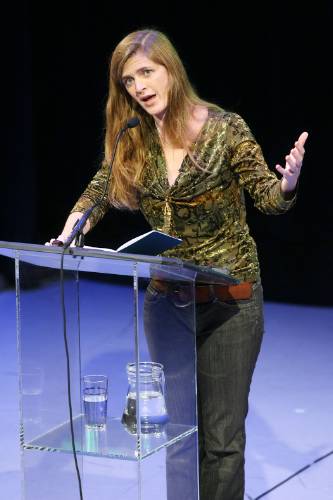
According to Power, this system of direct popular influence is almost unique to the United States (her actual point of contrast was Europe), and it is practically the only reason that the United States, even in its laggardly form, is one of the global leaders in the struggle to help Darfur. Power said that President Bush has mentioned Darfur far more in public than any other western leader, and that is purely a result of pressure bubbling up from citizens who want to see action. In addition, despite abiding GOP hostility toward to the International Criminal Court, there has been so much domestic pressure on Darfur that John Bolton was forced to give his kiss of approval to certain international actions intended to help Darfur.
In addition to nagging elected officials, there are also some interesting techniques that some younger activists are trying. One group is issuing “genocide grades” to congresspersons. (Missing big votes about genocide is a sure way to an F.) And it’s working. Some flunking representatives and senators have explicitly sought to raise their grade. If you have any kind of stock holdings, especially mutual funds, You can also call and ask to have Darfur-related stocks removed. “Divestment” is a big term in this field, and that’s also something you can pressure your elected official about.
In some ways the talk was “really” about the reduced prestige of the United States and the increased prestige of China. China is one of the major reasons that it is difficult to make progress in Darfur. China has major petroleum holdings in Sudan, so it is blocking efforts to stop the violence in Darfur. Basically this is just a fact of life we have to get used to (China is important), but we should also not forget that China can be shamed into action because it is very careful not to harm its prospects in the long term. It is possible to get even China to do things it doesn’t want.
It’s depressing to contemplate our reduced prestige, the primary effect of which is a palpable moral vacuum in the international arena. It’s sobering to realize how much damage the war in Iraq has done on this score, it is now simply a chip that countries with their own motives (let’s say, France, which has its own energy deals it is pursuing) can use any time they want to ignore U.S. exhortations on such subjects. The vacuum also extends to the UN Security Council, where a more influential China and a chastened United States mean continuing disarray in many parts of the world.
Back to Obama. All of this last stuff is the reason that Obama as president might be able to do so much good. Symbolically, he would send the right message to the rest of the world that we are ready to put the Bush presidency behind us, and Obama would doubtless take many concrete actions consistent with that. However, as Power pointed out, our problems are not limited to Bush; they extend to the domestic forces that put Bush in office. Similarly, while it is possible to imagine the United States taking a wide array of actions necessary to coexist in the world, it is difficult to imagine that happening without retwriting our national DNA. It will be interesting to see what kinds of actions have to happen on the international scene (I refer to proofs of our decreased prestige) in order for us to put our own chauvinism behind us and regain the good will of our erstwhile international allies. Power quoted someone (didn’t catch the name) to the effect that “the United States has to learn to become a team player even when it’s not the team captain.” Hear hear.

—Martin Schneider
Festival: The Medicine of the War in Iraq
It was an interesting thing, attending an event about the war in Iraq in which neither Bush’s policies nor the propriety of the war ever really took center stage. The subject was the medical side of the war. There was not a hint of “controversy” in the room, if anything the tone was deferential, quite properly—I’m sure there is unanimity on the question of whether our soldiers merit the best care we can possibly provide. Atul Gawande’s guests were Colonel John B. Holcomb, commander of the U.S. Army Institute of Surgical Research in Texas, flanked by Major L. Tammy Duckworth and Captain (Ret.) Dawn Halfaker, two veterans who lost limbs in separate incidents in 2004.
Tammy Duckworth’s name may be familiar, as she narrowly lost the race for Illinois’ 6th district in 2006. (From the sound of it, she hasn’t yet given up her ambitions for public office; she is now serving as director of the Illinois Veterans’ Affairs Department.) Having lost both of her legs, she appeared on stage with two prosthetic legs, only one of several options the VA has made available to her, including various types of wheelchairs. Dawn Halfaker was on a police patrol when a rocket-propelled grenade tore her Humvee in half. She lost an arm — were it not for her Kevlar armor, the injuries would have been far worse. She attended without her prosthetic arm, observing that wearing it can be a drag.
It’s important to note that both women displayed all sorts of traits common to all soldiers, wounded or unwounded, male or female, by which I mean wit, perceptiveness, pride, honor, and the like. Dawn made an acute point about the lot of female combat amputees: knowing that others are likely to interpret them accurately, a male veteran wears his scars with pride. Since fewer people immediately assume that a lost arm occurred in Iraq, a woman is more likely to cloak the amputation with a prosthesis. Tammy added, “I’m proud of my scars. I’m proud of my wounds. It’s not like it was a bar fight,” although she occasionally does jest in the latter vein: “You should see the other woman.” At one point Tammy displayed one of her “bar tricks,” swiveling her somewhat Terminator-like shin to a vertical position such that her foot could easily support her glass of water.
Not all audience members regularly encounter recent veterans (I am among that number). It was especially interesting to be reminded of the soldier’s quite proper ability to compartmentalize. Tammy has disagreed with the war all along, but as a service member, she was bound to follow the decision of the freely elected commander in chief, and was proud to do so. Tammy continued (paraphrasing), “If you disagree with the policy, it’s your duty to take it up with the politicians, and elect them out.” Dawn’s attitude was remarkably similar, if less inherently oppositional. Both described the bodily disfigurement as an “acceptable outcome” of battle—a seemingly strange position until you realize that a soldier lives with the daily possibility of instant death or capture by a sadistic enemy. This was a sobering and informative event, to say the least. —Martin Schneider
Jonathan Franzen and Anne Beattie: The Crotches of Others
Continuous reports from the 2007 New Yorker Festival, by the Emdashes staff and special guest correspondents.
The magic began late, in a frigid warehouse of folding chairs. My guest and I had been gazing for several moments at the cheery yellow New Yorker projection when Jonathan Franzen lurched out, accosted a chair, and bullied himself into a seated posture. Under the guise of switching off my cell phone, I nabbed a shadowy but unmistakable pic of the one-man discomfort zone.
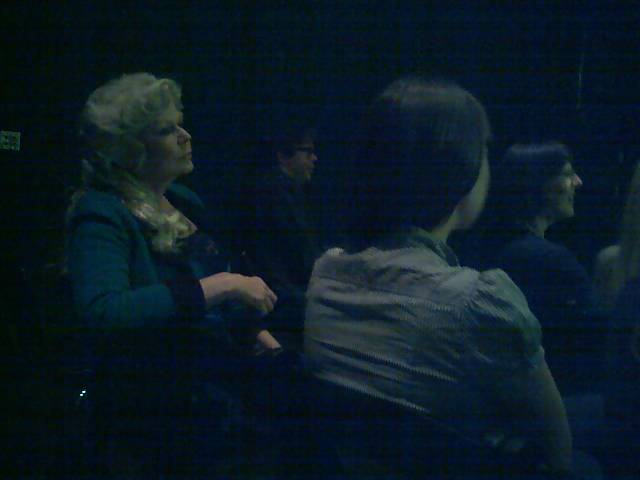
Far from the chap zipped into a bulky brown tuxedo at a Poets & Writers party a few years prior, Franzen 2.0 was sleek and Queer-Eyed in a well-cut grey suit jacket, pressed white shirt, and whiskered dark jeans. Why was I gazing at that section of the Franzen anatomy, you ask? Why, simply because I grew up during the Girbaud era and have never quite kicked the habit of allowing my eyes to graze the crotches of others for that small horizontal tag. Only this and nothing more.
The anemic moderator gave us an unsourced (I suspect Brian Greene) overview of string theory and the microgeometry that hides the other nine dimensions from our sight, comparing the microgeometric force to an Ann Beattie story. Ann Beattie herself loped up to the Lucite podium and introduced “Skeletons,” a “Halloween story.” Like a good 65 percent of her audience, her person was lanky and aquiline, hair a slight frizz. The story began with a lengthy description of an outfit no one should wear: sweatpants and a Chinese jacket. There was someone named Garret and someone named Kyle, and Linda, who was engaged to one of them. The odd fellow out was a Mormon, and his identification as such constituted the great humor of the story, according to the audience, who expulsed their first collective chuckle when the landlady of the story printed “Mormon” at the top of his telephone messages. Somewhere in the microgeometry of the story, Linda was a child again, in a skeleton outfit, leading some boys forward with a pumpkin flashlight; not much later, she was appearing in a ghostlike vision to the Mormon (heh heh heh) at a gas station, just before a crash. Feeling thoroughly tripped up by the many strings, N’Sync-style, I gave up and allowed Ann Beattie’s level alto to lull me into a passive fugue. Only the tetchy observation, to my guest, that characters should never be English majors or in therapy, roused me. Jonathan Franzen’s presence crackled nearby, gulping and grasping for water and replacing the glass.
After a flurry of academic applause for Ann Beattie, the moderator ambled up for a bizarrely tepid praise session of Le Franz. He joked, unsuccessfully, that our chap was an “up-and-comer” who wrote “mammoth undertakings,” and extolled him further as a “guest star on the Simpsons.” No string theory or geometries, micro- or macro. During his introduction, Franzen himself appeared to be folding himself into his torso, and had the air of an unengaged student. Putting off his approach until the last second, he finally hauled himself into the air, only to bend a second time to retrieve his glass of water, which was stowed modestly under his chair.
Several copious throat clears preceded a tousled, boyish, “Hi.” A greyed wing of Franzen fleece fell rakishly over one eye as he grinned frightfully and paid tribute to Ann Beattie’s work as “effortless, heartbreaking, and humane.” His cadence grew easier as he warned that his next story would be 32 minutes long and “unpleasant.” Centering on the relations between a detestable couple named Betsy and Jim, the trademark Franzen forked tongue delivered some splendid one-liners. In the moment, something was delightful about the sentence, “She had never spent a day with someone she disliked as intensely as her husband,” and the observation that Betsy and Jim are “each obliged to the other for overlooking so much.” Titters accompanied observations about how the indolent couple declines to participate in the battles for the best prep schools and allows their children to consume soft drinks. “Perfect characters for the New Yorker crowd,” observed my guest. The story swelled with the adipose tissue of an empty nest, an affair (Jim’s), and Franzen’s own nettled compassion for the characters. I revised my previous decree against characters in therapy when Franzen narrated Betsy’s visit to a therapist named Frank Clasper (here I pictured a salesman of the overly sincere variety). From Dr. Clasper emerges the pithy, Protestant observation about why Betsy’s brainy, acerbic older sister was preferred over Betsy, the pretty one: good looks are a symbol of social injustice and unmerited privilege; brains are something one works at. Resentful of being forced to talk, and wary after finding white dog hairs in her dog-less apartment, Betsy eschews the incisive clasp of the Dr. for a human “vending machine” of psychopharmaceuticals. On her way home from a visit to the vending machine, Betsy sees a Jack Russell terrier (aha, white hairs!) gazing intently into a bookstore window. She follows his gaze to the broad back of her pinstriped husband, standing in the fiction section (!) and clasped at the armpit by a younger version of herself. Enraged, she spits upon the dog, twice, and returns home, waiting to confront her husband. Franzen earned a hearty round of New Yorkerian guffaws for his observation that Jim laughs at Betsy as he does “at Democrats.”
At the finish, Franzen’s pleasant ease dropped from him like a pair of sweaty gym shorts. During his descent from the stage, I noticed a tender but insistent belly pushing out the pressed front of his button-down. Adipose tissue aside, he regained his chair as if he had been tasered and began to hunch actively.
The Q&A were full of the typical inquiries–who inspired you? What’s a typical writing day for you? An elfin sycophant with a handlebar mustache skipped whimsically to the mic and inquired of both Beattie and Franzen what they felt was their best work. Beattie replied that she was largely unable to judge and was never entirely happy; Franzen quipped that “‘like’ was not a verb that had [his] work as predicate.” His best work, he said, involved the rare moments when he said something sincere, that he still believed, and didn’t sound stupid soon after it was written. His tone suggested that the quantity of such somethings were not tremendous.
One sycophant, who purred that he was a “huge” fan of “The Corrections,” informed Franzen that he had a “pretty good idea” of why he used the name Aslan for the drug in that same, being also a “huge” fan of Narnia. At this point, Le Franz needed only an air sickness bag to bring his posture to full fruition, but he responded with a cordial invitation to the Narnian to interpret the reference, assuring him he could probably do a much better job than Franz himself. The sycophant deferred for a nanosecond before prattling that Aslan was a Jesus figure in Lewis’s “Chronicles,” and that Franzen had probably been making the point that the psychiatric drug was the messiah of the 21st century. He grinned, proud as a graduate reading his thesis to Mom. Franzen looked mildly tickled, and answered that even if that was what he meant, he would never admit it in public. The sycophant was seated, no doubt still feeling clever.
The requisite question about technique: what were the more difficult points for each? Beattie answered seriously that dialogue was easy, but transition and exposition were still challenging. With time, she added, she had developed a more innate sense of how to move through a story, rather than basing every story on its predecessor. Franzen approached the question with typical self-deprecating drollery, professing an unwareness, for the first five years of his writing career, that anyone would actually read what he wrote, which resulted in copious pages of writing that “only their father would love.” He described one afternoon where he saw the light and began slashing pages “in big chunks.” Aslan, the “six different layers of symbol and allusion,” and the “great, colorful, metaphorical, two-page paragraphs fell away.”
Outside the venue, a waxed black limo (license plate: MUSICP) waited, a “Franzen” sign taped to the window under the driver’s nose. I did not, for the record, jump into the back seat like a Motley Crüe groupie.
—Tiffany De Vos
“She Was His DNA”: Donald Antrim and Colm Toibin
Continuous reports from the 2007 New Yorker Festival, by the Emdashes staff and special guest correspondents.
The remarkable thing about New Yorker Festival events is their unique ability to bring together seeming diverse writers, only to find out they have a similar approach to the same issue. Two writers, both brought into the venue to discuss mothers; two men who saw their mothers in a different light.
The first, Donald Antrim, is the author of The Afterlife, a memoir about his mother. He openly admits he hated her at a number of points in his life, and it took therapy and this book to bring him to a point where he could deal with his feelings. He likened her to a resistance fighter—a woman who was forced into a mold she didn’t want by a woman she didn’t like. His mother was an alcoholic who got sober in the last part of her life, a woman who always insisted they were both artists. She created clothing of unusual design, shape, color, form, the subject of one of his New Yorker essays that’s also in The Afterlife.
Until this book, he said, he’d never written about “mother” in any of his novels. When he first started the book, he had no plans on publishing it, he told himself. He ran it past his family before it was published, and everyone was okay with how it turned out. He now misses her at times. And this is good.
Colm Toibin grew up with four siblings and a mother who would say, “Oh, if I’d have known about birth control, there’d have been none of you.” She was, as he put it, an absent mother. He never felt she knew anything about him, nor paid any attention to what he said or who he was. It was when he was driving her one day, and she said, “You drive like you are—you are constant,” that he realized she’d ever noticed him at all. He was quite pleased with this kind of non-attention, which allowed him to go about his business as a teen in a household where the older siblings were gone, his father had died when Toibin was 12, and he and his younger brother were still there with their mother. He puts her in most of his work, and never plans on writing directly about her. He’s killed her off, married her, put her away—done everything to her on the page. She always pretended that she was not the source of the mothers in his fiction, and he helped her maintain that fiction about the fiction. He spoke of the ebb of grief that still will sweep over him, of how he misses her still. There was no love or hate, their relationship was limbo; still, she was his DNA, his pulse, and he wishes her back.
The two approaches to mothers was unique, yet both men held their mothers in regard in different ways. One, Antrim, was fascinated that his mother had turned out to be the artist she’d claimed to be, even if he cannot keep her art on display, since the pain associated with its creation is too intense. The other, Toibin, laughs at the fact that the only coming out he ever did was out the front door. Both seem at ease, in their own way, with their relationships with their mothers, who happened to die a few months apart from each other. Mothers and sons. Intense, deep, complex relationships. Books are written, plays, films. And we sit in a small venue and listen to two men give their up their memories of their lives with their mothers. Some funny, some heartbreakingly sad. Women who shaped how they write simply by bearing the name “Mother.”
—Quin Browne
With All Due Respect to the Village Voice’s Rose Jacobs
The Seymour Hersh and David Remnick conversation—and this was the definition of conversation between rational, impassioned, frustrated, symbiotic people—had no relatonship to the predictable literary back-patting that Jacobs conjured up in her recent case against the New Yorker Festival. The subjects, debates, predictions, revelations, and suggested solutions in this talk were among the most vital in the world, for all of us alive on the planet now and for however long we’ll permit ourselves to remain. This is an event that should be transcribed, put on YouTube [it’s now on newyorker.com], and seen by anyone who cares about Iraq, Iran, the state of journalism, the value and health of the military, and the morality of the global decisions made by our administration.
2008 ticket of choice at the next table over (they were at the Hersh talk, too) at the 56th St. Starbucks: Gore and Obama.
“It’s Literary Women That I Drive Hours to See”: Annie Proulx and Junot Diaz
Continuous reports from the 2007 New Yorker Festival.
The audience who gathered for a reading from these two authors was a human Chex mix: bits and pieces of every group were there to listen to Annie Proulx and Junot Diaz, who write in different styles, have different cultural backgrounds and different styles of writing, and clearly respect each other a great deal as friends and as artists.
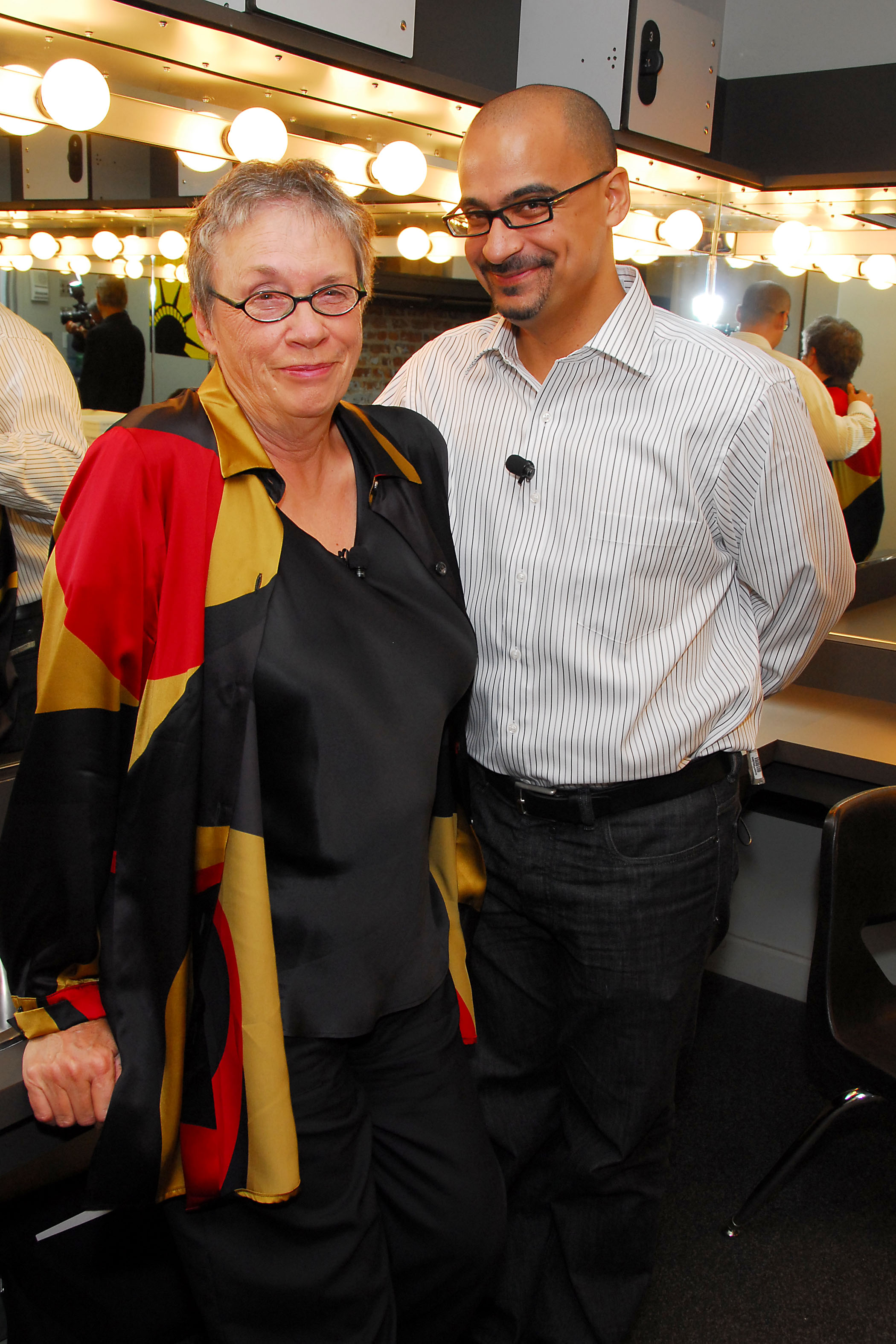
High energy abounded. “It used to Mick Jagger that got me excited,” said the woman next to me. “You know, rocker boys. Now it’s literary women that I drive hours to see.” Junot Diaz read a short paragraph from his novel The Brief and Wondrous Life of Oscar Wao—a paragraph in which, once again, his protagonist was being beaten up. He was self-deprecating as he read, apologetic to the audience, as if we wouldn’t enjoy his beautifully constructed sentences and wordplay. He was mistaken.
He talked about the fact that he continues to write short stories about humans and their failings in relationships. “As long as you keep cheating, I’ll keep writing.” he said. To prove this, he read the story of Alma and her lover; Alma has long arms, beautiful legs, and “an ass that exists beyond the 4th dimension.” Alma is all her lover isn’t, but as much as he loves being with her, he cheats on her, writing it all in his journal—which she finds. It’s not the journal that is his downfall, though, but the lie he tells to explain the contents that end it all with the delectable Alma.
Annie Proulx spoke briefly of the book she’d just finished about Wyoming’s Red Desert. When asked by a friend to write the text in his book of photography on that part of the country, she was surprised to find nothing written about it, and it became her next project to produce a book of short stories set there.
As she was researching the book, someone asked her to fill the chasm in sagebrush stories—less than a dearth, there have been none till now—and that brought about the short story she read next. “The Sagebrush Kid” is about the Sandy Skull stagecoach station, run by Mizpah and Bill Furr. Unable to have children, thwarted by eagles and coyotes not understanding that the piglet and dressed-up chicken were substitute children (you had to be there), Mizpah adopted a special sagebrush, and fed it gravy and bones and, well, that sagebrush grew and grew. While it grew, the station gained a reputation of, shall we say, not a place you wanted to spend the night.
Laced with the wonderful richness of language Proulx uses in all her work, we heard sentences that were spectacular in their music and accuracy: “He would buy cattle for a song, fatten them up, then sell them for an opera.” The story ends years later, with the understanding that the Sagebrush Kid has a cousin somewhere, and her name is Audrey.
The Q. & A. that followed was brisk, with both authors advising other writers to remember that fiction has to be disciplined, very structured and organized. Diaz said he felt that Proulx respects humanity, and that he’s a “self-hating boy,” because Proulx treats both sexes equally in her writing and doesn’t allow her subject matter to be defined by her sex. It was obvious that despite their differences, both writers have a great deal of admiration for each other, and that made for a cozy, stimulating evening.
—Quin Browne (Read more about Quin.)