
_Pollux writes_:
This year marked my first-ever _New Yorker_ festival. It was also my first time in New York City, unless I count a stopover on the way to South America and the time I was there to mark my second birthday.
More momentous than my second birthday, which involved plucking buds off a large potted plant in a hotel lobby, was my introduction to my first event at the festival: short-story readings by “T. Coraghessan Boyle”:http://www.tcboyle.com/ and “Mary Gaitskill.”:http://en.wikipedia.org/wiki/Mary_Gaitskill
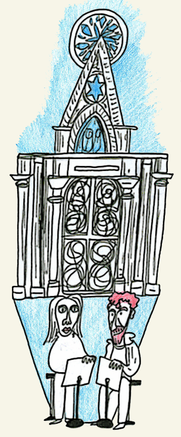
The Angel Orensanz Center is a beautiful venue, a Gothic Revival synagogue whose upper reaches were illuminated by a soft blue light, giving the impression that one was in the open night air. Candlelight illuminated the stage, which was occupied by the two literary luminaries.
Gaitskill went first, and read the touching “Don’t Cry.” Boyle then read his funny story “The Lie.”:http://www.newyorker.com/fiction/features/2008/04/14/080414fi_fiction_boyle
The moderator, “Branden Jacobs-Jenkins”:http://www.newyorker.com/online/blogs/books/branden-jacobs-jenkins, joked that the shared theme of the evening was “Babies in Danger”: Gaitskill’s story featured a character named Janice facing dangers in Addis Ababa as Janice’s girlfriend attempts to adopt a baby in the city, while Boyle’s “The Lie” is about a man who plays hooky from work by claiming that his baby has just died.
In the Q&A session following the readings, Gaitskill remarked that writing novels for her is a more difficult process than writing stories, since novel-writing leads to a tendency to go all over the place, like “a confused dog in a field.” She commented that with a short story, she could “aim her brain” in order to compose a shorter, and tighter, piece of work.
The two authors were also asked about the act of reading their stories in front of an audience. Boyle said he likes to read stories that have a complete story arc. He added that he never writes anything for the specific purpose of reading it before an audience, but that the actual rhythm of the words as they are read aloud is just as important as their meaning. He likes to give a good show: “Art is entertainment.”
For Gaitskill, public reading is an opportunity to turn impersonal words into a performance. As she pointed out, public reading uses our most primitive musical instrument of entertainment: the human voice.
With public reading, Gaitskill said she can directly relate to her audience, and customizes her readings to specific audiences. She likes to emphasize certain words depending on her audience, making certain words harder or softer, for example.
Both authors were asked about the film adaptations based on their work. Gaitskill talked about “_Secretary_”:http://www.secretarythemovie.co.uk/html/home.html, which was adapted from one of her stories (the initial short story idea was inspired by a newspaper clipping) and the frustrations and challenges surrounding it.
There was a discussion on internal dialogue, which in a book can be represented or described. In a film, internal dialogue is, for the most part, sacrificed, sometimes to the detriment of plot or the larger meaning of the original work.
It was commented that moviemaking, ultimately, is a group project. The writer has to live with the sometimes dramatic changes involved in the metamorphosis from book to film.
As Boyle, whose novel “_The Road to Wellville_”:http://en.wikipedia.org/wiki/The_Road_to_Wellville, was adapted into a film starring Anthony Hopkins and Matthew Broderick, aptly put it this way: a film is just a like a musician doing a cover of another artist’s song. It’s just a version, and you can’t control it.
Boyle revealed that “The Lie” will also be turned into a film. According to this “blurb”:http://news-briefs.ew.com/2009/10/16/joshua-leonard-of-humpday-to-direct-t-c-boyle-adaptation-the-lie/, it will be directed by Joshua Leonard of _Humpday_ fame.
It was a stimulating evening, and a great introduction, for me, into the minds and mentalities of the participants (both audience and presenters) involved in the 2009 New Yorker Festival.
Category Archives: On the Spot
The Element of Doubt: The Art of Reportage at NYU
Jonathan Taylor writes:
At Tuesday night’s symposium on Ryszard KapuÅ›ciÅ„ski and “The Art of Reportage” at NYU, Alastair Reid read from an address he said William Shawn had given in 1979 to The New Yorker‘s “business side,” which Reid said might not previously have “seen light of day” outside the magazine. Describing what the magazine’s editors looked for in a writer, Shawn cited the presence of “style”—a “literary quality,” even amid the straightforwardness and simplicity demanded of factual reporting. “Writers who don’t sound like nobody, and don’t sound like anybody else” (or quite nearly those words); “honesty” and “soundness,” not just, or even principally, of factual accuracy, but of “character that shows up in the writing.”
Reid was one of three speakers on “Literary Reportage Between Self and Other, Fact and Fiction,” the second of the evening’s two panels, discussing the role of the first-person narrator, the “I,” in the credibility of long-form narratives. He made an elegant and muscular case for the primacy of the literary quality, of the journalists’s voice, over the pretense to “objectivity.” He quoted Claud Cockburn’s attacks on fellow reporters for purporting to gather “facts” as if they were “gold nuggets” on a “frozen ground,” and Borges (a frequent interlocutor) on the chasm between called “lived reality” and “word reality.” He brought a refreshing lack of hemming and hawing on the subject, given that his subject was, in fact, the element of doubt that should be at the bottom of the reporting enterprise.
Moderator Lawrence Weschler interposed with a complicated anecdote of an observation by Andrew O’Hagan, to the effect that only in fiction can everything be immune to doubt, and that in nonfiction there is always the question, Did it really happen like that? Weschler, upon once recounting this observation, was upbraided by Janet Malcolm, insisting that it was, in fact hers, in The Silent Woman :
In a work of nonfiction we almost never know the truth of what happened. The idea of unmediated reporting is regularly achieved only in fiction. When Henry James reports in The Golden Bowl that the Prince and Charlotte are sleeping together, we have no reason to doubt him, or to wonder whether Maggie is “overreacting” to what she sees”….We must always take the novelist’s and the playwright’s and the poet’s word, just as we are almost always free to doubt the biographer’s or the autobiographer’s or the historian’s or the journalist’s. In imaginative literature we are constrained from considering alternative scenarios—there are none. This is the way it is. Only in nonfiction does the question of what happened and how people thought and felt remain open. We can never know everything; there is always more.
Adrian Nicole LeBlanc was brimming over with the doubts posed by her reporter’s point of view in her current project, a book about stand-up comedians. In the Bronx of her astonishing Random Family, her status as a journalist was of little account apart from her writings’ potential to alert the law, or social services. That reportorial tour de force left her unprepared to manage her point of view amid the blandishments of a entertainment industry determined to control her reporting, and comedians determined to control her as an audience (mirroring her own performance for readers). Her remarks discreetly raised the question of not only the journalist’s “I” in reporting, but the journalist as “we” and “you”—the degree to which much journalism is preoccupied with itself (the event itself included).
LeBlanc appeared reluctant to welcome Reid’s liberation from the fact-gathering model, saying “I believe there is a world of comedy” and that it’s her job to delve in and bring out “the information.” But—citing Joseph Mitchell’s Joe Gould’s Secret as a model along the way—she demonstrated how much rests with her “I,” in explaining her doubts and struggles on how to present that information, and whether, or how much, to take the reader along her own path through the story. That path, she said, was made only possible by her own extreme depression at the time, a condition made the comedians genial company. But her emergence from it has created a new distance from her subjects.
Ultimatlely, LeBlanc said her goal in reporting is that the people she writes about will recognize themselves, and that readers, if they were able to discover the backstory of the writing and editing of the book, wouldn’t feel betrayed.
Drawing swift chuckles from Polish-speakers in the audience before the translator conveyed his remarks, Polish reportażysta Wojciech Jagielski referred to communist-era journalists’ habit of critiquing the regime indirectly through writing on seemingly innocuous topics, exemplified by KapuÅ›ciÅ„sk’s writing on Ethiopia or the Shah. Jagielski said the habit dies hard for him; even if it’s not a matter of covert doublespeak, it’s still vital that his journalism be about “something else” in addition to the local events being described, be they in Chechnya or Uganda. He said he found that “other” subject for his book on those countries and others, in the inscription on a gravestone in the Caucusus: He who thinks about the consequences will not become a hero.
An account of the evening’s previous panel, “On the Ground and On the Page,” will be in a future post.
Beyond the New Yorker Festival II: ‘The Art of Reportage’ at NYU
Jonathan Taylor writes:
In my last post, I mentioned attractive anniversary readings being put on by New York Review Books Classics. I also want to note another upcoming event at NYU on “literary reportage,” which inescapably includes a lot of New Yorker contributors: Alastair Reid, Adrian Nicole LeBlanc, Lawrence Weschler, Philip Gourevitch, Robert S. Boynton, Eliza Griswold and Elizabeth Rubin. And in addition, Suketu Mehta, author of the awesome Maximum City: Bombay Lost and Found.
The October 6–7 symposium takes as its point of departure the renowned, and debated, work of Ryszard KapuÅ›ciÅ„ski, some of which itself appeared in the magazine. This 2007 memoir of his first trip abroad—to India as a reporter for Poland’s Sztandar Mlodych (The Banner of Youth) in 1955— is freely readable online.
Full release after the jump:
AFTER KAPUŚCIŃSKI: THE ART OF REPORTAGE IN THE 21ST CENTURY
A 2-DAY SYMPOSIUM
October 6-7, 2009
NYU’s Hemmerdinger Hall
100 Washington Square East
Subway: West 4th: B,C,D,E,F,V; 8th St: R,W; Astor Place: 6.
Free and open to the public on a first come, first-in basis.
This two-day symposium offers an exciting public conversation about
the state of the art of reportage amid a rapidly changing media
landscape, various approaches to and practices of long-form and
literary journalism, and the ongoing legacy of renowned practitioners
like Polish journalist Ryszard Kapuściński. At a time when categorical
differences between fiction and nonfiction are increasingly ambiguous,
and the gap between their respective segments of the publishing market
increasingly small, a discussion of reportage as a literary art form
is paramount.
This free public program is being co-sponsored by the Polish Cultural
Institute in New York, the National Book Critics Circle, the New York
Institute for the Humanities at NYU, and the Literary Reportage
concentration of the Arthur L. Carter Journalism Institute at NYU, in
association with the Overseas Press Club of America and Words without
Borders.
More information: http://www.PolishCulture-NYC.org
AFTER KAPUŚCIŃSKI: THE ART OF REPORTAGE IN THE 21ST CENTURY
A 2-DAY SYMPOSIUM
October 6-7, 2009
NYU’s Hemmerdinger Hall
100 Washington Square East
PROGRAM & PARTICIPANTS
TUESDAY, OCTOBER 6TH
Panel I: The Art of Reportage: On the Ground and On the Page
5:00 PM-7:00 PM
How does narrative arise from reportage? What transformation occurs
during the writing process? Answers from journalists who combine
investigative skills and literary craft.
Jane Ciabattari, Moderator, is President of the National Book Critics
Circle and a member of the Executive Board of the Overseas Press Club.
Her reporting from abroad and cultural criticism have appeared in the
New York Times, The Guardian online, npr.org, Bookforum, the
Washington Post, Los Angeles Times, and Columbia Journalism Review.
Joshua Clark is author of Heart Like Water: Surviving Katrina and Life
in Its Disaster Zone (2007 National Book Critics Circle award
finalist). He has worked as a correspondent for NPR and Salon.com.
Eliza Griswold is author of The Tenth Parallel: Dispatches from the
Fault Line Between Christianity and Islam (FSG, forthcoming 2010), a
New America Fellow, and a 2010 Rome Fellow at the American Academy in
Rome. Her reportage has appeared in the New Yorker, Harper’s and the
New Republic.
Arif Jamal is author of The Shadow War: The Untold Story of Jihad in
Kashmir (Melville House, 2009). Former contributing writer to the New
York Times, he is a fellow at the Center on International Cooperation
at New York University.
Elizabeth Rubin, a recent Edward R. Murrow press fellow at the Council
on Foreign Relations, is a contributing writer for the New York Times
Magazine. Her award-winning reportage from Iraq, Iran, Afghanistan,
Saudia Arabia, Russia, the Caucasus, the Middle East, Africa, and the
Balkans has appeared in the Atlantic Monthly, the New Republic,
Harper’s, and the New Yorker.
Paweł Smoleński is author of 7 books in Polish, including Burial of a
Butcher, on tensions between Poles and Ukrainians, and Hell in
Paradise, on post-Saddam Iraq. He received a 2005 Kurt Schork Award in
International Journalism from Columbia University’s Journalism School.
TUESDAY, OCTOBER 6TH
Panel II: Literary Reportage Between Self and Other, Fact and Fiction
7:30 PM-9:00 PM
If a strictly objective take is self-evidently impossible, what sort
of warrant as to strict veracity ought the reader expect from the
creator of long-form narrative nonfiction? To what extent, if any,
ought that writer’s vantage be grounded in a personal “I” voice, and
to what extent does even that commitment shade into a sort of
fiction?
Lawrence Weschler, Moderator, is concurrently Director of the New York
Institute for the Humanities at NYU and Artistic Director of the
Chicago Humanities Festival, and the author of over a dozen books,
including The Passion of Poland, Calamities of Exile, and Everything
That Rises: A Book of Convergences (2007 National Book Critics Circle
Award winner).
Wojciech Jagielski is the author of 4 books in Polish, including Night
Wanderers (2009), about child soldiers in Uganda, and, in English
translation, Towers of Stone: The Battle of Wills in Chechnya (Seven
Stories, October 2009).
Adrian Nicole LeBlanc is author of Random Family: Love, Drugs, Trouble
and Coming of Age in the Bronx (2003, NBCC finalist), a 2006 MacArthur
Fellow, and a visiting scholar at the Arthur L. Carter Journalism
Institute.
Suketu Mehta is author of Maximum City: Bombay Lost and Found (2004),
a 2007 Guggenheim Fellow, and Associate Professor in the Literary
Reportage concentration of the Arthur L. Carter Journalism Institute
at NYU.
Alastair Reid is an eminent poet, longtime New Yorker correspondent
from Spain, Scotland, and Latin America, one of the foremost
translators of the work of both Pablo Neruda and Jorge Luis Borges,
and a fellow of the New York Institute for the Humanities.
WEDNESDAY, OCTOBER 7TH
Panel III: KapuÅ›ciÅ„ski’s Legacy in the 21st Century
6:30 PM-8:30 PM
Ryszard Kapuściński was one of the most celebrated, albeit
controversial journalists of the last fifty years, a gorgeous stylist
and a rhapsodic, if at times not strictly reliable, witness. To what
extent is the kind of reportage he engaged in even possible today?
What lessons can the next generation of writers draw from his
example?
Robert S. Boynton, Moderator, is Director of NYU’s new Literary
Reportage concentration, former Senior Editor at Harper’s, and author
of The New New Journalism (2005).
Anna Bikont is a senior writer and co-founder of Poland’s leading
daily newspaper Gazeta Wyborcza, author of We, People from Jedwabne
(2004; English translation forthcoming from Yale Univ. Press), and a
2008-09 Cullman Center fellow at the NYPL, where she was researching a
biography of Ryszard Kapuściński.
Ted Conover is the author of Newjack: Guarding Sing Sing (2001
National Book Critics Circle Award winner), a 2003 Guggenheim Fellow,
and Distinguished Writer in Residence at NYU’s Arthur L. Carter
Journalism Institute.
Klara Glowczewska is Editor in Chief of Condé Nast Traveler, the only
travel publication to win a National Magazine Award, translator of
three of Ryszard KapuÅ›ciÅ„ski’s books, including Travels With Herodotus
(2007). She is a member of the Executive Board of the Overseas Press
Club.
Philip Gourevitch is Editor in Chief of The Paris Review, a longtime
staff writer at the New Yorker, and author of We Wish to Inform You
That Tomorrow We Will Be Killed With Our Families (1998 National Book
Critics Circle Award and Overseas Press Club Award) and, with Errol
Morris, of The Ballad of Abu Ghraib (2008).
New York Review Books: Then the Backlash Came
Jonathan Taylor writes:
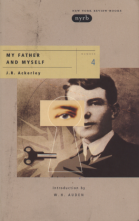
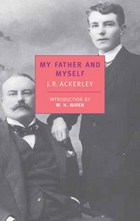
Just kidding! Everyone loves New York Review Books Classics, and for good reason. Few things are as unreservedly worth celebrating as the 10th anniversary of this publishing project, which is single-handedly reshaping the understanding of the world’s recent literary past. By the way, their cover design scheme has become so well-known, does anyone remember that, a whole decade ago, it was rather different? Here’s my edition of J.R. Ackerley’s My Father and Myself, alongside the current one:
Anyway, Martin’s got the New Yorker Festival covered, but NYR Books are having their own anniversary festivities through November—in New York, London and both Cambridges—listed here, including:
- Monday, September 21, 7 pm
Idlewild Books hosts a reading by Tete-Michel Kpomassie, author of An African in Greenland - Tuesday, October 6, 7 pm
Idlewild Books, launch party for the first graphic novel published by NYRB, Poem Strip by Dino Buzzati, featuring translator Marina Harss - Tuesday, October 13, 7 pm
London Review Bookshop, John Banville and John Gray discuss the work of Georges Simenon - Thursday, October 29
NY Institute of the Humanities, New School Tishman Auditorium with Fred Wiseman, Walter Murch, Timothy Snyder, Ruth Ben-Ghiat, Chris Hedges discusssing the war writings of Curzio Malaparte and Vasily Grossman
Incidentally, Timothy Snyder is the author of a recent eye-opening article in The New York Review of Books about where, and how, the greater part of the Holocaust took place, that should be a must-read for all humans.
And the mention of Malaparte reminds me the great work of another series, a little lower-profile, but whose distinctive jackets are equally signals of worthy reading you might not otherwise know about: Northwestern University’s European Classics. They brought Malaparte’s Kaputt to my bookshelf before New York Review Books yet existed, as well as another eventual NYRB title, Stefan Zweig’s Beware of Pity.
Kevin Fitzpatrick’s “Algonquin” Book Tour Starts Sunday!
Martin Schneider writes:
Via the mysterious conduit known as “Facebook” arrives news that the new book about the Algonquin Round Table by our dear friend and colleague Kevin Fitzpatrick is commencing his book tour!
I’ve not had the pleasure of meeting Kevin, but Emily knows him well and assures me that he is a capital fellow and an unimpeachable resource on the subject of Dorothy Parker and her acerbic friends. Really, I see no way that buying his book could ever constitute a poor decision.
Emdashes readers will remember that we presented exclusive coverage of the book a little while back.
Good luck, Kevin!
I’ve pasted his press release below, complete with events, each of which is a delightful occasion to marinate in all things Dorothy Parker, The New Yorker, and wit in general—and to buy the book!
* * *
Hi friends and family,
I am happy to announce that my second book is out now. I am the editor of “The Lost Algonquin Round Table” and I hope you will feel compelled to want a copy. It is a collection of writing by the members of the group, 16 writers such as Dorothy Parker, Robert Benchley, Robert E. Sherwood, Edna Ferber, George S. Kaufman, Heywood Broun and many others. It has fiction, essays, humor, poems and reviews. It was a lot of fun to work on with my co-editor, Nat Benchley. To promote the book I launched my own publishing imprint, Donald Books, which you can find out more about on
www.donaldbooks.com.
So how can you get a copy? Easy! If you live in NYC, my “tour” schedule is below. For those outside of the city, you can go to any decent bookstore and they can order the book for you. Just tell them the title and they should be able to locate it to order; ISBN (hardcover): 9781440151521, ISBN (paperback): 97181440151514; it takes about a week to get it in. The book is also on all the major online booksellers, such as Amazon, Barnes and Noble, Powell’s, etc. You can also order it direct from iUniverse.com (see link on donaldbooks.com).
From my web site, here is the info on where I will be starting this weekend and running through September:
Sunday, Aug. 16, 11 AM, Long Branch Free Public Library, 328 Broadway Long Branch, NJ 07740 732.222.3900. As part of the annual Dorothy Parker Day, Kevin C. Fitzpatrick will give a talk, reading and book signing. Free. Open to the public.
Wednesday, Aug. 19, 6 PM, The Corner Bookstore, 1313 Madison Avenue, at E. 93rd Street, New York, NY 10128. (212) 831-3554. Official book launch and reception party. Editors Nat Benchley & Kevin C. Fitzpatrick will be on hand with special guests. Books will be available for purchase and signing. Free. Open to the public.
Thursday, Aug. 20, 8 PM, Don’t Tell Mama, 343 W. 46th Street, New York, NY 10036. Big Night Out presents the “1930s Idol” cabaret competition. Kevin C. Fitzpatrick will be signing/selling copies of the book plus is a judge in the show. $12 and two drink minimum. Open to the public. Reservations encouraged: 212-757-0788.
Saturday, Aug. 22, 12 PM, Algonquin Hotel, 59 W. 44th Street, New York, NY, 10036. Algonquin Round Table Walking Tour. Editor Kevin C. Fitzpatrick has led this literary walking tour for ten years. Walk in the footsteps of the Vicious Circle and see the locations they visited, from speakeasies to old haunts. Cost is $20 ea. At 3 p.m. in the lobby will be a book signing, followed by a small celebration to mark Dorothy Parker’s birthday today. Reservations encouraged: 212-222-7239.
Wednesday, Aug. 26, 6-9 PM, Museum of the City of New York, 1220 Fifth Avenue, there is a special Wednesday evening “speakeasy” on the roof, with live music and Prohibition era cocktails. $12 admission gets you into the museum’s first floor and it’s Prohibition exhibition (and a free drink). Kevin will give a talk and sign copies of the book.
Sunday, Sept. 27, 12 PM, Governors Island (Colonel’s Row). The Jazz Age Lawn Party and Roaring Twenties Party. Live music by Michael Arenella and the Dreamland Orchestra. Book signing 12-3 PM. $5 admission. Open to the public.
Thanks for the support, I really appreciate it.
Sincerely,
Kevin C. Fitzpatrick
kfitz@bway.net
What’s the Future of Print? Find Out Tonight at an NYC Panel With Emdashes Founder & Print Magazine Editor, Not to Mention Smart, Entertaining Others!
Emily Gordon writes in her other persona as editor of Print magazine, whose website is about to be completely relaunched, thank the Al Gore:
What’s going to happen to print (lowercase p)? If I figure it out by tonight, I’ll tell you! I’m on a panel about independent magazines at the Art Directors Club, 106 West 29th St. (bt. 6th and 7th), from 6:30-8:30 p.m. tonight. Yes, tonight! I know you’ve got a lot of summer invites, but this will be a lot of fun, and not depressing at all, I promise. I’d love to see you there, friends & fellow magazineers!
Here’s the full description:

On Wednesday, July 8, Colophon in collaboration with the Art Directors Club hosts a unique presentation and discussion about independent magazines entitled “The Future of Print.” This is an essential event for anyone involved in the creative industries.
In recent years, an explosion of independent magazines has reinvigorated the medium of print. Freed from the constraints of the mainstream, independent magazines continually innovate and experiment for their devoted readers around the world. Energetic, groundbreaking, and unafraid, these are magazines for readers who believe that print is still a vibrant medium. Colophon, in collaboration with the Art Directors Club, investigates The Future of Print through a panel discussion featuring editors and publishers from Capricious, Print, Woooooo!, and The Nation.
To celebrate the launch of the new book We Make Magazines–Inside The Independents, published in conjunction with the Colophon Independent Magazine Biennale, Colophon and the Art Directors Club in New York presents a unique discussion event, exploring key issues around independent publishing with major figures from New York’s independent publishing scene.
Panel Moderator: Andrew Losowsky, Co-curator, Colophon and Editor, We Make Magazines
Panelists:
* Sophie Mörner, founder and publisher, Capricious
* Emily Gordon, editor-in-chief, Print
* Jason Crombie, editor and founder, Woooooo!
* Claudia Wu, Me Magazine
Topics:
* What makes magazines special
* The secrets to publishing success
* The importance of creative independence
* Whether you can make money from a passion project
* What’s next for print.
Wednesday, July 8, 2009
6:30-8:30 pm
ADC Gallery
106 West 29th Street, NYC
ADC Members: Free
Non-Members: $5 at the door
RSVP by clicking the button below.
The Uptown Pearl: End of an Era
Martin Schneider writes:
Last Friday, I saw Vieux Carré by Tennessee Williams at the Pearl Theatre on 8th Street. Hilton Als gave the show a good review in the June 8 issue. I recommend the show, but it’s only playing for a few more days (through June 14), so make haste!
Anyone who has spent much time in the East Village will know the Pearl. It’s located on the old site of the Theatre 80 St. Marks, where I dimly remember seeing a Godard double-feature before it stopped showing classic movies around 1993.
This week marks the last week of the phenomenally fruitful artistic directorship of Shepard Sobel, as well as the last week of performances in the East Village space; they are moving to the New York City Center in midtown. It’s sad news for people who like the good things in life to stay the way they are.
The Pearl is my favorite theater company in New York. It was (and, one expects, will remain) the quintessential repertory theater in New York, mounting well-acted “straight” (that is, interpretation-free) productions of classic plays ranging from Shakespeare to Ionesco and beyond. I saw plays there by worthwhile playwrights of yore you don’t see produced often: Lessing, Calderón de la Barca, Goldoni.
The first play I ever saw there was Shakespeare’s Cymbeline, in 1996. To this day it remains one of the freshest productions of Shakespeare I can recall, a feat accomplished on a small stage with a bare set.
Over the years I saw probably about 25 productions, which gave me a chance to get to know the versatile company. I won’t soon forget names like Joanne Camp, Rachel Botchan, Celeste Ciulla, Carol Schultz, Arnie Burton, Robin Leslie Brown, Hope Chernov (this is a company where the woman seem to get the choicest roles), Arnie Burton, Dan Dailey, Robert Hock, Dominic Cuskern, Sean McNall, John Wylie, Edward Seamon. I’m grateful to all of the above as well as everyone else who helped with the productions, for the pleasures they afforded me over the years.
I’m confident the Pearl will prosper 40 streets north, but I’m still sad that I won’t again see their productions off of St. Marks Place. I’m sure I’ll continue to see their productions (Shaw’s Misalliance next year looks tasty).
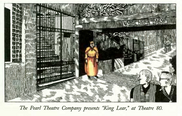
Update: In the lobby of the Pearl hangs a framed drawing cut out from the pages of The New Yorker. It appeared in the September 19, 1994, issue. Here it is (click to enlarge):
Celebrate Dorothy Parker This Weekend, at Governor’s Island!
Martin Schneider writes:
The annual Parkerfest (it is the 11th) takes place on June 6 and 7. The always ambitious Kevin Fitzpatrick has much planned. (By the bye, June 7 is also the anniversary of Dorothy Parker’s death, in 1967.)
It will be held on Governors Island. Come attend a huge Roaring Twenties weekend, with vintage clothes, automobiles, live jazz, and outdoor cocktail parties.
The Governors Island Jazz Age Lawn Party is produced by Michael Arenella, who will lead his famous Dreamland Orchestra in “hot-and-sweet” period music. Vintage attire is encouraged, and there is a wide range of fun things to do both days.
All information about the schedule of activities, which runs from 11 AM to 5 PM, can be found the Society’s website.
Sign up for the Society’s newsletter, and you will be constantly up to date on all matters Parker-related.
Pnin & Semicolons: Zadie Smith & Jonathan Safran Foer at NYU
Kirsten Andersen writes:
Zadie Smith and Jonathan Safran Foer sat down on April 30 at New York University for a ninety-minute discussion that began with a list—originally drafted by Smith in an email to Foer—of topics the two writers covered in a recent (and one assumes more private) conversation.
That list included foreskin, farting, and a nation’s romantic love for its president, and it served as the springboard to a milder discussion moderated by Foer, during which Smith addressed the Internet’s effect on writing (“an absolute disaster for writers”); writing about family (“writers come to destroy their families; there’s no doubt about it”); and her insistence on writing in the third person, despite the fact that “it looks antique now.”
The stage at Vanderbilt Hall remained unlit as the sun set in the windows along MacDougal Street, and it became difficult to see the faces of Smith and Foer from my seat in the middle of the auditorium. Still, I could easily make out Smith’s red head wrap, peacock blue mini-dress, and yellow stack heels. She was, as Foer might say, luminous, and when the conversation was opened to the audience for questions, a group of adoring men in front of me smiled at each other and shook their deferent heads.
Asked about her definition of failed writing, Smith scratched her arm and rubbed her neck. “Indulgence, making a fool of one’s self, caricature, overplotting, bad confused endings, too many semicolons,” she said. She smoothed her dress and crossed her legs as she dismissed femininity as a code for “passivity and delicacy”; she cited Pnin as one of her favorite novels.
“I’m constantly feeling like I’m on the back foot,” insisted the 2005 Orange Prize winner. Smith said that her forthcoming book, Changing my Mind: Occasional Essays, was an extended exercise in self-education. Citing her less than desirable primary school experience, Smith said she feels she is constantly learning “on the hoof.” A few heads pulled back and the brilliant writer nodded in earnest. All things considered, it seemed unlikely. Still, I took her elegant, artful word for it.
Kirsten Andersen is a poet, writer, and editor.