Martin Schneider writes:
To see New York Times columnist Frank Rich interview New Yorker reporter Jane Mayer about the Bush administration’s torture policies at the 92nd Street Y, as I did last Tuesday in the delightful company of Emily and Jonathan, is to experience (in the audience) a certain kind of informed liberal orthodoxy in its most undiluted form. At times I felt that if we were to concentrate any more intently, we might inadvertently summon the corporeal form of Keith Olbermann, if not I.F. Stone himself.
As it happened, it was that degree of obvious advocacy and affection in the audience that permitted the conversation to be as focused, and yet as unfussy, as it was. In other words, Mayer and Rich scarcely had to adjust their dialogue to the audience—we were all on the same page. Rich wanted Mayer to explain what was happening with the torture story, and that’s exactly what she did. We were along for the ride.
Mayer’s latest book, The Dark Side, is now out in paperback. She is certainly one of the best-informed people in the country (not on a government payroll) when it comes to our government’s recent rendition and torture practices. She confessed a desire to investigate some new story, but as the facts of this one are not yet out, she keeps getting drawn back in.
On Obama, Mayer ventured a familiar combination of hope and incipient disappointment. Rhetorically Obama has been so good on the subject that it’s difficult to assess the obvious backsliding. The Bush administration left behind an intractable legal problem—how to prosecute dangerous members of Al Qaeda (almost certainly) whose rights have egregiously been violated and whose cases would surely be thrown out of court under any normal circumstances. As one CIA employee told her, “The problem was always the disposal plan.” The Obama administration clearly regards the matter of Ali Saleh Kahlah al-Marri, the subject of Mayer’s February 2009 article in The New Yorker, as a test case to see how this will play out, so keep your eye on that. On the subject of disposal, the Bush administration apparently contemplated with some seriousness a plan of putting the prisoners on a ship that would then circumnavigate the globe in perpetuity, an idea Rich instantly dubbed “Halliburton cruises.”
One interesting revelation was that journalists are not permitted to interview convicted terrorists—and they are also not permitted to interview people who for legal reason have had access to them, this “two degrees of separation” prophylactic approach bearing the bland appellation “special administrative measures.”
Mayer noted that there are detailed reports produced by the likes of the CIA’s inspector general and the Justice Department’s Office of Professional Responsibility that have yet to be released, an eventuality that is likely, in her view. So brace yourself for more shocking revelations. One of the tiny number of people permitted to see the interrogation transcripts called them the “the most disgusting thing he had ever seen.” Like any good reporter, Mayer takes the view that disclosure of these practices is essential to the maintenance of an open society.
Simplistic as it sounds, that process will yield heroes and villains. Doug Feith, David Addington, John Yoo, and their ilk are apparently “very nervous,” while others, like Alberto J. Mora, once general counsel of the United States Navy (as Mayer reported in 2006), distinguished themselves with their courage in opposing these reprehensible practices. Addington et al. prompt the question, were they imparting sound legal advice or did they have their collective thumb on the scale? The absence of an important 1983 waterboarding precedent in Yoo’s internal memoranda prompts the latter interpretation, an inauspicious sign.
One of the most interesting questions that remains is the degree to which the torture regime was a sincere effort to obtain valid intelligence or a cynical attempt to manufacture a justification for the war in Iraq. In my opinion, the available facts aren’t encouraging. If that manufacturing is exposed, it’s going to take a very long time for our country to come to terms with the official, costly duplicity in which our governmental representatives engaged.
The first question of the audience Q&A section demanded an impossible degree of information, albeit one close to the concerns of this blog: “Can you describe the process of writing a New Yorker piece from start to finish?” Mayer’s comments were appreciative yet betrayed a glimpse of the pressure that such high standards bring: “The process is endless, no one would believe it. . . . We have an in-house grammarian who will mark up your copy to the point that you want to cry—or change professions. . . . I have a hunch that it’s the typeface that makes us look so good.” She also singled out editor Daniel Zalewski for his unerring instincts.
There was more, but my hand can furtively scribble only so much, and the remainder of my markings are unintelligible, even to me.
Category Archives: On the Spot
Tonight: See Jane Mayer and Frank Rich (w/ New Yorker Discount)
Martin Schneider writes:
This found its way into my in-box:
Jane Mayer in Conversation with Frank Rich at the 92nd Street Y
Tuesday, May 19, 8 pm
Join Jane Mayer, New Yorker staff writer and author of the best-selling book The Dark Side: The Inside Story of How the War on Terror Turned Into a War on American Ideals, and Frank Rich, New York Times Op-Ed columnist and author of Ghost Light: A Memoir, for a lively discussion on Mayer’s book, current events and issues of national security, civil liberties and American ideals.
New Yorker readers save 20% on the listed ticket price with the discount code FR20. Click www.92Y.org/Mayer, call 212.415.5500 or visit the 92nd Street Y Box Office, at Lexington Avenue at 92nd Street.
Emily, Jonathan, and I will be attending, so if you see us, by all means say hello!
New Museum 90s Panel: Roseanne Profile as Decade’s Time Capsule
Jonathan Taylor writes:
Friday night’s “The 90s vs. The 90s” panel discussion was occupied for a long time on what, either at the time or in retrospect, was “dark” or “light” about the decade, in the words of the moderator, n+1‘s Mark Greif.
The purest vein of nostalgia for the 90s was expressed by Aaron Lake Smith, 25. To him, the “public conversation was more interesting,” because, in its weird way, it was addressing “the roots of capitalism”—why did Columbine happen; Ross Perot and the “giant sucking sound”; the Zapatistas—as opposed to the sham of, say, today’s torture “debate.” Scott Hamrah—once of Suck.com, a URL worth a thousand Q&A’s—was quick to knock down young Aaron’s rosy version, countering that the “conversation” was about O.J., not Subcomandante Marcos.
At a certain point, Marisa Meltzer suggested that the middle period of the 90s was a high point of sorts for the well-being of women, on an arc described between the Anita Hill testimony (1991) and the Lewinsky affair (1998, although Meltzer zeroed in on that year’s premiere of “Sex and the City” as the decade’s Altamont). As evidence of the good times, she cited the 1995 New Yorker profile of Roseanne Barr—”it’s like something beamed to you from some era you never lived through and never will again” she said, or something close thereto.
Quite so. The article is likely overshadowed in many memories by the foofaraw over Roseanne’s consulting-editorship of the 1996 “Women’s Issue.” But after all the talk about authenticity and shallowness, John Lahr’s profile of Roseanne, who might be the closest thing to America’s Bertolt Brecht, is a heartening reminder of the substance that can be created by spectacle.
Adam Gopnik and Steven Pinker Debate Darwin, May 20
From the press release:
Adam Gopnik, author of Angels & Ages, A Short Book About Darwin, Lincoln and Modern Life and Steven Pinker, author of The Blank Slate and many other works, will debate a simple and deep subject: How far can Darwin take us as a guide to why we are the way we are? [I suspect neither side will be adopting the creationist position…. —Ed.]
Here are the details:
ADAM GOPNIK with STEVEN PINKER
Angels and Ages
Wednesday, May 20, 2009 at 7:00 PM
South Court Auditorium
The New York Public Library
Stephen A. Schwarzman Building
Fifth Avenue & 42nd Street / Enter at Fifth Avenue
Buy Tickets & SAVE $10 on every LIVE ticket!
Become a Friend of the Library for as little at $40 and you ticket
will be $15 instead of $25 plus you will pay NO service fees.
Adam Gopnik, author of Angels & Ages, A Short Book About Darwin, Lincoln and Modern Life and Steven Pinker, author of The Blank Slate and many other works, will debate a simple and deep subject: How far can Darwin take us as a guide to why we are the way we are?
Gopnik draws a line and suggests that Darwin can take us only to the edge of art and culture and not beyond; Pinker suggests that Darwin, and Darwinian thinking, in the form of evolutionary psychology, can take us deep into the seeming mysteries of why we like stories and pictures, and the kind of stories and pictures we like.
Both ardent Darwinians [See? Told you. —Ed.], Adam Gopnik and Steven Pinker will offer different—perhaps complementary, perhaps permanently contrasting—visions of what Darwin’s legacy is on the two hundredth anniversary of his birth.
About Adam Gopnik
Adam Gopnik has been a staff writer at The New Yorker since 1986. In 2000, he began writing New York Journal, about culture and daily life in New York City. He previously spent five years in Paris, writing Paris Journal, a similar column about the life of an expatriate in Paris. Gopnik is the author of Paris to the Moon, The King in the Window, and Through the Children’s Gate. In 1998, he received the George Polk Award for Magazine Reporting for his Paris Journal. Before he came to The New Yorker he was an editor at Alfred A. Knopf and a fiction editor at GQ. In 1990, Gopnik co-curated an exhibition entitled “High and Low: ModernArt and Popular Culture” at the Museum of Modern Art in New York, with the museum’s director, Kirk Varnedoe. He also co-authored the book under the same title.
About Steven Pinker
Steven Pinker is Harvard College Professor and Johnstone Family Professor of Psychology at Harvard University. His research on visual cognition and the psychology of language has won prizes from the National Academy of Sciences, the Royal Institution of Great Britain, and the American Psychological Association. He is the author of The
Language Instinct, How the Mind Works, and The Blank Slate, and writes frequently for The New Republic and The New York Times. He has been named Humanist of the Year, and is listed in Foreign Policy and
Prospect magazine’s “The World’s Top 100 Public Intellectuals” and in
Time magazine’s “The 100 Most Influential People in the World Today.” His latest book is The Stuff of Thought: Language as a Window into Human Nature.
New Yorker Summit: Happening Today
Martin Schneider writes:
The New Yorker Summit is taking place today at New York University. (A bit more convenient location than the Conference of previous years, which was held way over by the West Side Highway, in Chelsea.)
The lineup includes many luminaries, including Howard Dean, Geoffrey Canada, Nassim N. Taleb, Naomi Klein, and Elizabeth Edwards, along with familiar personages from the magazine like Seymour Hersh, Malcolm Gladwell, James Surowiecki, Ryan Lizza, and on and on. (Here’s the schedule.)
If I weren’t on the other side of the Atlantic, I would so be covering this. Failing that, we refer you to Jason Kottke, who has promised “some sort of live-ish coverage.”
More to come as the magazine posts reports, videos, and the like. Attendees, I wish you all intellectual, social, and culinary pleasure.
Update: The group NYU Students Organizing for America is covering the summit live via Twitter.
Catch Gladwell and Borowitz at the Moth, May 21
Martin Schneider writes:
Talk about fortuitous timing—no sooner does a big Malcolm Gladwell article hit the newsstands than we receive word about an appearance he will be making in New York City this month, at the Moth Members’ Show at Symphony Space on May 21. Since a recent appearance at the Moth raised a few eyebrows, we’re glad to see that he’s diving in again.
Andy Borowitz, who appeared last week at the 92nd Street Y to celebrate/mock Obama’s 100th day in office, will host.
Here’s the press release:
Our Annual Moth Members’ Show
Thursday, May 21 at Symphony Space
Crack up: Stories about Comedies and Calamities
Storytellers include:
Malcolm Gladwell
Author of The Tipping Point, Blink and Outliers: The Story of Success
Sarah Jones
Tony award-winning playwright, performer, author and poet
Steve Osborne
Former lieutenant in NYPD detective bureau, Manhattan Gang Squad
Peter Zilahy
Essayist, playwright, and author of dictionary-novel, The Last Window-Giraffe
Hosted by:
Andy Borowitz
Comedian, actor and writer, featured regularly in The New Yorker, The
New York Times, and at borowitzreport.com
Become a Moth Member and receive 2 FREE tickets
With a $100 donation you will receive two tickets to the Members’ Show
($70 value) as well as our brand new double CD, with stories by
Richard Price, Sam Shepard, Mike Birbiglia, A.J. Jacobs ($15 value,
available only with membership), among other benefits.
When you join at a higher level of membership you get even more
benefits and perks. For a complete list of member levels and benefits
and to join go to www.themoth.org/membership.
We Need Your Support
Moth members are hugely important in helping us present unique voices
at our Mainstage and StorySLAM series, as well as our community
outreach program, MothShop, which brings storytelling workshops free
of charge to underserved communities. Moth Members also help us
produce our free–and commercial-free–podcast each week. Take a moment
to read about the importance of the membership program and what our
members have helped us to accomplish this year.
In these turbulent times, everyone needs a place to tell their stories
and hear the tales of our time. The Moth is that place. Please help
us offer more storytelling opportunities by becoming a Moth member.
How to Join:
Join online.
Call The Moth office at 212-507-9833 with your credit card information.
Mail a check, payable to Storyville Center for the Spoken Word, and
mail it with your name, mailing and email addresses to:
The Moth
330 West 38th Street, Suite 1403
New York, NY 10018
Storyville Center for the Spoken Word, d/b/a The Moth, is a 501 (c)
(3) not-for-profit organization. All donations are 100% tax deductible
and all donors receive a receipt for tax purposes.
Thank you for your support!
The Moth Board & Staff
P.S. Don’t Forget to RSVP to The Members’ Show when you join!
(to David Mutton at 212-507-9833 or rsvp@themoth.org)
Don’t wait for your donor receipt, call or email to RSVP as soon as
you have processed your online membership or mailed your check.
Show Information:
Crack up: Stories about Comedies and Calamities
at Symphony Space
2537 Broadway (at 95th St)
6:30pm Doors open
7:30pm Stories begin
Member tickets need to be reserved by calling 212-507-9833 or emailing
rsvp@themoth.org, and can be collected on the evening of the show from
Symphony Space box office.
A limited number of tickets are on sale at $35 from Symphony Space.
Happy Day! The New Yorker and Print Take Home Ellies!
Martin Schneider writes:
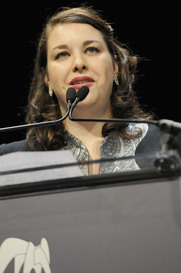
Last night, at the American Society of Magazine Editors awards ceremony (our coverage of the nomination announcement is here and here), The New Yorker took home awards for fiction by E. Annie Proulx and Aleksander Hemon, photography by Platon, and criticism by James Wood. Congratulations to all!
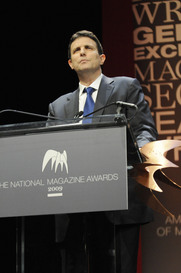
Judging from the reaction on Twitter, the victory of Field and Stream over The New Yorker and Vogue in the 1,000,000+ circulation category was a bit of a shocker.
Meanwhile, Print won the award for general excellence, under 100,000 circulation. Congratulations to Emily and everyone at that outstanding publication for the well-deserved recognition!
Thursday: See Jonathan Safran Foer Interview Zadie Smith
A friend passes on information:
Acclaimed British writer Zadie Smith’s first book, White Teeth, won a number of awards, including the Guardian First Book Award and the Whitbread First Novel Award. Smith’s second novel, The Autograph Man, won the 2003 Jewish Quarterly Literary Prize for Fiction. On Beauty was published in 2005, and won the 2006 Orange Prize for Fiction.
Jonathan Safran Foer is the best-selling author of Everything Is Illuminated, which won numerous awards, including the Koret Award for best work of Jewish fiction of the decade, and, like White Teeth, the Guardian First Book Award. His second novel, Extremely Loud and Incredibly Close, was a finalist for the IMPAC Prize. Foer joined the NYU Creative Writing Program faculty in 2008, and lives in Brooklyn,
New York.
Date: Thursday, April 30th, 7:00 p.m.
Location: Tishman Auditorium, Vanderbilt Hall, 40 Washington Square South
Egrets and Tigers and Editors, Oh My! Matthiessen on Wondrous Creatures
Martin Schneider writes:
File it under “lectures I wish I’d seen.” Yesterday, 81-year-old author Peter Matthiessen appeared at the Emerson Center in Bozeman, Montana, to tell tales from his adventuresome life, one that combines working as a commercial fisherman with helping George Plimpton found The Paris Review, undertaking naturalist expeditions in Siberia with submitting revisions to William Shawn.
Matthiessen described Shawn as “one of the strangest guys you could imagine” but also fiercely loyal to his writers. One suspects that to the good citizens of Bozeman, the valuable plumage of egrets and the “big red ears” of Shawn belong to much the same category (certainly, Gail Schontzler of the Bozeman Daily Chronicle implies as much).
Is Matthiessen speaking in New York any time soon? Is his novel Shadow Country the masterpiece many have claimed? I think the answers go “no” and “yes,” which I’ll regard as a glass half full.
Hunting and Deciding: NYC Event Today With Jonah Lehrer
From the press release:
Please join us today—Monday, April 20—at 6 p.m., on the 7th floor of 20 Cooper Square, for food, drinks and a conversation with one of the brightest lights in the journalism of ideas: Jonah Lehrer.
Jonah will be discussing a story he wrote last summer for The New Yorker entitled “The Eureka Hunt: Why Do Good Ideas Come To Us When They Do?” That story sprung from his research for his latest book, How We Decide, which was published in February by Houghton Mifflin. Jonah will also be talking about the nexus between his book research, his magazine pieces and his very active blog, called The Frontal Cortex, which focuses on neuroscience. And yes, he’ll also be fielding questions about his recent appearance on The Colbert Report.
You can download Jonah’s New Yorker story at http://tinyurl.com/66qqhw. You can read his blog at http://scienceblogs.com/cortex.
The editor at large for Seed magazine, Jonah Lehrer is the author of Proust was a Neuroscientist (Houghton Mifflin, 2007) as well as How We Decide. In addition to The New Yorker and Seed, he has written for Nature, Wired, The Washington Post and The Boston Globe. He is also a contributing editor at Scientific American Mind and National Public Radio’s Radio Lab. A Columbia graduate, he also studied at Oxford as a Rhodes Scholar. The New York Times called Proust was a Neuroscientist “a precocious and engaging book that tries to mend the century-old tear between the literary and scientific cultures.” Publishers Weekly called How We Decide “a fascinating book . . . that will help everyone better understand themselves and their decision making.”
This event is part of the four-year-old “Inside Out” speaker series sponsored by the Science, Health and Reporting Program (SHERP) at NYU’s Carter Institute of Journalism. Leading the conversation, as usual, will be Robert Lee Hotz, distinguished writer in residence at the Carter Institute and the science columnist for The Wall Street Journal.
For logistical details, see: http://journalism.nyu.edu/events/?ev=2008-jonahlehrer