
Category Archives: Looked Into

The New Yorker Digital Edition, a Few Early Reactions

I’m looking at the “New Yorker Digital Edition,”:http://archives.newyorker.com/ and I thought I’d get a few initial thoughts down here.
* Is this the most ambitious integration of a magazine on the Internet that we have yet seen? If anybody reading this can think of something comparable, please write in and let us know! To summarize: every subscriber to the magazine now receives, in addition to the physical version in the mailbox, an identical version of the magazine (including layout and ads) in a digital format that can be viewed in any browser wherever there is an Internet connection. Furthermore, every subscriber may now view every single issue the magazine has ever published. The Internet is a palpable problem for magazine publishers, because they are an expensive proposition and the audience is spoiled by widespread free content on the Internet. _The New Yorker_ can use assets that less lofty magazines cannot bring to bear, but this may be an exciting model for other magazine publishers to consider.
* If you attempt to access an archived issue as a non-subscriber, the program inquires whether you would like to purchase the issue for $4.99. In this way the model could potentially increase revenue over and above the subscription revenue. Quoting from the Digital Edition: “For $4.99, you’ll receive access—for one year—to the entire issue in which the article you’re looking for originally ran.” Question: will people confronted with such a demand opt for a subscription instead? How many articles does one have to want to read before a subscription is a better use of one’s money? On “Amazon”:http://www.amazon.com/The-New-Yorker-1-year/dp/B00005N7T5/ref=pd_bbs_sr_1?ie=UTF8&s=magazines&qid=1226059422&sr=8-1 you can get a year’s subscription for $39.95, so that’s about the cost of 8 individual articles. I think this aspect of the model may well lead to an increase in subscriptions.
* The search function within the Digital Edition itself is limited to the issue you are viewing. I noticed something rather tantalizing: I was looking at the “May 31, 2004, issue”:http://archives.newyorker.com/?i=2004-05-31#folio=032 (the one with the “William Finnegan article”:http://emdashes.com/2008/11/prescient-finnegan-gleans-poli.php on “Barack Obama”:http://www.newyorker.com/archive/2004/05/31/040531fa_fact1?currentPage=all), and I did a search on “Bill Clinton.” Two hits came up, _apparently responding to full-text hits_. (The search results seem to reproduce the actual lines of text in which “Bill Clinton” appeared.) Anyone who has used _The Complete New Yorker_ DVD archive knows that this is potentially a big item, because _The Complete New Yorker_ limits the user to a keyword/abstract search (it’s a bit more complicated than that, sometimes searches appear to respond to text that is not limited to the “library card” presented in the “article abstract” section). In any case, anything resembling full-text search capability is pretty awesome. I think we need to hear more about this.
* As Jonathan Taylor was the “first to notice”:http://emdashes.com/2008/11/take-the-new-yorker-digital-ed.php, you can now execute a search at “newyorker.com”:newyorker.com, and if an article is not available on the website, the abstract result now includes a link that brings you to the article in the Digital Edition. That works seamlessly, it’s very impressive.
* Dig the URL format for linking to articles in the Digital Edition, it looks like this:

http://archives.newyorker.com/?i=2004-05-31#folio=032

(That’s the Obama article again.) The “032” is a page number. So if you know the date of the issue and the page number (remember to use a placeholder zero or two to keep it a three-digit number), you can generate a valid URL on the fly. At Emdashes, we will endeavor to include such links to articles as we move forward.
* What about royalties? _The Complete New Yorker_ is the legacy of judicial rulings stating that a magazine publisher has the right to reproduce the full magazine but not in such a way that the individual articles can be copied with impunity. Does the Digital Edition maintain this logic? It probably does—you still can’t grab an ASCII version of any article and put it on your website. (I’ve always felt that this Solomonic judicial ruling struck an ideal middle path between protecting the rights of contributors and the public good of making the magazine available to all at an affordable price.)
* Look and feel: I like the usability but it’s juuuust a bit pinched. I’m not crazy about the dialog boxes that pop up, but that’s a small thing and I expect it to change over time. It’ll be interesting to see how it all evolves. On my MacBook, the bottom toolbar is almost always off the screen, meaning I have to scroll down to access it. The left/right buttons are a little “HTML-y” for my taste, but I do like that the interface responds well to the left and right arrow buttons. Flipping through the magazine is enjoyable, but the experience of dipping in and out of pages might need to improve a little bit. Still: this is a great beginning.
* Hey, recent issues have active links to the web! You can click on any URL in the issue, whether it be in _New Yorker_ content or in advertisements. Pretty sneaky, sis. In addition, the table of contents (for new issues) is hyperlinked to enable you to access every article directly from there, which is a nice touch.

Literary Notes from All Over: a Digital Edition

Benjamin Chambers writes:
* Anyone else notice that The New Yorker is launching a “digital edition” later this year? You’ll read this edition via the Web, it’ll look just like the magazine, but you’ll get access to it before the print edition arrives in your mailbox or even most newsstands. Current subscribers can get the digital version free for the duration of their subscriptions, as long as they sign up; non-subscribers can get a free, four-issue trial subscription, though after that, it’s $39.95. Looks promising. (Searchable, too.)
* Wouldn’t it be nice if you could collect all of your favorite TNY stories in one place? Thanks to Emily, I found a link on Galleycat about AnthologyBuilder.com, a service that allows you to pick and choose from its list of stories to create your own anthology. Right now, there’s a limit on what you can choose from, but the possibilities are obvious. Perhaps TNY is already figuring out a way to pay its current authors so it can build such a service of its own? If I could create a personal TNY anthology, I’d include some John Cheever, Mary Lavin’s “The Great Wave,” Muriel Spark’s “In the House of the Famous Writer,” and … well, I’m just getting started. I’ll have to work on a list. Which stories would you include?
* Something I didn’t expect to ever see, but found touching: notes from David Foster Wallace’s memorial service, courtesy of Stephen, of the blog Band of Thebes. I quite liked the notes, but there’s something terribly ironic about Wallace’s memorial service being rendered in bursts of shorthand reminiscent of Twitter.
* Dzanc Books, an independent literary publisher (which numbers among its authors TNY poet Terese Svoboda), is holding a Write-a-Thon on November 15th to raise funds for its writers-in-the-schools workshops. Check it out, round up some sponsors for the big day, and when November 15th comes, write your heart out.

He was E-mail Before E-mail was Cool

Benjamin Chambers writes:
Remember when e-mail was new? If you’re like me, probably not as well as you think you do, if John Seabrook’s January 10, 1994 story on Bill Gates, “E-mail from Bill,” is anything to go by.
For instance, Seabrook talks about how odd it was to meet Gates for the first time, after first exchanging a number of e-mails:

As we shook hands, he said, “Hello, I’m Bill Gates,” and emitted a low, vaguely embarrassed chuckle. Is this the sound one E-mailer makes to another when they finally meet in real space? I was aware of a feeling of being discovered.

Doesn’t this seem to be a fairly odd observation under the circumstances—not to mention precious? I have to wonder how in this context e-mailing people before meeting them in person differs from corresponding with them by letter: what had really changed? Hindsight is 20/20 and all that, but Seabrook gets even goofier:

Maybe this is the way lots of people will communicate in the future: meet on the information highway, exchange messages, get to know the lining of each other’s mind, then meet face to face. In each other’s physical presence, they will be able to eliminate a lot of the polite formalities that clutter people’s encounters now, and say what they really mean. If this happens, it will be a good thing about the information highway: electronic communication won’t reduce face-to-face communication; instead, it will focus it.

Still, it’s kind of fun to read such an unabashedly wide-eyed view of the medium from a time when e-mail really was new. It’s like opening a time capsule.
Seabrook followed up his Gates profile with an “In the Mail” piece on pp. 8-9 of the February 7, 1994 issue of TNY. (It doesn’t appear on the TNY website or in the index of The Complete New Yorker.) In it, he summarizes reader response to his article and includes some additional thoughts on what it was like to go from having virtually no e-mail correspondence to an amount of e-mail that must have seemed overwhelming for the time:

“[T]he morning that article appeared on the newsstands, I checked my mailbox and found it stuffed: twenty-nine messages. In the following three weeks, I received three hundred and ninety-six electronic messages from readers, almost all of them strangers. Over that period, I also received eight phone calls about the article, seven letters, and one fax … In my greenness about the information highway, I put my E-mail address in the article, and now I suppose I will be hearing from readers for years.”

I gather Seabrook wasn’t put off by his readers’ responses though, because he helpfully supplied his e-mail address again. I’ll reprint it here, just as a reminder of times (and companies) gone by: 73124,1524@compuserve.com. (Remember when you could put a comma in your e-mail address? Oh, for the days of the open range!)
Seabrook also writes about his changing feelings about receiving so much e-mail: at first he was thrilled, then overwhelmed, and finally more interested in the process than the content: “Now I find myself looking forward more to composing E-mail than to receiving it … Composing E-mail composes me.” Wonder if he still feels that way?
He quotes from a number of readers, who are variously humorous, frivolous, and bemused by the possibilities of the new medium. My favorite:

Real problem with the Information Superhighway is typified by this letter: God only knows how many idiots like me will tie up your time with responses.

Amazing how much things have changed, no?

Norman Lewis’s Letters From a Vanished Spain

Jonathan Taylor writes:
Patrick French’s authorized biography of V.S. Naipaul, The World Is What It Is, will come out in the U.S. next month, complete with its salacious revelations of marital cruelty. After it was published in Britain in spring, the formidable Stephen Mitchelmore questioned the connection being hastily drawn between the writer’s vices and his books:

When I found out Naipaul was married, it was after I’d read and enjoyed the overtly autobiographical novel The Enigma of Arrival which does not (if a twenty-year-old memory serves) mention any other presence in the narrator’s Wiltshire cottage. Does this demonstrate a protective love or contemptuous indifference? Such is the ambiguity of writing.

Another new British bio, Semi-Invisible Man by Julian Evans, is not set for U.S. release. Like Naipaul, its subject, Norman Lewis, was a novelist and travel writer whose work appeared in The New Yorker. This work, too, turns on the writer’s sculpting of lived experience, switching, almost silently, between fiction and nonfiction as needed. An observation about Lewis in the Times Literary Supplement review of Semi-Invisible Man nicely illustrates the parallel. Lewis’s Voices of the Old Sea (1984) is a spare memoir of three summers he spent in an isolated Catalonian fishing village in the 1950s:

Lewis’s visits, we learn from the biography, were made in a large Buick, in the holidaying company of his partner of the the time and their children. You wouldn’t guess this from Voices of the Old Sea. Lewis was a secretive, contradictory man who nursed his inconsistencies because they fitted his understanding of how the world worked.

I haven’t gotten my hands on Semi-Invisible Man yet. But the UK reviews sent me to Voices of the Old Sea, and thence to some of Lewis’s New Yorker articles, mostly published in the 1950s and 60s.
Voices conjures the elemental traditional life of the village he called Farol, on the eve of its destruction by the tourist industry. This conquest was decades old by the time Lewis wrote the book. Farol’s residents were adamantly attached to a hardscrabble subsistence economy and a culture of atavistic paganism still not yielding completely to Catholicism, much less to anything called “Spain.” Their cosmology was dualistic: one world was Farol, the seaside, cat-infested village whose authority figures were fishermen. Its eternal Other was Sort, and inland, dog-riddled hamlet of cork farmers and other peasant landlubbers who wore shoes rather than rope sandals (chief among Farol’s superstitions was an abhorrence of leather).
As land and houses are bought up to build a hotel, a kind of suspense builds slowly, even though the final outcome seems obvious. And in fact it is shocking when suddenly the villagers, once dismissive of the possibility of change, cheerfully exterminate any private habit of life once the price became irresistible, to be replaced with something palatable to visitors’ expectations of Spain. It’s a sobering read for anyone historically minded who has been to the Costa Brava, or any other part of Europe extensively developed for tourism, and is tempted to think they have an eye for what is “authentic” to the place.
Lewis’s contemporary account of his sojourns in southern Spain, in a March 10, 1956, New Yorker “Letter from Ibiza,” has the same principal theme. He sought out Ibiza as he migrated “farther south each year to keep ahead of the tourist invasion.” Ibiza also exhibited a basic dichotomy between fisherman and peasant.

The existence of the generous, impoverished fisherman and that of the peasant, with its calculation and lacklustre security, are separated by a tremendous gulf. For a fisherman, to be condemned to plant, irrigate and reap, bound to the wheel of the seasons, his returns computable in advance to the peseta, is the most horrible of all fates.

However, the fisher and the farmer had in common their absolute faith in methods and customs that Lewis dated back to Roman, Carthaginian, and Arab rule over the island, equidistant between Iberia and Africa.

The Ibizan peasant is the product of changeless economic factors—a fertile soil, an unvarying climate, and an inexhaustible water supply from underground sources. These benefits have produced a trancelike routine of existence…. Much of the past is conserved in the husk of convention, and archaic usages govern his conduct toward all the crucial issues of life.

But already, Ibiza had a steady flow of transient bohemians and “modern remittance men—the free-lance writer who sees two or three of his pieces in print a year, and the painter who sells a canvas once in a blue moon.” And as in Catalonia, mass tourism was approaching, luring Ibiza’s fishermen into the unthinkable occupation of captaining boat excursions, and sometimes into trysts with “fair strangers.”
In Ibiza, Lewis describes this phenomenon almost whimsically; when he refers to the island’s “first cautious step forward into the full enlightenment of our times,” the undoubted irony is gentle. Similarly, in his October 15, 1955, New Yorker “Letter From Belize,” Lewis sees a “glamorized and air-conditioned Belize emerging as another Caribbean playground for the people of the industrial North” as a bona fide solution to the country’s economic problems, however unappealing it might be to the discriminating traveler. While alluding knowingly to the New Yorker reader’s distaste for “the chagrins of the tourist area,” he concludes with tips for “someone seized by weariness of the world” to retire in Belize, “Gaugin-style.”
But by the 1980s, Lewis had no remaining illusions about “the full enlightenment of our times.” His 1968 London Times article “Genocide in Brazil,” which exposed the oppression of Amazon peoples, had led to the founding of the tribal rights group Survival International. And in place of the little ironies facing the lucky discoverer of an “unspoiled” place, Voices of the Old Sea is a terse requiem. The beginning of tourist boat outings in Farol represent the collapse of the main pillar of the existing order, recorded with the bitter knowledge that there is now no traditional society that is not doomed, if it has not already disappeared.
Given how much Spain’s Costa Brava had changed already by the time Lewis was writing, Voices of the Old Sea is devastating in its understatement. Refraining from overtly referring to the full extent of the later transformation of the place, Lewis lets us fill in the blank sequel ourselves with the shocking knowledge we already have about our “enlightened” age. (I can only wonder what Lewis would have made of The New Yorker‘s other “Letter from Ibiza,” by Nick Paumgarten in 1998.)
Some differences between the article and the book point to the ways Lewis reshaped his experiences in order to bring out what he saw, in hindsight, as their ultimate meaning. An apparent allusion to Farol in the “Letter From Ibiza”—”my favorite Catalonian village”—gives it a “native population of a thousand,” and says 32 hotels had already been built. Without saying so explicitly, Voices of the Old Sea gives the impression of a village of perhaps a few dozen households, and the drama focuses on the creation of a single hotel, heightening the sense of nearness to extinction of the bearers of the old ways.
This misleading effect seems to amount to a clever method of omission, rather than an altering of the facts outright. But without the biography, I haven’t even succeeded in tracking Farol down to correlate his account to any known place. This epic blog comment is the most extensive discussion I’ve found about whether the village exists, or existed, under that name, or was perhaps a fictionalized place in which Lewis synthesized his area experiences.
Lewis’s longest New Yorker work was the 1964 serialization of his book on the Sicilian Mafia, The Honored Society. What keeps him interested in Sicily is the same thing as in Ibiza. The glittering history of an island, its Roman and Arab past seemingly concealed under a decrepit present, but to the lingering eye, actually revealed by it. The Mafia, he writes, is the descendant of an organization formed to defend the poor from the depredations of the Inquisition, which were more economic than theological. It eventually allied itself instead with the feudal landowning class, and after World War II, inhabited the shell of electoral politics (with the help of the U.S. military).
It is the same deadly combination of atavism and modernity that is also often Naipaul’s subject; the two also share a dazzling focus on its material manifestation in landscapes scarred by man. Joan Didion wrote in 1980 that for Naipaul, the world is “charged with what can only be described as a romantic view of reality, an almost unbearable tension between the idea and the physical fact.” The World Is What It Is, indeed. Or, as Lewis put it in the title of a memoir: The World, The World.
Like any other writer, a biographer is wrestling with “the tension between the idea and the physical fact.” French has the goods on “the physical fact”: Naipaul handed over his wife’s damning diaries, sight unseen, and The Guardian says they “take us probably as far as it is possible to go to the core of the creative process.” Andrew O’Hagan in the London Review of Books notes that in Semi-Invisible Man, Evans, who was Lewis’s editor and friend, reveals his misgivings about whether and how to use his own diary entries about a maritally sensitive incident. O’Hagan suggests the degree to which Evans grapples with “the idea,” in fact calling the book “an improvisation on the very idea of being Norman Lewis.”
In either case, it’s worth remembering that, however close we are getting to “the creative process,” it’s only through another’s creative process. I for one am looking forward as much to reading Evans’s book as French’s.

Literary Notes from All Over

Benjamin Chambers writes:
Boy, the literary news has just been piling up. Here’s a quick taste:
* The Nobel prizes were just handed out, and American poets got skunked—as usual, according to David Orr in the Times. According to Orr, New Yorker poets John Ashbery and Adrienne Rich both shoulda been contendas. (Larissa MacFarquhar did a profile on Ashbery in the November 7, 2005 issue, but no one seems to have done the same for Rich, although D.T. Max did a Talk piece on her refusal of the National Medal of the Arts in 1997.)
* Philip Roth was recently interviewed on NPR about his new novel. I’m not a fan of Roth’s work, but I found Robert McCrum’s long interview with him in The Guardian fairly interesting, particularly the section that talks about the hostile reception his story, “Defender of the Faith,” which appeared in the March 14, 1959 issue of TNY: “For much of the Sixties he was declared a traitor to his people, abused and denounced up and down as worse than anti-Semitic.”
* This week, Yale celebrates the 250th birthday of Noah Webster, author of the eponymous dictionary. Webster, I learned, is the person responsible for separating American English from British English in key ways: “The French version of words like ‘centre’ [also used by the Brits] became ‘center’ and he dropped the British ‘u’ in words like colour’ and the redundant ‘k’ in musick and other words.” Jill Lepore, who wrote a November 6, 2006 essay on Webster for TNY, is a fan: “You cannot look up a dictionary definition today and not stumble across many definitions that were written by Noah Webster.” Happy birthday, Noah.
* In this Kansas City Star profile of novelist and poet Jim Harrison, I found a reference to his September 6, 2004 TNY piece, “A Really Big Lunch.” Concerns a 37-course meal he once had, which took 11 hours to eat. Gotta look that one up … feeling a bit peckish.
* May not be as good for sales as the Oprah Book Club, but Melville’s Moby-Dick may soon become the Massachusetts state (er—commonwealth) novel, if its state House of Representatives has anything to say about it, and apparently it does. The bill proposing the honor for Moby-Dick was filed “at the request of fifth-grade pupils at Egremont Elementary School so they could follow the bill through the legislative process.” However, “those pupils are now in the seventh grade, and the bill still isn’t law. It needs to pass the state Senate and get the signature of Governor Deval Patrick.” While you’re waiting for it to become official, check out John Updike’s May 10, 1982 TNY review of Melville’s career after Moby-Dick came out. Updike reverses quite a few myths about Melville, chiefly that Moby-Dick was not, as is popularly supposed, a financial or critical flop.
* Not sure this qualifies as “news,” but I’d never seen these writing commandments from Henry Miller before. Not sure if they’re really his or not, but they might be worth checking out.
Have fun surfing!

Irving Berlin Weighs in on the Financial Crisis

Emily copies and pastes:
**When I Leave the World Behind**
I know a millionaire
Who’s burdened down with care
A load is on his mind
He’s thinking of the day
When he must pass away
And leave his wealth behind
I haven’t any gold
To leave when I grow old
Somehow it passed me by
I’m very poor but still
I’ll leave a precious will
When I must say good-bye
I’ll leave the sunshine to the flowers
I’ll leave the springtime to the trees
And to the old folks, I’ll leave the mem’ries
Of a baby upon their knees
I’ll leave the night time to the dreamers
I’ll leave the songbirds to the blind
I’ll leave the moon above
To those in love
When I leave the world behind
To every wrinkled face
I’ll leave a fireplace
To paint their fav’rite scene
Within the golden rays
Scenes of their childhood days
When they were sweet sixteen
I’ll leave them each a song
To sing the whole day long
As toward the end they plod
To ev’ry broken heart
With sorrow torn apart
I’ll leave the love of God
I’ll leave the sunshine to the flowers
I’ll leave the springtime to the trees
And to the old folks, I’ll leave the mem’ries
Of a baby upon their knees
I’ll leave the night time to the dreamers
I’ll leave the songbirds to the blind
I’ll leave the moon above
To those in love
When I leave the world behind
—Irving Berlin, 1915
(Treat: Hear the Singing Miamians do it in four-part barbershop harmony.)

Test Your Banned-Books Knowledge

Benjamin Chambers writes:
The American Library Association is celebrating banned books this week. Trust the Brits to come through with élan, by which I mean they’ve created a quiz, about which, more anon. High time, I thought, for Emdashes to create a quiz of its own: which New Yorker authors have been banned most often?
Top of the list would have to be J.D. Salinger, for Catcher in the Rye (which I gather TNY rejected) and of course Vladimir Nabokov, for Lolita. (Check out William Styron’s 1995 account of why Random House refused to publish it.) Who else should be on the list?
Once you finish with our quiz, head on over to the Guardian, and take theirs. First, though, you might want to bone up by learning more about the top 10 books that Americans tried most frequently to remove from library shelves in 2007. From there, you can also learn which were the top 10 most-frequently challenged books of this century, which is almost a two-for-one, really, because all but 3 of those books were also the most-frequently-challenged books of the 1990s. (Do authors no longer want to be banned in Boston?)
The quiz was posted by the Guardian, and it has at least one UK-centric question on it: “Why did a UK exam board remove Carol Ann Duffy’s poem ‘Education for Leisure’ from the GCSE syllabus?”
This is what’s known in common parlance as a rigged game, so I’m going to even the odds—you can find the poem in question below this article covering the hullabaloo. (Note that somebody complained about the poem because of its “description of a goldfish being flushed down the toilet”.) Apparently, Duffy replied to the official stricture with another poem, which left its target feeling “gobsmacked.” Wish poets had that kind of power in this country.

Hugging a Semicolon: National Punctuation Day

NPD-2.png
Paul “The Wavy Rule” Morris writes:
“Hey, it’s National Punctuation Day today!” I exclaimed to a co-worker who had just come back from break involving coffee-drinking and texting on a cellphone, an act that sadly failed to employ any punctuation marks.
“Oh, okay,” he said. “What am I supposed to do now? Hug a semicolon?”
Well, no, National Punctuation Day does not involve hugging semicolons (which are, in any case, notoriously shy punctuation marks). This Day, which has a website devoted to it, has a series of activities that you can do to honor these symbols of ours. Cook a question-mark meatloaf, bake exclamation-point cookies, take a picture of annoying punctuation gaffes, and celebrate the difference that good punctuation-mark use makes.
The benevolent founder of Emdashes (itself a website name that celebrates a punctuation mark), Emily Gordon, who eats, shoots, and leaves, loves and respects punctuation marks–so much so, in fact, that she decided to run a contest to name an unnamed one. (Interroverti, The Qué Mark, and Quiggle were the winners.)
Aldus Manutius, and all the typographical innovators in history, would be proud. Let us celebrate National Punctuation Day by using punctuation marks even more: let’s use semicolons in our text messaging (“The party sounds fun; I should go”), interpuncts on our iPhones, and ellipses in our e-mails (“You didn’t go to the party… Why?”).

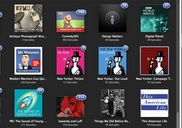
I Think I Need the “Campaign Trail” Podcast to Be Updated Daily

podcasts.jpg
This is very selfish of me, I know; Ryan Lizza, Hendrik Hertzberg, George Packer, Peter Boyer, John Cassidy, Jeffrey Toobin, Elizabeth Kolbert, David Remnick, and the ultraclassy Dorothy Wickenden, who would very likely get my vote for VP, surely have other things to do besides record humorous yet incisive podcasts about the state of the election, but I don’t care. I am dangerously hooked. I must have more.
I once described Emdashes as “methadone for New Yorker addicts,” for the shakes between the issues. (All due respect and sympathy here for actual addicts, to whom this feeling would be a mere bee in the bonnet when they know from hives.) But what is the remedy for the incurable New Yorker-phile whose itch cannot be scratched by the magazine, weekly-ish podcasts, website, and the pleasant tingle created by the advent of the New Yorker Festival? Also, she is very disturbed by Sarah Palin, yet, like many Americans, cannot look away?
There’s only one answer: more “Campaign Trail.” Could we perhaps wake up to fifteen minutes of the gang chatting over breakfast? Should there be an iPhone app? The withdrawal is already gripping me, and it’s only been a few minutes since my last listen. Good nurses of The New Yorker, please come to my aid.
Related: Martin, who is admirably well informed on things political, is also a fan.