
Martin Schneider writes:
On this quiet, chilly Friday, just a few percolating thrums over at newyorker.com before Super Bowl weekend (in which, as far as I can tell, nobody is interested):
* The remarkable “Remembering Updike” blog continues with Tobias Wolff. The sentiments of so many celebrated writers, in genuine thrall to Updike—it leaves me awestruck.
* Evan Osnos argues that Obama had better get his keister to China, stat.
* Inspired by a new book of photographs, Eliza Honey becomes a “trash detective.”
Meanwhile, on the new (!) politics podcast, rechristened “The Political Scene,” Dorothy Wickenden, James Surowiecki, and Steve Coll discuss the stimulus package, the bank bailout, and the deteriorating situation in Pakistan and Afghanistan.
Category Archives: Looked Into
A New Alice Tully Hall: Paul Goldberger’s Tour

_Pollux writes_:
If you’re interested in buildings or New York City or music, this is the post for you. Paul Goldberger, the architecture critic for _The New Yorker_, takes a tour of the newly renovated Alice Tully Hall, part of the Lincoln Center for the Performing Arts in New York City. We got the “skinny from Unbeige”:http://www.mediabistro.com/unbeige/architecture/the_new_yorkers_paul_goldberger_takes_a_walk_around_the_new_alice_tully_hall_106914.asp, and I’m digging the building’s new prow-like lobby that juts out like a bocal on a bassoon. Apparently, the new Tully’s sounds will be richer and more alive than they used to be. But what will New York City pigeons think of the new building? Only time will tell.
“Sundry Sorts of Dry Goods”: The New Yorker & Early Newspapers
Jonathan Taylor writes:
Apropos of Jill Lepore’s new Critic at Large piece on early American newspapers, this topic was of particular interest to the New Yorker in its early days. One of the first instances of the once-frequent “That Was New York” department, in 1929, was about the New-York Gazette, founded in 1725 and “the first New York newspaper.” (I put this in quotes advisedly; who knows what revisions might have come to the historical record? “That Was New York” retailed a colorful story, since shown to be a fable, about why Staten Island is part of New York City and not New Jersey.)
Back to colonial newspapers: Later in 1929, a four-part series ran under the “That Was New York” banner, collecting “items from the press” from the Revolutionary period, replete with florid, character-assailing advertisements. However, these “clippings,” signed David Boehm, give no citations, and I confess to feeling completely uncertain as to whether they are a collection of real items, or the driest of parodies by Mr. Boehm. (Who, by the way, has no other New Yorker bylines; is he the same David Boehm who cowrote the 1931 opera-parody Broadway play “Sing High, Sing Low” with The New Yorker‘s Murdock Pemberton—perhaps also the David Boehm who collaborated on the screenplay of “Gold Diggers of 1933”?)
The Chicagoan: “No Obeisance to Park Avenue, Mayfair, or the Champs Elysees”
Jonathan Taylor writes:
I only just happened on this New York Times Book Review piece from a couple weeks ago, about The Chicagoan, a short-lived magazine launched in 1926 in ardent imitation of The New Yorker. (The article is by Matt Weiland, late of that Chicago institution The Baffler–or still of it? What is up with The Baffler, anyway?)
The University of Chicago Press is putting out a hefty coffee table book about the magazine, which was seemingly forgotten until some issues were unearthed by historian Neil Harris at the university’s Regenstein Library. Harris notes that The Chicagoan was “an effort to counter the city’s negative reputation” as “a place of raw commerce and crime–brawny, philistine, vulgar, and violent.”
A gallery of Deco-mad covers and other images, PDFs from the book, including a lot more interior pages of the mag, and an interview with Harris, are at the publisher’s site. It’s all just too much to digest here. The attractions are clear: Be off, and be back to discuss!
This Is Not Your Father’s Cartoon–Well, Actually, It Is
Benjamin Chambers writes:
I was astonished by the raw politics on display in this Donald Reilly cartoon when I ran across it in the December 30, 1967 issue of The New Yorker last night:
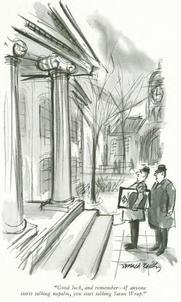
It refers to the October 1967 riots at the University of Wisconsin, when students who objected to the presence of recruiters from Dow Chemicals on campus because of the company’s role in making napalm were involved in a bloody melee with police. Apparently, David Maraniss wrote a very good book about the event, titled They Marched into Sunlight.
At first, I was surprised because I couldn’t remember another cartoon in the magazine that so explicitly named/attacked a single company. (Can Emdashes readers suggest any?) But I’m no longer certain the cartoon is as much of an indictment of Dow as I first thought.
The cartoon seems to speak from a position of comfortable distance, where the absurdity of doing spin for a company that manufactures a horrific weapon of war at the same time that it makes Saran Wrap is as much a part of the cartoon’s humor as the certainty that the Dow recruiter will be greeted with student antagonism of an entirely different order of magnitude.
In other words, what counts in the joke is the mismatch between the two men’s expectations and what the recruiter is about to encounter. One could imagine a parallel cartoon in which two Christians, about to face lions in a Roman arena, marshal their rhetoric.
What do you think?
The Sound of One Graf Clapping: William Steig and “Disquiet, Please!”
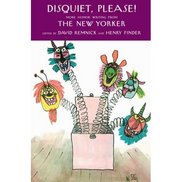
Emily writes (see note below):
I have and am reading Disquiet, Please!: More Humor from The New Yorker, and I expect to post about it again. For now, won’t you join me in admiring this William Steig drawing on the cover? I think it’s glorious and deranged. Actually, it reminds me of a current New Yorker artist’s less well-known work: cartoonist Eric Lewis‘s found-sculpture Garbage Flowers. If I were you, I’d gather some of the inexpensive flowers before they’re all sold (several already seem to be), add the humor anthology, and there’s the formula for your whole Christmas list.
This has been an uncompensated endorsement of unqualified enthusiasm from phantom publisher and fond founder Emily Gordon, whose evanescent presence you will see around here from time to time. In case you’re stopping by for the first time in a while, current editor Martin Schneider is the author of all unsigned posts, so he should get the compliments!
We Already Knew Hendrik Hertzberg Was a Winner
…but the Columbia Journalism Review just reconfirmed it, with a “Winner” laurel for Hertzberg’s recent Comment on the hateful Proposition 8. CJR‘s Charles Kaiser writes, “His opening paragraph is worth the price of the magazine.”
It seems unlikely that you, the Emdashes reader, haven’t seen Keith Olbermann’s Special Comment on this Californian embarrassment and on the essential comfort of love in a hard world, but just in case, here it is. —E.G.
_Update_: Ta-Nehisi Coates “agrees”:http://ta-nehisicoates.theatlantic.com/archives/2008/11/i_show_you_how_to_do_this_son_1.php, saying that this Comment demonstrates why Hertzberg is the “king” of the weekly column. It’s endearing how much Coates loves the column, and I admire how he gets the post to end on a laugh. —Martin Schneider
“Writer Gives Long Account”
Jonathan Taylor writes:
Matthew Yglesias, seemingly not a print subscriber with access to Digital Reader, reminds me of something I’ve been wanting to take note of here: the pleasures of the New Yorker abstracts. Directed by The Atlantic‘s Ross Douthat to Rebecca Mead’s 2003 article about Jaime Pressly, “The Almost It Girl” (Digital Edition link here) he points to what must be the longest abstract I’ve seen on the site (and the article itself isn’t particularly long):
She compares her role to Reese Witherspoon’s in “Election.” Describes a synchronized-swimming lesson she took for the role. Recently, she was asked to audition as the replacement for a minor character on “That 70’s Show,” but she had misgivings. While working hard to become a name, Pressly has had to witness the galling success of actresses who were born names, like Kate Hudson. Pressly comes from humble theatrical origins: her mother ran a dance studio. Her parents separated when she was in her early teens, and she and her mother moved to Orange County. She dropped out of school to model and left home at 15. She now lives in a million-dollar house and recently became engaged to Jay Gehrke, a former professional baseball player. “People will take me more seriously if I’m married…” She has also created a lingerie line called J’aime. In the space of a week, she learned she hadn’t gotten “Blade 3,” “That 70’s Show,” or “Mask 2.” The launch of J’aime took place at the Palms Casino Resort, in Las Vegas. Describes the runway show. Mentions two frat guys who said they didn’t know Pressly’s name but remembered her from “Not Another Teen Movie.”
An Yglesias commenter observes that the poker-faced cataloging of details had to have been a bit of abstracting humor. Another of my all-time favorite abstracts, of V.S. Naipaul’s 1984 essay “The Crocodiles of Yamoussoukro,” is rather negligent in taking note of the narrative content of the piece, seemingly intent on parodying Naipaul’s essentializing vision and brutally simple style:
150 miles inland the President’s ancestral village of Yamoussoukro has been transformed. The President would like it to be one of the great cities of Africa & the world. Tells about its ultra-modern splendor. Down one side of the Presidential palace there is an artificial lake into which have been introduced man-eating crocodiles. These are totemic, emblematic creatures & they belong to the President. There were no crocodiles in Yamoussoukro before. No one knows precisely what they mean. The crocodiles are fed with fresh meat every day. People can go & watch. Most visitors are tourists. Writer gives long account of a visit & discusses the crocodile ritual which is mysterious. He interviews a number of people, mainly expatriates, about the Ivory Coast. He learns that life in the interior is truly African. Daytime city life with its Western influence is not the real Africa.
James Wood wrote in this week’s issue about Naipaul “the Wounder,” so it’s interesting that Edward Hoagland said of “Yamoussoukro,” “Though these are the same kind of excursions he has made in other countries with mordant mockery in mind, this time he is not exploring ‘the great wound of Africa’ but instead its astonishing, unknowable and hypnotic ‘completeness.'” A dubious proposition itself, but, as Hoagland writes, in this case, Naipaul’s piece is “full of honest changes of judgment about particular people, generally on the side of appreciating them better.”
The New New New Journalism
Perhaps, like me, you’ve heard about Claire Hoffman’s “interview”:http://www.newyorker.com/talk/2008/11/24/081124ta_talk_hoffman?yrail with Prince in last week’s Talk of the Town, even if you haven’t read it yet. The one where, tapping a Bible, he’s “all”:http://emdashes.com/2008/11/punctuation-update-new-yorker.php, “God came to earth and saw people sticking it wherever and doing it with whatever, and he just cleared it all out. He was, like, ‘Enough.’ ” (Okay, now I’ve read it, to get the real quote.)
Feel free to keep it meta with this “interview”:http://www.brianmpalmer.com/clairehoffman.html of Hoffman by Brian Palmer, a rangy discussion of Hoffman’s techniques and the journalists she counts as influences, at _The New Yorker_ and elswehere. About her Prince interview, she reveals that he “wouldn’t let me use a tape recorder or my notepad. I walked out and sat in my car and wrote for an hour. I don’t have long chunks of dialogue, but I was able to remember stuff.” (Wow. I interviewed someone on the phone last night _with_ a notepad, and I’m not sure it will yield a chunk as long as the quote above.)
This revelation of Prince’s tape-recorder prohibition puts a new angle on the claim, reported by “Perez Hilton”:http://perezhilton.com/2008-11-17-prince-was-misquoted-the-singers-camp-claims, by “Prince insiders” who say that Prince was misquoted and point to the fact that Hoffman…didn’t record the interview.
Now, if I was doing this right, I’d interview Palmer, and then maybe someone would interview me….
Campaign-Trail Pain Painful, Though Even More Painful Had Palin Prevailed
Emily takes a break from a long issue close to write:
I was sorry to hear from the latest “Campaign Trail” podcast that most-having host Dorothy Wickenden has busted her ankle. President-elect Obama surmised that Chicago Sun-Times reporter Lynn Sweet’s cracked shoulder was the “only major incident” from the Grant Park party. Could this be the second media-related injury this election season? Either way, I hope both bones heal quickly and well.
Also, I was delighted to learn, at the end of this week’s podcast, that “The Campaign Trail” will continue to continue (as Simon & Garfunkel would say), as “The Transition,” which Wickenden describes as “a program about the new political scene in Washington and around the country as the shift in power gets underway.” I’m so glad: The show is too enlightening, and—particularly last week, when the crew became charmingly manic—too entertaining to end.